Delhi High Court quashes reassessment proceedings for obtaining sanction from incorrect statutory authority.
Meetu Kumari | May 21, 2026 |
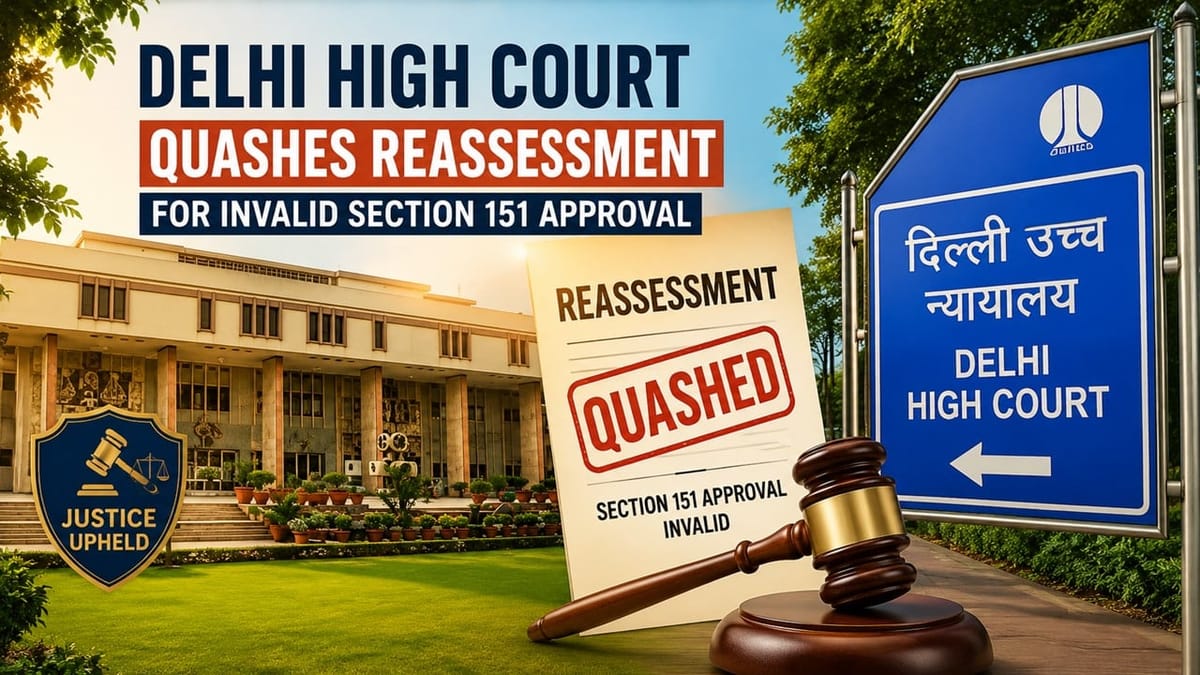

Delhi High Court Quashes Reassessment for Invalid Section 151 Approval
The Delhi High Court on 8 May quashed reassessment proceedings initiated against a deceased assessee after holding that the approval for reopening under Section 151 of the Income Tax Act, 1961 had been granted by an incompetent authority. A Division Bench comprising Justice Dinesh Mehta and Justice Amit Mahajan, however, rejected the petitioner’s contention that the notice was invalid merely because it had been issued in the name of the deceased assessee through his father. The court pointed out that
“The legislature’s conscious choice of the expression ‘legal representative’ rather than ‘legal heir’ is not without significance; it reflects the intent of legislature to cast a wider net for the purposes of tax proceedings.”

The writ petition was filed by Vijender Pal Jain, father of late assessee Rishi Raman Jain, challenging the reassessment proceedings initiated under Sections 148 and 148A(d) for AY 2016-17. The petitioner argued that the notice dated 30.07.2022 had been issued against a dead person, as the assessee had expired on 20.03.2018 during the original assessment proceedings. It was further contended that since the Revenue had invoked the extended limitation period, approval for reopening ought to have been obtained from the Principal Chief Commissioner of Income Tax (PCCIT) under Section 151(ii), whereas the sanction had been granted only by the Principal Commissioner of Income Tax (PCIT).
The Revenue defended the proceedings by stating that the notice had been issued in the name of “Mr. Rishi Raman Jain through Legal Heir Mr. Vijender Pal Jain.” It was also pointed out that Vijender Pal Jain himself had participated in the reassessment proceedings and filed a reply acknowledging that he was acting as the legal representative of the deceased assessee.

The High Court observed that the expressions “legal heir” and “legal representative” operate in different legal spheres and cannot be treated as interchangeable. Referring to Section 159 of the Income Tax Act read with Section 2(11) of the Code of Civil Procedure, the Bench held that the term “legal representative” has a much wider scope and includes any person representing or intermeddling with the estate of the deceased.
The Court noted that by filing replies before the department and expressly describing himself as the legal representative of the deceased assessee, the petitioner had himself submitted to the reassessment proceedings in a representative capacity.
Thus, the Court rejected the challenge relating to service of notice upon the petitioner. However, on the issue of sanction under Section 151, the Bench held that the approval granted by the PCIT was invalid since the extended limitation period had been invoked, requiring approval from the PCCIT.
The Court therefore allowed the writ petition and quashed the reassessment notice dated 30.07.2022 for want of proper approval from the competent authority.
To Read Full Judgment, Download PDF Given Below

In case of any Doubt regarding Membership you can mail us at [email protected]
Join Studycafe's WhatsApp Group or Telegram Channel for Latest Updates on Government Job, Sarkari Naukri, Private Jobs, Income Tax, GST, Companies Act, Judgements and CA, CS, ICWA, and MUCH MORE!"