Meetu Kumari | May 29, 2026 |
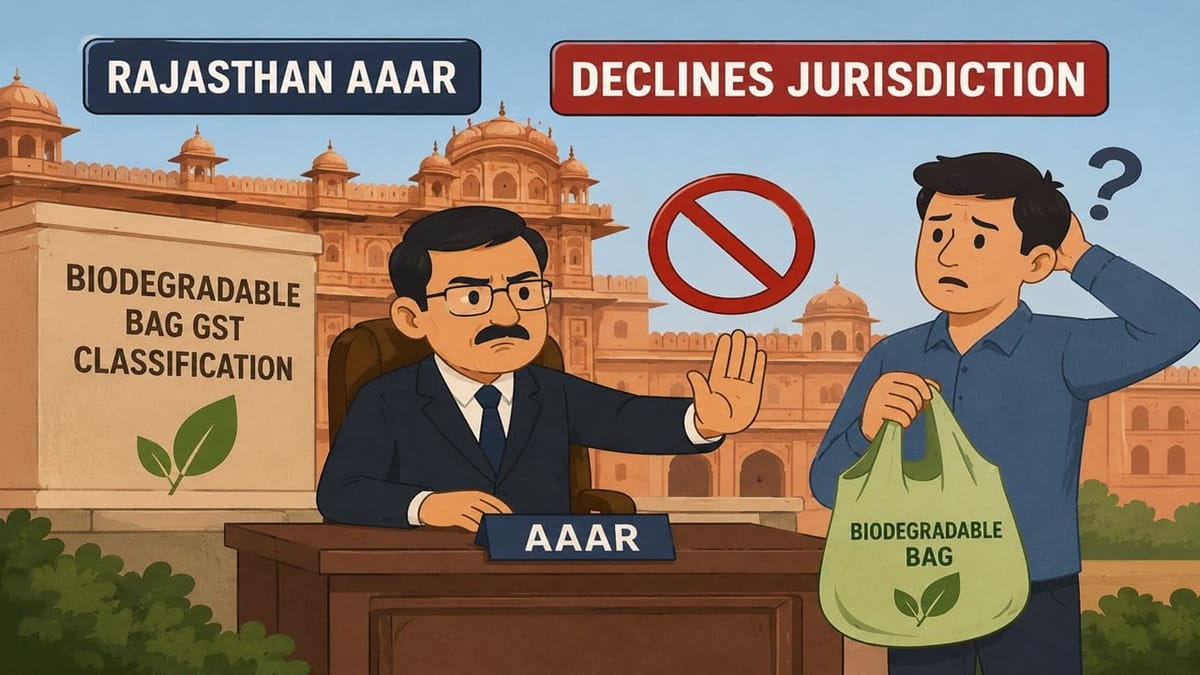

Rajasthan AAAR Declines Jurisdiction on Biodegradable Bag GST Classification
The Rajasthan Appellate Authority for Advance Ruling (AAAR) upheld the classification of compostable plastic bags under Chapter 39 and ruled that advance ruling authorities do not have jurisdiction to conclusively determine whether a product satisfies technical standards of biodegradability for availing concessional GST benefits.
A Bench comprising Member (Central Tax) Sh. Manish Kumar and Member (State Tax) Sh. Kumar Pal Gautam dismissed the appeal filed by M/s Easy Flux Polymers Private Limited against the Rajasthan AAR ruling dated December 17, 2025.

The appellant, engaged in the manufacture and supply of compostable plastic bags, had sought an advance ruling on the classification and applicable GST rate on biodegradable bags after Notification No. 09/2025-CTR inserted Entry No. 319 prescribing 5% GST on “Paper Sacks/Bags and Biodegradable Bags” under Chapters 39 and 48. The company relied on CPCB, CIPET and TÜV Rheinland certifications to claim that its products were biodegradable and compostable under ISO 17088 and EN 13432 standards.
The Rajasthan AAR had earlier held that the products were classifiable under Heading 3923 as plastic bags under Chapter 39. However, it declined to conclusively determine whether the bags qualified as “biodegradable bags” for the purpose of the concessional GST rate, observing that such technical determination falls outside the jurisdiction of advance ruling authorities.

Before the AAAR, the appellant contended that compostable bags are inherently biodegradable and that the environmental certifications issued by CPCB and Rajasthan Pollution Control Board conclusively established eligibility for the concessional 5% GST rate. It further argued that once competent environmental authorities had recognised the products as compostable, GST authorities could not disregard those certifications.
The Bench observed that the competence to determine technical or scientific standards relating to biodegradability or compostability lies with nodal agencies such as Pollution Control Boards under the Plastic Waste Management Rules, and not with advance ruling authorities functioning under Section 97(2) of the CGST Act.
The appellate authority noted that the certificates issued by pollution control authorities were primarily for authorising manufacture and sale under environmental laws and were subject to continued compliance with prescribed conditions. It also observed that the test reports relied upon by the appellant were based on samples drawn by the party itself, and therefore neutrality of the sampling process could not be independently verified.
The AAAR further held that advance ruling authorities are limited to interpretation of GST law and cannot adjudicate scientific questions relating to environmental compliance or technical standards of biodegradability.
The AAAR also observed that the jurisdictional GST authorities may draw product samples and obtain testing from appropriate agencies for determining eligibility under the notification.
Thus, the appeal was dismissed and the ruling passed by the Rajasthan AAR was upheld.
To Read Full Order, Download PDF Given Below.

In case of any Doubt regarding Membership you can mail us at [email protected]
Join Studycafe's WhatsApp Group or Telegram Channel for Latest Updates on Government Job, Sarkari Naukri, Private Jobs, Income Tax, GST, Companies Act, Judgements and CA, CS, ICWA, and MUCH MORE!"