Meetu Kumari | Jun 15, 2026 |
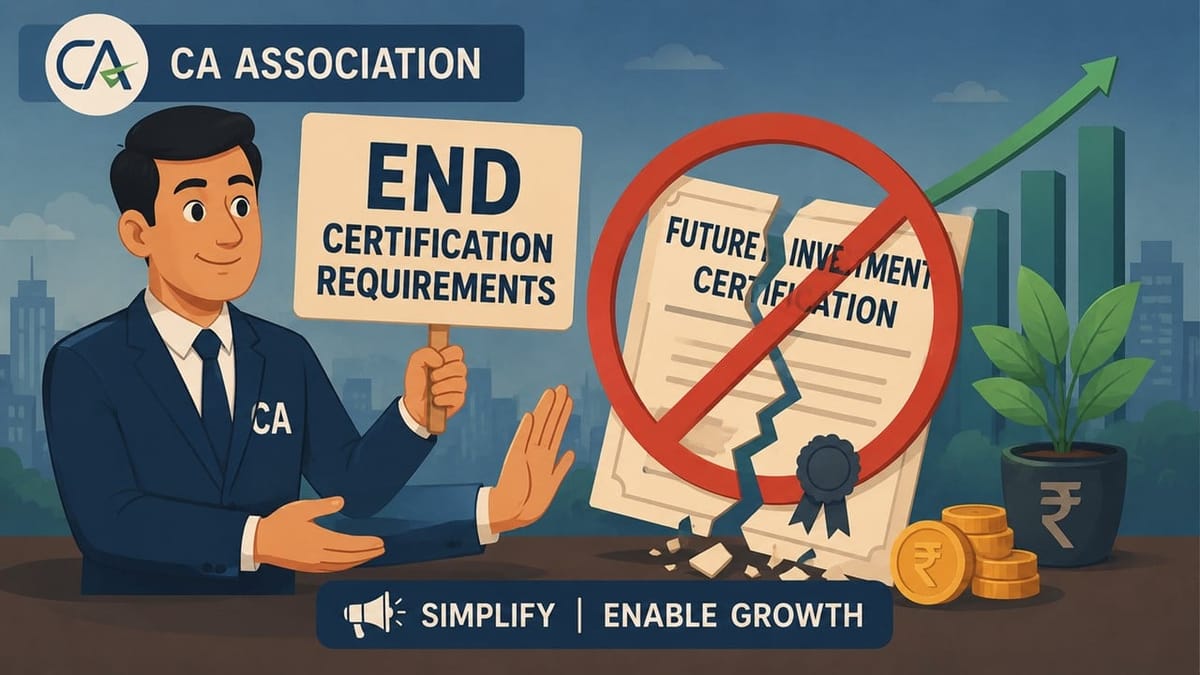

CA Association Seeks End to Future Investment Certification Requirements
The Chartered Accountants Association, Surat (CAAS) has urged the Central Pollution Control Board (CPCB) to immediately discontinue or modify certificate formats that require Chartered Accountants to certify proposed or future capital investments. In a detailed representation dated 6 June 2026, CAAS contended that such certifications are professionally unsafe, inconsistent with ICAI’s ethical framework and expose practitioners to disciplinary risk.

The representation was filed after CAAS members reported that industries seeking approvals from Pollution Control Boards were being asked to furnish Chartered Accountant certificates in pre-drafted formats covering proposed investments, expansion projects, change in product mix, installation of machinery and similar matters. According to CAAS, the prescribed formats not only require certification of future events but also leave little or no room for Chartered Accountants to incorporate essential safeguard clauses regarding scope of work, basis of verification, management responsibility, limitations and reliance on information provided.
CAAS stated that it had earlier raised the issue before the Gujarat Pollution Control Board (GPCB). During subsequent discussions, the association was informed that the certificate formats were linked to requirements originating from the CPCB, prompting the matter to be escalated to the central regulator.
“A Chartered Accountant can verify historical facts, examine books of account, check invoices, scrutinise fixed asset registers, verify bank payments, inspect accounting records, and report on documents produced. However, a Chartered Accountant cannot certify a future event as though it is an accomplished fact.”

The association argued that a statement that an entity “would invest” a specified amount in the future is inherently uncertain and dependent upon management decisions, financing arrangements, statutory approvals and market conditions. Such information, it submitted, may be furnished through management declarations, project reports, board resolutions or other supporting documents, but should not be converted into an unqualified CA certification.
CAAS further contended that the existing formats conflict with ICAI’s Guidance Note on Reports or Certificates for Special Purposes (Revised 2016), which requires inclusion of key reporting elements such as applicable criteria, scope of work, practitioner responsibility, inherent limitations and restriction on use.
“CPCB may prescribe the information it wants. CPCB cannot prescribe professional misconduct as the method of giving that information.”
The representation also highlighted potential disciplinary implications under the Chartered Accountants Act, 1949. Referring to ICAI’s ethical framework, CAAS maintained that Chartered Accountants are not expected to provide assurance on future events, projections or proposed actions that are incapable of present verification.
Warning that similar formats appear to be used across multiple State Pollution Control Boards, the association described the issue as a national professional concern rather than a Gujarat-specific problem. It cautioned that continuation of such practices could encourage non-compliant certifications, create conflicts between professionals and clients, and undermine confidence in regulatory certifications.
CAAS has therefore requested CPCB to review all certificate formats relating to capital investment and expansion projects, discontinue requirements involving certification of future investments, permit ICAI-compliant safeguard paragraphs in all certificates, and issue a nationwide clarification directing State Boards not to reject certificates merely because they contain professional qualifications, limitations or explanatory disclosures.
The association has also proposed an interim mechanism under which future or proposed investments would be supported through management declarations, project reports and undertakings, while Chartered Accountants would be permitted to certify only information capable of verification from existing records. According to CAAS, such an approach would protect professional standards without compromising the regulatory objectives of pollution control authorities.

In case of any Doubt regarding Membership you can mail us at [email protected]
Join Studycafe's WhatsApp Group or Telegram Channel for Latest Updates on Government Job, Sarkari Naukri, Private Jobs, Income Tax, GST, Companies Act, Judgements and CA, CS, ICWA, and MUCH MORE!"