Meetu Kumari | Jun 26, 2026 |
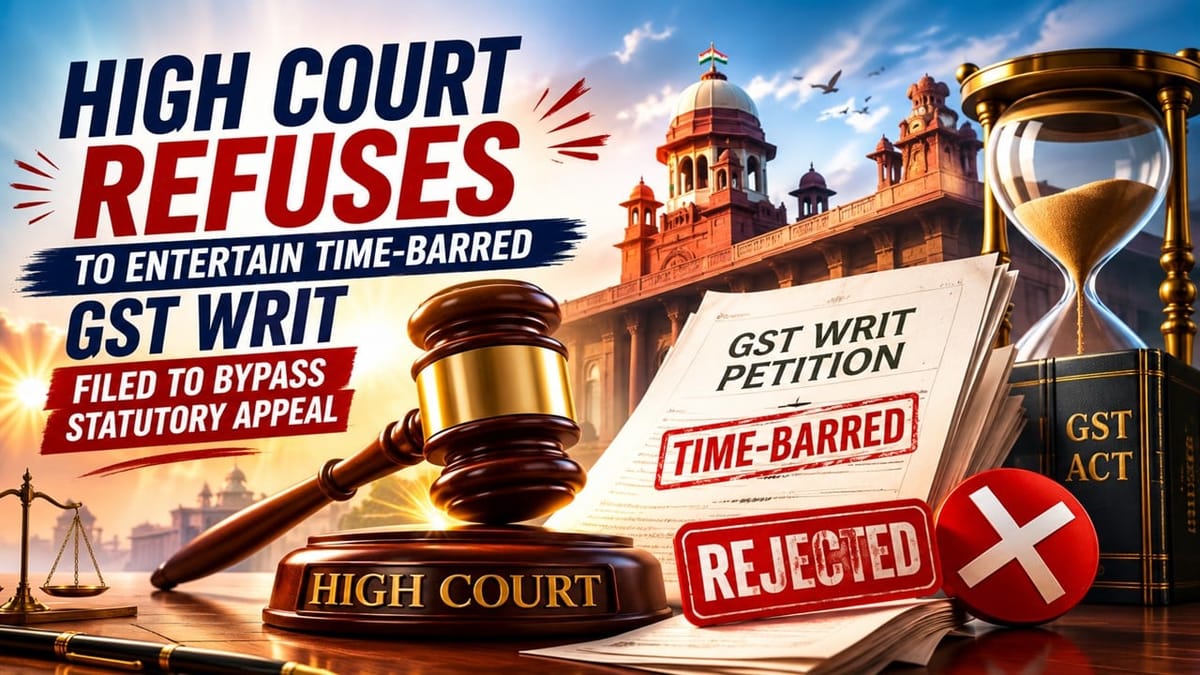

High Court Refuses to Entertain Time-Barred GST Writ Filed to Bypass Statutory Appeal
The Allahabad High Court has dismissed a writ petition challenging a GST assessment order and show cause notice, holding that a taxpayer cannot invoke writ jurisdiction under Article 226 merely to bypass the limitation prescribed for filing a statutory appeal under the GST Act. The Court observed that writ jurisdiction cannot be used to defeat the legislative scheme of limitation, particularly where there is no jurisdictional error or violation of natural justice.
The petitioner challenged the assessment order dated 4 June 2025 and the preceding show cause notice dated 17 March 2025, contending that the proceedings under Section 74 of the GST Act were without jurisdiction. The petitioner also sought protection against coercive action by the State GST authorities.

The High Court noted that the petitioner had participated in the assessment proceedings by filing a reply to the show cause notice and had also been granted an opportunity of personal hearing. Therefore, the Court found no violation of the principles of natural justice or any jurisdictional defect warranting interference under Article 226 of the Constitution.
The Court further observed that the writ petition had been filed almost one year after the assessment order. It also recorded that the petitioner had earlier filed a writ petition in January 2026, which was dismissed as withdrawn with liberty to file a fresh petition with better particulars. However, such liberty did not extend or revive the limitation period prescribed for filing a statutory appeal under Section 107 of the GST Act.

Emphasising the statutory scheme, the Court noted that an appeal under Section 107 must be filed within three months from the communication of the order, with a further condonable period of one month under Section 107(4). Relying on the Supreme Court decisions in Singh Enterprises v. CCE and Commissioner of Customs and Central Excise v. Hongo India Pvt. Ltd., the Court reiterated that where a statute prescribes a specific limitation period along with a limited power to condone delay, neither the appellate authority nor the Court can extend that period beyond what the statute permits.
The Bench rejected the petitioner’s attempt to characterize the challenge as one involving defects in the show cause notice under Section 74, observing that these grounds were available immediately after issuance of the notice and could have been raised within the statutory appellate timeline. It remarked that the petitioner had remained a “fence sitter” and sought to invoke writ jurisdiction only after losing the opportunity to file a statutory appeal.
Referring to its earlier decision in Atlantis Intelligence Ltd. v. Union of India, the Court reiterated that although limitation may not apply to writ proceedings in the strict sense, the principles of delay, laches, and diligence continue to govern the exercise of extraordinary jurisdiction. Entertaining such a petition would effectively render the statutory limitation provisions otiose and allow litigants to indirectly achieve what they could not do directly.
Holding that the case involved neither a gross violation of natural justice nor any patent illegality, the High Court dismissed the writ petition. However, it clarified that if the petitioner chooses to pursue any remedy available in law, including filing an appeal, the observations made in the judgment shall not prejudice the decision of the appellate forum.
To Read Full Judgment, Download PDF Given Below

In case of any Doubt regarding Membership you can mail us at [email protected]
Join Studycafe's WhatsApp Group or Telegram Channel for Latest Updates on Government Job, Sarkari Naukri, Private Jobs, Income Tax, GST, Companies Act, Judgements and CA, CS, ICWA, and MUCH MORE!"