Allahabad HC Judge requests Chief Justice not to assign him bail matters following Supreme Court's Criticism:
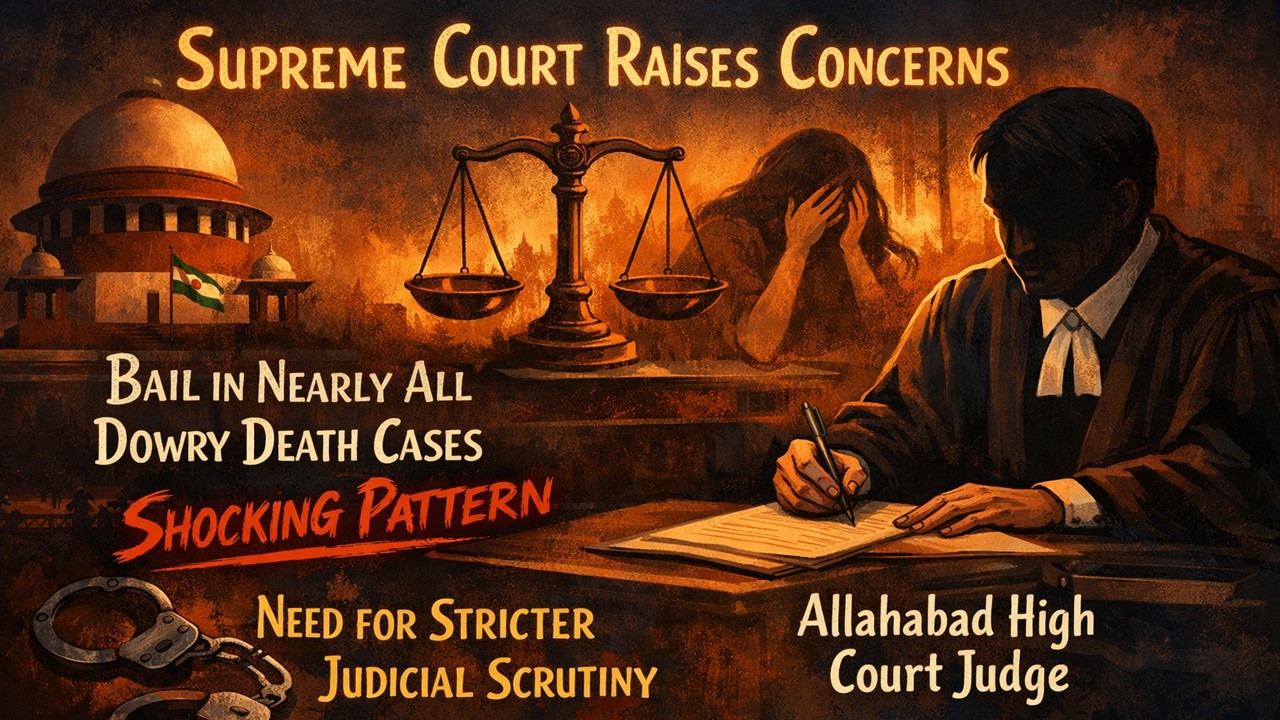
The Supreme Court raised serious concerns over an Allahabad High Court judge granting bail in nearly all dowry death cases, calling the pattern “shocking” and stressing the need for stricter judicial scrutiny.
SC Pulls Up Allahabad Justice Pankaj Bhatia
 Saloni Kumari
 Mar 18, 2026
Allahabad HC Judge requests Chief Justice not to assign him bail matters following Supreme Court's Criticism
The Supreme Court of India has taken the judge of the Allahabad High Court, Justice Pankaj Bhatia, under investigation as per the recent information received that he granted bail in nearly all dowry death cases heard by his bench. Among the total of 510 bail orders in dowry death cases handled by Justice Pankaj Bhatia between October and December 2025, it was discovered that he granted bail in 508 cases, which is about 99.6% of the total cases.
The issue was highlighted when the Supreme Court, in a bench comprising Justice J. B. Pardiwala and Justice K. V. Vishwanathan, was hearing a case where the court criticised Justice Pankaj Bhatia's decision of granting bail as "shocking and disappointing". The justice had passed the bail order in February '09.
The Supreme Court quashed the bail order, holding, "We fail to understand on plain reading of the impugned order as to what the High Court is trying to convey… what weighed with the High Court in exercising its discretion in favour of the accused for the purpose of grant of bail in a very serious crime like dowry death." The court stressed that the courts must carefully examine evidence, the nature of the crime, and circumstances in such dowry-related cases before passing bail orders.
Following these remarks, Justice Bhatia requested the Chief Justice not to assign him bail matters, saying the criticism had a "demoralising and chilling effect". In most cases reviewed, bail was granted based on factors like postmortem findings, lack of prior criminal record, and time spent in custody. In about half the cases, the court stated there was no evidence of harassment “soon before death", which is key in dowry death cases under the law. The majority of the accused had spent less than a year in jail.
The cases involved mainly husbands and in-laws, with causes of death including hanging, poisoning, and strangulation. Bail conditions were almost identical, typically requiring a bond of Rs 20,000 with two sureties. Out of all 510 cases, bail was denied in only two, where evidence strongly indicated severe violence, including burn injuries and firearm use.
About Author


Saloni Kumari
Content Writer
Saloni is a Content Writer with 2+ years of experience at studycafe.in. She writes legal, taxation, and finance related content including GST, Income Tax etc. Skilled in translating complex judicial pronouncements and regulatory developments into clear, and reader-friendly articles. Experienced in covering judgements of ITAT, High Court, GSTAT, and news related to Income Tax, GST, and corporate law. She can be reached at [email protected].
Saloni is a Content Writer with 2+ years of experience at studycafe.in. She writes legal, taxation, and finance related content including GST, Income Tax etc. Skilled in translating complex judicial pronouncements and regulatory developments into clear, and reader-friendly articles. Experienced in covering judgements of ITAT, High Court, GSTAT, and news related to Income Tax, GST, and corporate law. She can be reached at [email protected].
 StudyCafe
 Delhi, Delhi, India
 2918
2918My Recent Articles
- ITAT Remands Rs 3.33 Crore Demonetisation Cash Deposit Case to AO, Directs Rs 10,000 Relief Fund Payment
- Income Tax Dept Increases Scope for Saksham Nudge Initiative to Further Include Professional Insuring Timely Compliance
- Vedanta Subsidiary ESL Steel Receives GST SCN for Rs. 2.76 Lakh IGST Demand Over Alleged RCM Short Payment
- Good News! ICAI Opens One-Day Window for Submission of MEF Form 2026-27 at meficai.org
- New WhatsApp Fraud Alert! Can Replying ‘NO’ Put Your Bank Account at Risk? CA Allegedly Loses Rs 1.70 Lakh
Up Next
Loading suggestions…


Recent Posts

All Posts



Recent Posts
All Posts