Avoid Surprise Tax Notices From Income Tax Department: Understanding AIS and TIS-Based Notices:
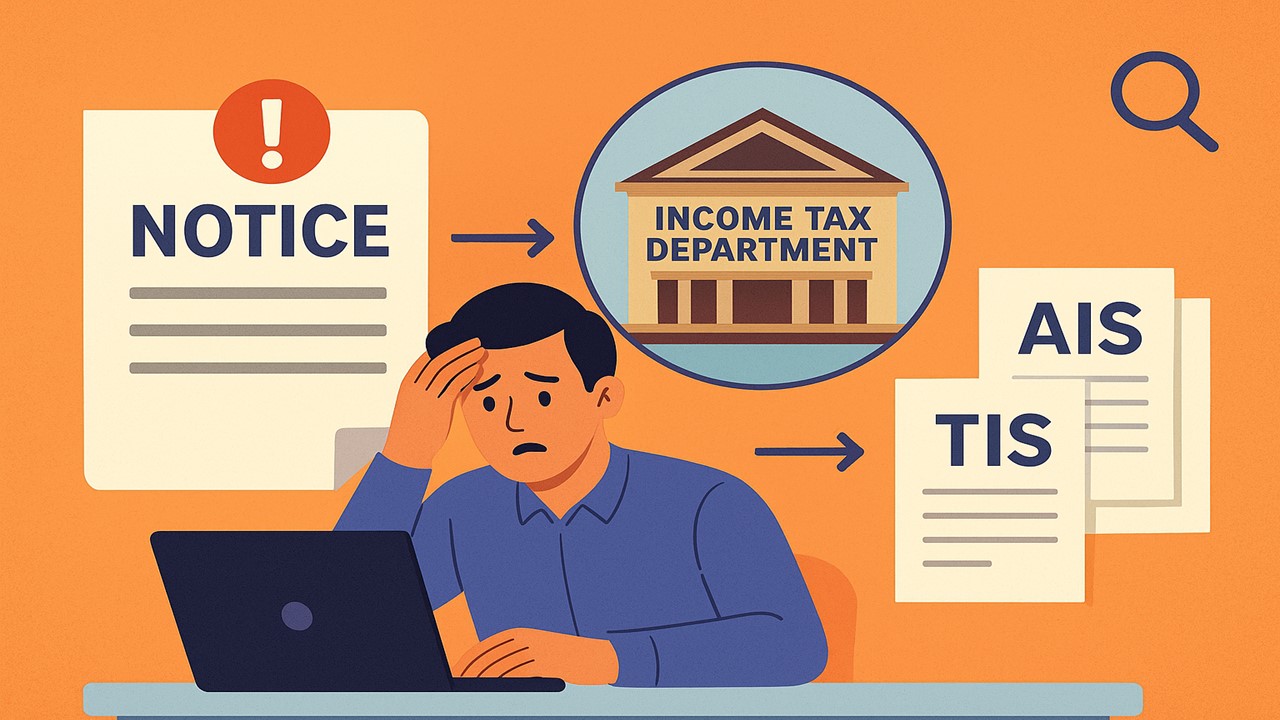
If the data filed in your return does not match the AIS data, the system flags you as high-risk.
What Triggers AIS and TIS Based Income Tax Notices
 Nidhi
Nidhi Dec 8, 2025
Table of Contents

Avoid Surprise Tax Notices From Income Tax Department: Understanding AIS and TIS-Based Notices
The Income Tax Department issues notices for many reasons, including errors, mismatches, or non-compliance in their income tax return. In recent years, the Department has become more data-driven, making it easier to track each financial transaction you make. Sometimes, the income tax notices are triggered by the AIS (Annual Information Statement) and the TIS (Taxpayer Information Summary). Many taxpayers ignore these documents until they receive a notice from the Income Tax Department.
What are AIS and TIS?
The Annual Information Statement (AIS) is a detailed report given by the income tax department to the taxpayers, which includes a consolidated view of all their financial transactions during a financial year. The TIS (Taxpayer Information Summary), on the other hand, is a simplified, category-wise summary of the taxpayer's financial transactions for a financial year.What Triggers the Notices?
The AIS includes information such as:- Share trades.
- Bank interest
- Property transactions
- Foreign remittance
- Mutual fund investments
- Credit card spending
- GST turnover
- Cash deposits and withdrawals
Common Reasons for Receiving an Income Tax Notice
Here are the most common reasons one can receive an income tax notice:- Your cash deposits are higher than the income you have declared in your ITR.
- You have sold a property but did not report the capital gains.
- You have undisclosed foreign income.
- You did not pay tax on the Bank interest.
- There is a mismatch between the GST turnover and the Income Tax Return
- You regularly make high-value transactions.
Why Form 26AS Matching is Not Sufficient
Form 26AS shows details about the TDS, TCS, advance payment, refund details, etc. Many individuals think that Form 26AS captures everything, which is wrong. AIS captures the full picture, including the high-value transactions, SFT reports, and even credit card spends above Rs. 1 lakh. Many get notices despite matching 26AS perfectly.Feedback System in AIS
The Income Tax Department allows taxpayers to give feedback on the information displayed in AIS. Taxpayers can report any discrepancies or incorrect information in their financial data. You can agree or disagree, or partially agree with the AIS data. An earlier feedback reduced the chances of receiving a notice. However, if you ignore the wrong data and do not give any feedback, the income tax department will issue notices demanding tax along with a penalty. Many individuals never go through the AIS and do not give this feedback. They blindly file a return from Form 26AS, which can be a costly mistake. Therefore, taxpayers must always cross-check the data in AIS.Why are Notices Increasing Every Year?
In recent years, the notices have increased because multiple entities like banks, brokers, and even foreign remittance portals now automatically report to AIS. Manual concealment is becoming almost impossible, as everything is being tracked electronically.How to Avoid AIS-Based Notices
To avoid an AIS-based notice, always:- Download your AIS before filing your return.
- Match every entry with your books and financial records.
- Provide feedback if you find any discrepancies.
About Author


Nidhi
Content Writer
Nidhi is a skilled content writer specializing in personal finance. She creates clear, engaging articles on mutual funds, investments, insurance, and wealth-building strategies. With a passion for simplifying complex financial topics, Nidhi helps readers make informed money decisions with confidence. She can be reached at [email protected]
Nidhi is a skilled content writer specializing in personal finance. She creates clear, engaging articles on mutual funds, investments, insurance, and wealth-building strategies. With a passion for simplifying complex financial topics, Nidhi helps readers make informed money decisions with confidence. She can be reached at [email protected]
 Studycafe
 New Delhi, Delhi, India
 1832
1832My Recent Articles
- Karnataka High Court Gives Another Chance in GST Matter Due to Lack of Hearing
- Delay Should Be Condoned if Explanation is Unrefuted: ITAT
- Non-Service of Income Tax Notice, Ill health of taxpayer, ITAT condones Appeal filing delay
- Books of Accounts Cannot be Rejected Without Any Specific Defect: ITAT Kolkata
- Karnataka High Court Sends ITC Matter Back to GST Authorities for Reconsideration
Up Next
Loading suggestions…


Recent Posts

All Posts
Recent Posts
All Posts