ITAT Upholds Rs. 2.25 Lakh Penalty Levied for Section 269SS Violation in Immovable Cash Property Sale:
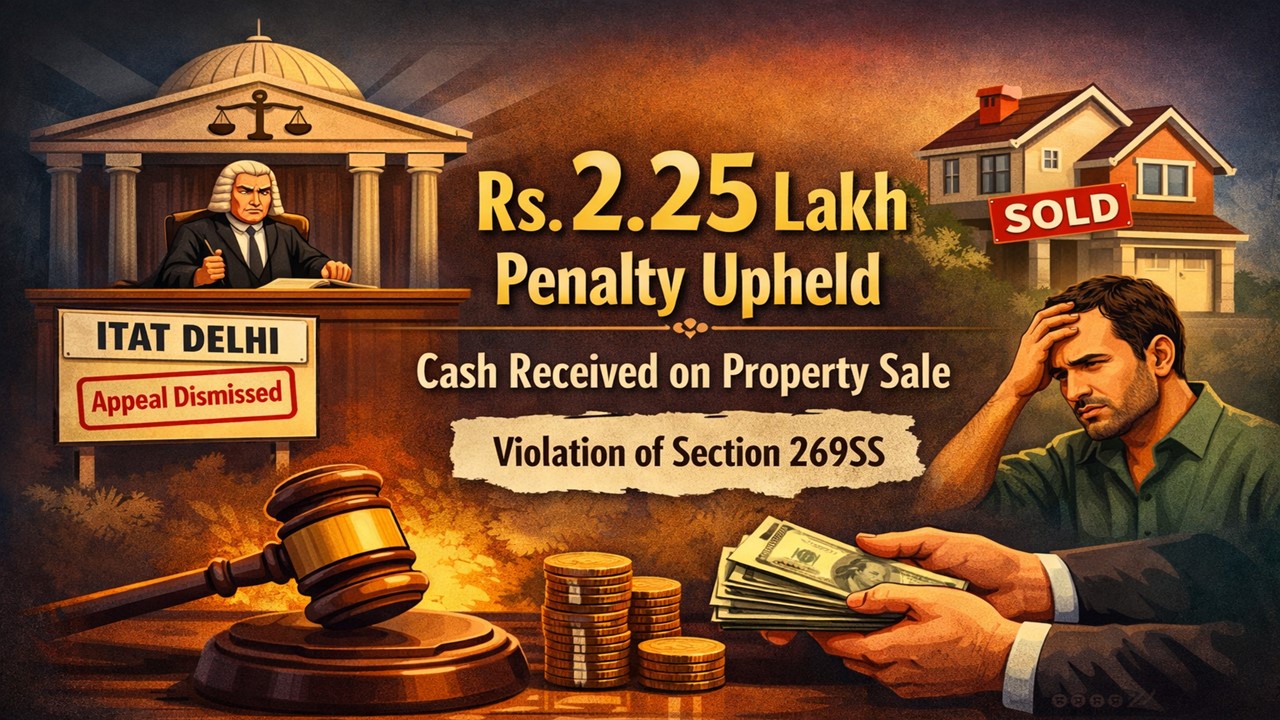
ITAT Delhi dismisses assessee’s appeal, upholding Rs. 2.25 lakh penalty for cash received on property sale in violation of Section 269SS.
Cash Receipt Above Rs. 20,000 Violates Section 269SS
 Saloni Kumari
 Jan 22, 2026
ITAT Upholds Rs. 2.25 Lakh Penalty Levied for Section 269SS Violation in Immovable Cash Property Sale
ITAT Delhi dismissed the assessee's appeal, holding that cash received by selling an immovable property exceeded Rs. 20,000, which is an explicit violation of Section 269SS of the Income Tax Act. The tribunal did not find any valid reason interfering in the ruling of CIT(A), hence sustained the penalty levied on the assessee.
Ms Sapna Jain has filed the current appeal in the Income Tax Appellate Tribunal (ITAT) Delhi, challenging an order dated August 05, 2025, passed by the CIT(A)/NFAC Delhi under Section 250 of the Income Tax Act.
Previously, the Assessing Officer (AO) had imposed a Rs. 2.25 lakh penalty on the assessee under Section 271D of the Income Tax Act because the assessee received cash exceeding Rs. 20,000 while selling an immovable property, which was alleged to be in violation of Section 269SS. The AO stated that the total cash received by the assessee was Rs. 5.50 lakh; however, since the property was owned jointly by her husband, only 50% of her share was considered as a penalty.
The aggrieved assessee filed an appeal before the CIT(A). However, the CIT(A) dismissed the appeal of the assessee after analysing the facts of the case, holding that cash received on transfer of immovable property is explicitly covered under the scope of Section 269SS as per the explanation to the section, and therefore, the imposed penalty was valid.
Thereafter, the assessee filed an appeal before the ITAT Delhi. Where she argued that the cash received was not a loan or deposit but part of the sale consideration of the property. She explained that around 65% of the sale amount was received through checks and only about 35% was received in cash. Thereafter, the cash was immediately deposited into her bank account to settle the outstanding bank loan, as per the loan settlement letter. She cited several earlier judgments based on similar issues where penalties were deleted due to the genuineness of transactions and the immediate routing of cash through bank accounts. However, the tax department argued that cash receipts above Rs. 20,000 in such transactions attract a penalty as per the specified rule.
When the tribunal analysed arguments from both sides, it noted that none of the judgments cited by the assessee aligned with her present case. The Tribunal held that receiving cash exceeding Rs. 20,000 on the sale of property is a clear violation of Section 269SS, and therefore, the penalty under Section 271D was correctly imposed. In conclusion, the tribunal upheld CIT(A)'s order and dismissed the assessee's appeal by sustaining the penalty imposed.
About Author


Saloni Kumari
Content Writer
Saloni is a Content Writer with 2+ years of experience at studycafe.in. She writes legal, taxation, and finance related content including GST, Income Tax etc. Skilled in translating complex judicial pronouncements and regulatory developments into clear, and reader-friendly articles. Experienced in covering judgements of ITAT, High Court, GSTAT, and news related to Income Tax, GST, and corporate law. She can be reached at [email protected].
Saloni is a Content Writer with 2+ years of experience at studycafe.in. She writes legal, taxation, and finance related content including GST, Income Tax etc. Skilled in translating complex judicial pronouncements and regulatory developments into clear, and reader-friendly articles. Experienced in covering judgements of ITAT, High Court, GSTAT, and news related to Income Tax, GST, and corporate law. She can be reached at [email protected].
 StudyCafe
 Delhi, Delhi, India
 2924
2924My Recent Articles
- Major Relief in Arbitration Case: MCIA Denies Rs 908 Crore Statement Claim Made by Allied Silica Against Tata Chemicals
- MCA and ICSI to Hold User Awareness Session on Form AOC-4 Filing Amid Glitches on MCA-21 Version-3 Portal
- GSTN Introduces New E-Invoicing Facility for Self-Invoices Under Reverse Charge Mechanism
- Flexi Cap vs Multi Cap Funds: What's the Real Difference?
- IBA Recommends Public Sector Banks to Reduce Ambit of Physical Branch Audits to 50% of Total Business
Up Next
Loading suggestions…


Recent Posts
All Posts


Tags
Recent Posts
All Posts