Bought Sovereign Gold Bonds Later? Budget 2026 May Change Your Tax Story; Check Govt Proposal:
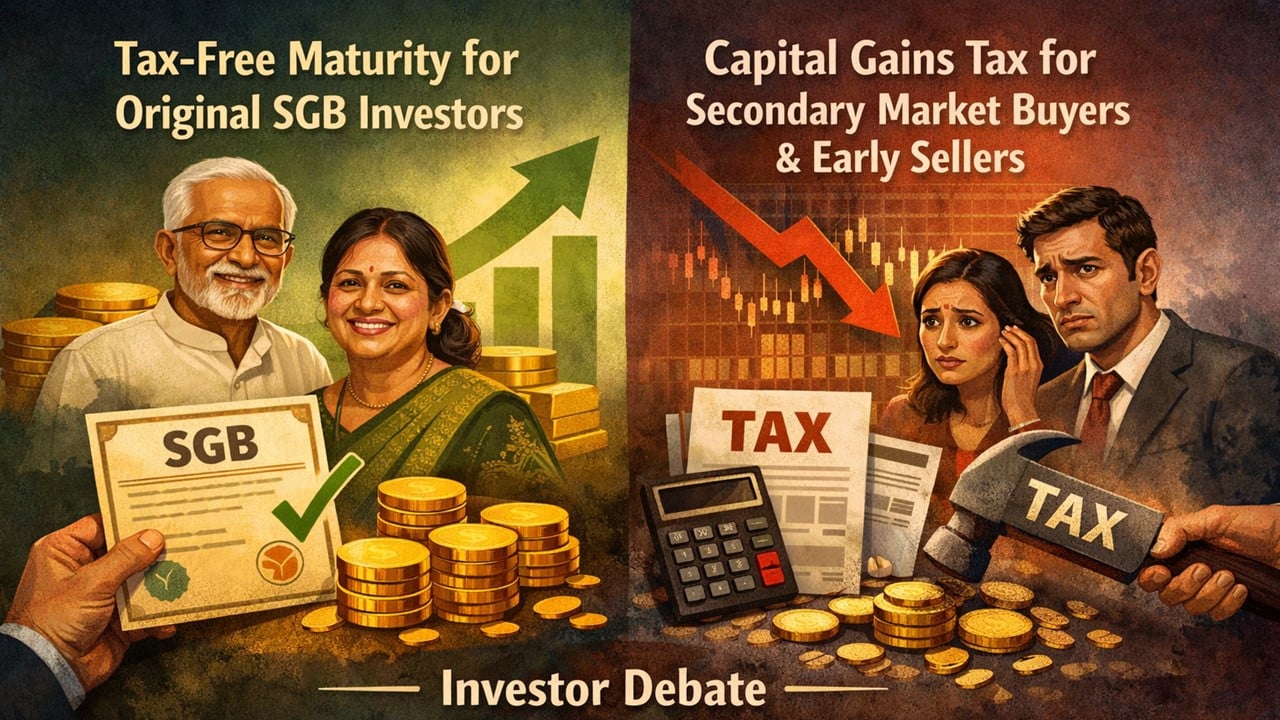
Budget 2026 proposes tax-free maturity only for original SGB investors holding until maturity, while secondary market buyers and early sellers may now face capital gains tax, sparking debate among investors.
Budget 2026 Clarifies Sovereign Gold Bond Taxation
 Saloni Kumari
 Feb 5, 2026
Bought Sovereign Gold Bonds Later? Budget 2026 May Change Your Tax Story; Check Govt Proposal
Presently, the capital gains generated from the redemption of Sovereign Gold Bonds (SGBs) issued by the Reserve Bank of India are not taxable under section 70(1)(x) of the Income Tax Act. However, several individuals purchase SGBs later from the market, i.e., not at the time of original issue, which has created a cause of confusion that SGBs are later purchased from the market.
As per the recent proposal after the presentation of the Union Budget 2026-27, the government has clarified that tax exemption will only be offered to individuals who bought the SGB directly at the time when they were first issued by the Central Bank, i.e., RBI, on the condition that they should hold it continuously until its maturity. Individuals buying SGBs later, buying from someone else, or buying from the market may not be eligible for this relief at the bond maturity.
Now, this proposal has created a crisis among investors and has become a serious topic of debate nowadays. Several investors feel it is unfair because initially, SGBs were promoted as giving tax-free maturity benefits. However, the government has clarified that the tax-free benefit promise still exists in the bond, since individuals who originally bought the bond and hold it until its full maturity of eight years' tenure period are still enjoying the tax exemption benefit.
She said, "But you went through a secondary market, and then you are making a killing. Why shouldn't I get something? And you're not even holding it for maturity. Even if you hold it for maturity, you pick it up from somewhere else (secondary market). So, I'm placing a bit of a premium on it."
The Finance Minister explained that initially, SGBs were launched with a primary aim of covering long-term investors who buy on their launch and stay invested until maturity. Further explained, those buying bonds later from the secondary market or trading them for profit are using them differently for their own benefit. As per her, if someone is earning a significant amount of profit through trading or buying from others, it is justified for the government to collect tax on such profits.
The Finance Bill proposes four key taxation situations in Sovereign Gold Bonds (SGBs). First, investors who buy SGBs at the time of issue and hold them until maturity will continue to enjoy tax-free capital gains. In the second situation, if someone buys SGBs from the secondary market and holds them until maturity, the gains will be taxable. The third situation is like this: if investors both buy and sell in the secondary market, capital gains tax will apply. Fourth, if someone buys at launch but redeems the bonds in the middle of the tenure period of eight years, after five years, capital gains in that case will be taxable.
Sovereign Gold Bonds (SGBs) were introduced in 2015 to make people aware of investment in paper gold and make investors shift from investment to physical gold. Between 2015 and 2024, the government launched 67 tranches, and investors bought bonds equal to about 147 tonnes of gold. As gold prices increased sharply, issuing new tranches became financially difficult for the government after 2024. At the same time, older SGBs became very popular and valuable in the secondary market.
Issues are also associated with a higher Securities Transaction Tax (STT) for F&O. Explaining the same, the finance minister said, "We are not touching STT in general. We are touching only futures and options. This is an area where people are continuously calling us to say that the public is losing money. And those losing money are generally the ones who normally don't have that kind of spare cash to speculate. So, is the government supposed to sit and watch? We want to do what we can to deter people from getting there."
About Author


Saloni Kumari
Content Writer
Saloni is a Content Writer with 2+ years of experience at studycafe.in. She writes legal, taxation, and finance related content including GST, Income Tax etc. Skilled in translating complex judicial pronouncements and regulatory developments into clear, and reader-friendly articles. Experienced in covering judgements of ITAT, High Court, GSTAT, and news related to Income Tax, GST, and corporate law. She can be reached at [email protected].
Saloni is a Content Writer with 2+ years of experience at studycafe.in. She writes legal, taxation, and finance related content including GST, Income Tax etc. Skilled in translating complex judicial pronouncements and regulatory developments into clear, and reader-friendly articles. Experienced in covering judgements of ITAT, High Court, GSTAT, and news related to Income Tax, GST, and corporate law. She can be reached at [email protected].
 StudyCafe
 Delhi, Delhi, India
 2866
2866My Recent Articles
- ITAT Sets Aside Rs 59.84 Lakh LTCG Addition, Orders De Novo Assessment
- Digisol Systems Receives Rs 1.76 Crore GST Show Cause Notice Over Excess ITC Availment, Return Discrepancies
- H.G. Infra Engineering Wins Major GST Relief as Karnataka Tax Authority Drops Entire Rs 94 Crore Demand
- ITAT Condones 608-Day Delay in Rs 79.28 Lakh Addition Dispute, Remands Case for Fresh Adjudication Citing Natural Justice
- ITAT Cuts Section 272A(1)(d) Penalty From Rs 30,000 to Rs 10,000 for Income Tax Notice Default After Assessee Cooperates in Assessment
Up Next
Loading suggestions…


Recent Posts

All Posts

Tags
Recent Posts
All Posts