CBIC Circular for Handling Export Cargo Returning to India Due to Strait of Hormuz Closure:
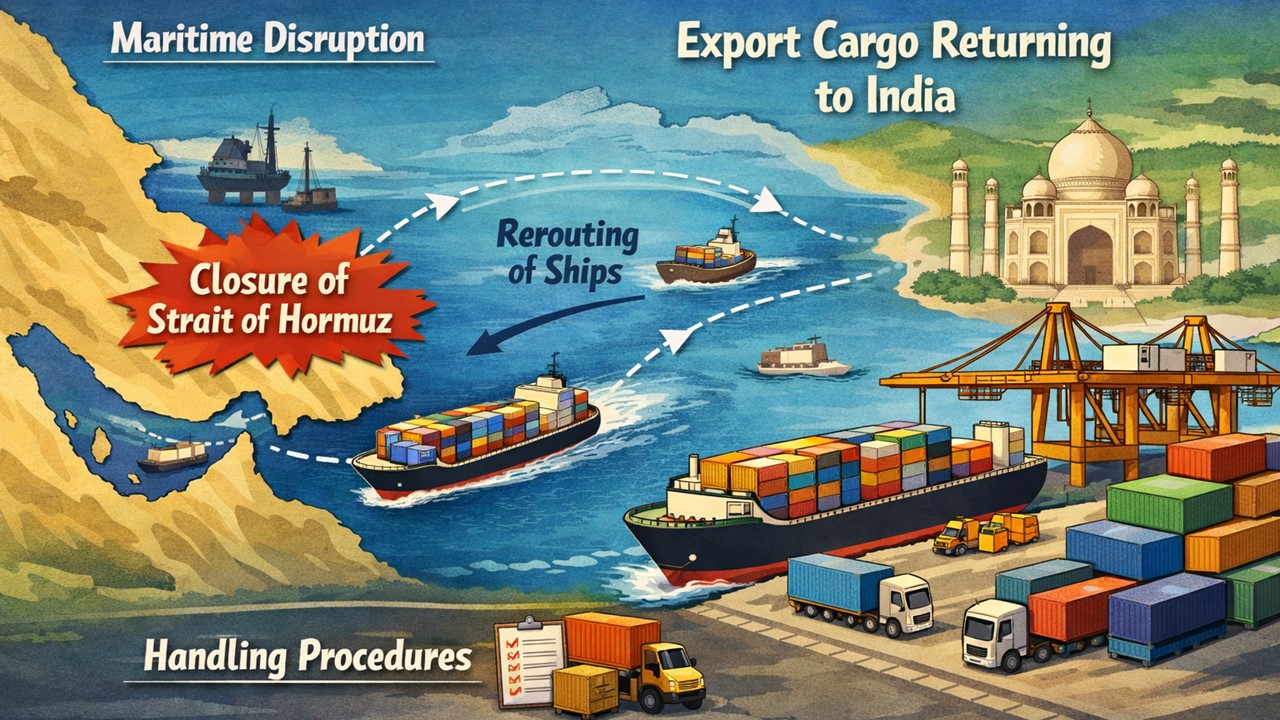
The CBIC has suggested possible procedures for handling export cargo returning to India due to maritime disruptions caused by the closure of the Strait of Hormuz.
CBIC Issues Relief Measures for Cargo Returning Back to India
 Saloni Kumari
 Mar 11, 2026
CBIC Circular for Handling Export Cargo Returning to India Due to Strait of Hormuz Closure
The Central Board of Indirect Taxes and Customs (CBIC) under the Ministry of Finance (Department of Revenue) has issued a Circular No. 09/2026-Customs dated March 08, 2026, addressed to all the Principal Chief Commissioners/Chief Commissioners of Customs/Customs (Preventive)/Customs and Central Tax and Principal Director General/Director General under CBIC, regarding the return of export cargo from international waters due to the closure of the Strait of Hormuz-Section 143AA of the Customs Act, 1962.
The circular disclosed that the government had received several representations stating that certain vessels carrying export cargo were released from Indian ports; however, they could not reach their destination ports due to the closure of the Strait of Hormuz and the consequent disruption caused to the maritime routes because of it. The vessels are not returning to their initial ports in India. Now, these representatives are requesting the government to provide possible suggestions to manage these cargoes.
Considering the same, the board has analysed the matter and has suggested possible procedures to ease trade and ensure expeditious handling of cargo that has been brought back to India due to the closure of the Strait of Hormuz or similar disruptions. The following are the procedures that have been suggested for different situations:
1. The cargo had been loaded on the vessel, the vessel was within Indian territorial waters, and EGM or SDM was not filed:
a. In this case, the captain or the master of the vessel at that point is required to submit an undertaking giving a statement that the vessel has not crossed India's territorial waters. If the ship had departed earlier from an Indian port and had not visited any foreign port, it could dock again at the Indian port without submitting a Sea Arrival Manifest (SAM).
b. Containers can be unloaded at the port terminal without filing a Bill of Entry, but the condition is that the shipping documents must first be checked.
c. The details of the container should be cross-checked with the shipping bills. During this verification, seals of the containers also need to be examined and aligned with seal details as disclosed in the shipping bills. If the seal is broken or tampered with, the container must go through a 100% inspection.
d. It is necessary to ensure that the shipping bills and let export order are cancelled.
e. If the exporter requests, the customs officer may allow the Back to Town facility.
Refer to the official circular to know the detailed procedures for other conditions.
About Author


Saloni Kumari
Content Writer
Saloni is a Content Writer with 2+ years of experience at studycafe.in. She writes legal, taxation, and finance related content including GST, Income Tax etc. Skilled in translating complex judicial pronouncements and regulatory developments into clear, and reader-friendly articles. Experienced in covering judgements of ITAT, High Court, GSTAT, and news related to Income Tax, GST, and corporate law. She can be reached at [email protected].
Saloni is a Content Writer with 2+ years of experience at studycafe.in. She writes legal, taxation, and finance related content including GST, Income Tax etc. Skilled in translating complex judicial pronouncements and regulatory developments into clear, and reader-friendly articles. Experienced in covering judgements of ITAT, High Court, GSTAT, and news related to Income Tax, GST, and corporate law. She can be reached at [email protected].
 StudyCafe
 Delhi, Delhi, India
 2919
2919My Recent Articles
- ITAT Directs AO to Reconsider Rs 16.44 Lakh Capital Gains and Rs 25.87 Lakh Stamp Duty Value Addition
- ITAT Remands Rs 3.33 Crore Demonetisation Cash Deposit Case to AO, Directs Rs 10,000 Relief Fund Payment
- Income Tax Dept Increases Scope for Saksham Nudge Initiative to Further Include Professional Insuring Timely Compliance
- Vedanta Subsidiary ESL Steel Receives GST SCN for Rs. 2.76 Lakh IGST Demand Over Alleged RCM Short Payment
- Good News! ICAI Opens One-Day Window for Submission of MEF Form 2026-27 at meficai.org
Up Next
Loading suggestions…


Recent Posts
All Posts

Tags
Recent Posts
All Posts