Delhi High Court Dismisses PIL Challenging Tax-Free Agricultural Income:
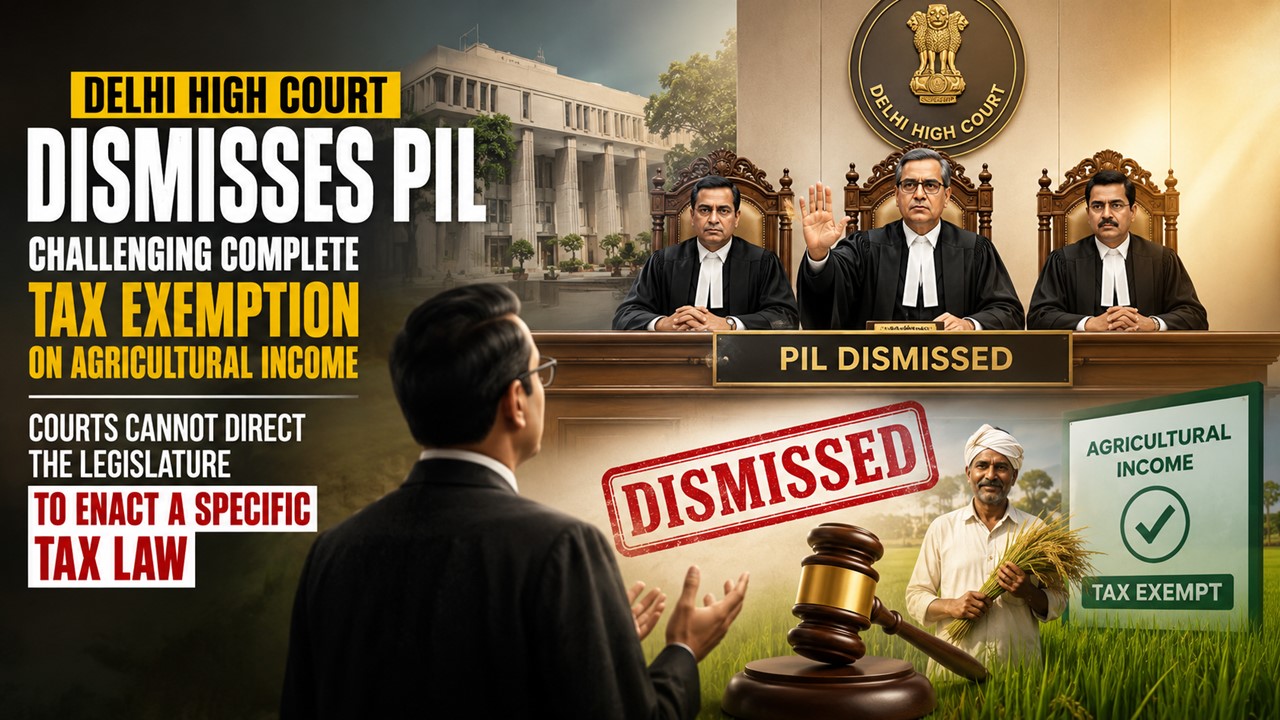
The Delhi High Court dismisses a PIL challenging the complete tax exemption on agricultural income, saying courts cannot direct the legislature to enact a specific tax law.
HC Calls PIL Against Agricultural Income Tax Exemption ‘Misconceived’
 Saloni Kumari
 May 14, 2026
Delhi High Court Dismisses PIL Challenging Tax-Free Agricultural Income
On Wednesday, May 13, 2026, the Delhi High Court dismissed a public interest litigation (PIL) contesting the full exemption of agricultural income from taxation. The court has titled the petition as “misconceived” and asserted it could not direct the government or legislature to introduce a new tax law.
The bench comprising Honourable Chief Justice D K Upadhyaya and Justice Tejas Karia had heard the PIL. The court had observed that the petitioner was consistently praying to direct the legislature or the Delhi Government to form a specific law, which is beyond its jurisdiction or power. Consequently, the court dismissed the complete plea.
The court held, "From a perusal of the prayer clause, it is apparent that the petitioner is seeking a mandamus to the legislature to enact a particular law. Such a direction is impermissible. The writ petition is highly misconceived and is dismissed."
The petitioner had also argued that exempting the complete agricultural income from taxation for farmers is an explicit inequality among taxpayers. This relief is also sometimes unfairly misused by the wealthy taxpayers. Further claimed that the provision was initially introduced to support the lower section of society, vulnerable farmers or the poor; however, high-income earners are taking advantage of the same. They are reportedly using the provision to avoid paying taxes.
The petitioner clarified that the aim of this provision was not to avoid taxation on agricultural income but to create a regulatory framework to prevent misuse by affluent people earning large agricultural incomes. It was highlighted that the present provision lacks a reasonable connection with the objective of protecting small farmers.
The plea also highlighted that only Assam and West Bengal still effectively impose agricultural income tax, mainly on plantation crops such as tea. In Delhi, no such law exists, and agricultural income remains completely tax-free. The petitioner had requested directions for the Delhi government to consider policy or legislative measures to address the alleged misuse of the exemption.
About Author


Saloni Kumari
Content Writer
Saloni is a Content Writer with 2+ years of experience at studycafe.in. She writes legal, taxation, and finance related content including GST, Income Tax etc. Skilled in translating complex judicial pronouncements and regulatory developments into clear, and reader-friendly articles. Experienced in covering judgements of ITAT, High Court, GSTAT, and news related to Income Tax, GST, and corporate law. She can be reached at [email protected].
Saloni is a Content Writer with 2+ years of experience at studycafe.in. She writes legal, taxation, and finance related content including GST, Income Tax etc. Skilled in translating complex judicial pronouncements and regulatory developments into clear, and reader-friendly articles. Experienced in covering judgements of ITAT, High Court, GSTAT, and news related to Income Tax, GST, and corporate law. She can be reached at [email protected].
 StudyCafe
 Delhi, Delhi, India
 2889
2889My Recent Articles
- ITAT Sets Aside Rejection of Charitable Trust’s Section 12AB Registration Application, Remands Case to CIT(E) for Fresh Consideration
- Can Same-Sex Partners Claim Tax Exemption on Gifts as Spouses? Karnataka High Court to Examine
- ITAT Remits Section 80G Renewal Application to CIT(E) for Fresh Consideration in Light of CBDT Circular
- Dreamfolks Services Faces Rs 1.58 Crore IGST Demand Over ITC Availment on Invoices Issued by GST-Cancelled Supplier
- ITAT Restores Taxpayer's Appeal In Interest of Natural Justice After CIT(A)'s Failure to Decide Appeal on Merits
Up Next
Loading suggestions…


Recent Posts

All Posts

Recent Posts
All Posts