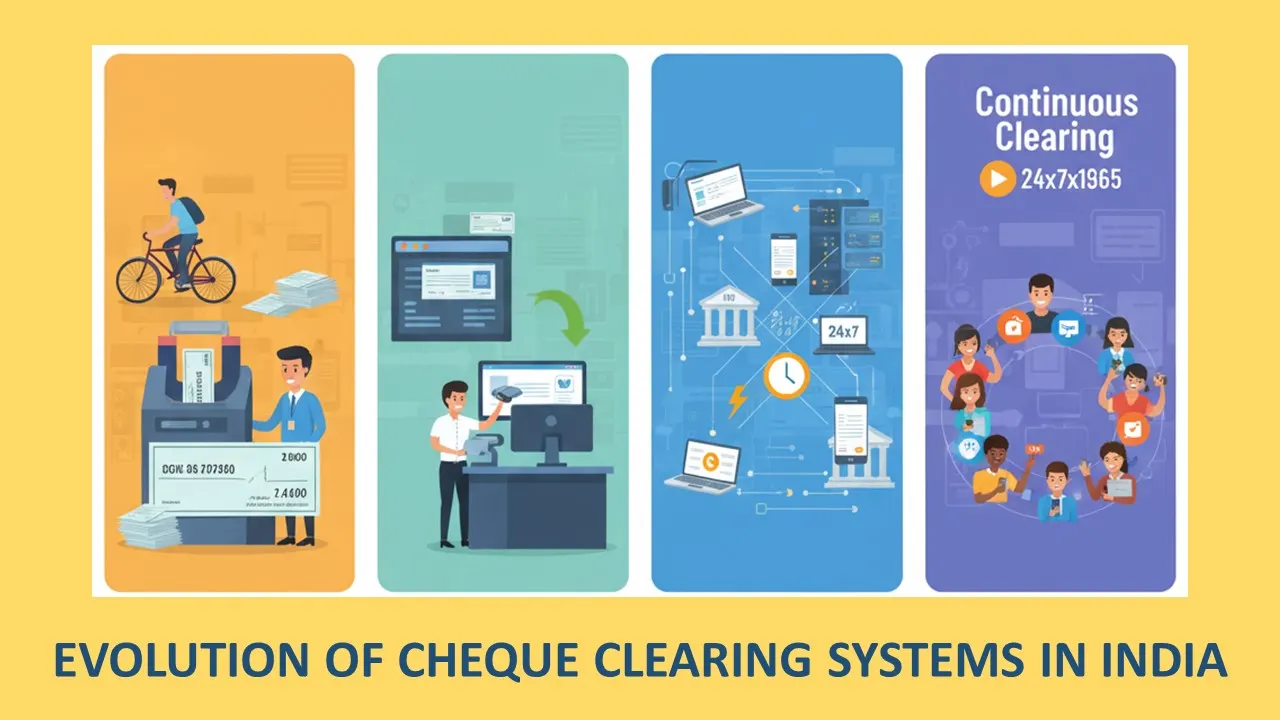
Evolution of Cheque Clearing Systems in India: From MICR to Continuous Clearing

RBI has announced a phased shift from batch-based CTS to continuous, real-time cheque clearing from October 4, 2025, reducing settlement time to just a few hours.

RBI Launches Continuous Clearing for Cheques

shashank kothiyal | Oct 8, 2025 |

Evolution of Cheque Clearing Systems in India: From MICR to Continuous Clearing

Evolution of Cheque Clearing Systems in India: From MICR to Continuous Clearing

Starting October 4, 2025, the Reserve Bank of India (RBI) will introduce a new system to clear cheques within a few hours—a significant improvement from the current processing time of up to two working days.

Under the new system, cheques will be scanned, processed, and settled continuously during business hours, instead of being cleared in batches. This means that the current T+1 clearing cycle (where T is the day of cheque deposit) will be reduced to just a few hours.

Currently, the Cheque Truncation System (CTS) clears cheques in one or two working days, depending on when they are deposited. The RBI aims to improve customer convenience and reduce settlement risk by moving to a faster, real-time clearing process.

How the transition will work

Phase 1: October 4, 2025 – January 2, 2026

  • Banks must confirm (approve or reject) cheques presented to them by 7:00 PM the same day.
  • If a bank does not respond by 7:00 PM, the cheque will be automatically treated as approved and included for settlement. The deadline for processing all cheques will be 7:00 PM.

Phase 2: From January 3, 2026

  • Cheques will need to be confirmed within 3 hours of being received by the bank.
  • Example: If a cheque is received between 10:00 AM and 11:00 AM, the bank must confirm it by 2:00 PM (3 hours from 11:00 AM).
  • If the bank does not respond in time, the cheque will again be considered approved by default and cleared.

RBI’s Revolutionary Shift: From Batch Processing to Continuous Clearing in India’s Cheque Truncation System

Executive Summary

The Reserve Bank of India has announced a paradigmatic transformation in India’s cheque clearing infrastructure through its circular dated August 13, 2025. This landmark reform transitions the Cheque Truncation System (CTS) from traditional batch processing to continuous clearing with settlement on realisation, dramatically reducing cheque clearance time from the current T+1 to T+2 days to just a few hours. The implementation will occur in two carefully orchestrated phases: Phase 1, beginning October 4, 2025, and Phase 2 commencing January 3, 2026.

Historical Context: Evolution of Cheque Clearing in India

The MICR Era (Pre-2008)

Before the advent of CTS, India’s cheque clearing system relied heavily on Magnetic Ink Character Recognition (MICR) technology. This system, operational since the mid-1980s, required physical movement of cheques across clearing houses, resulting in 3-4 working days for cheque realisation. The MICR system operated through 66 MICR centers across India, with each center handling clearing and settlement within its local geography.

The traditional MICR process involved multiple steps: customer deposits, physical transportation to service branches, sorting by MICR clearing centers, and physical delivery to respective bank branches. The return cycle for rejected instruments was completed the next day, with settlement occurring only after the completion of the return cycle

Introduction of Cheque Truncation System (2008-2010)

The RBI first implemented CTS as a pilot project in the National Capital Region (NCR), New Delhi on February 1, 2008. This was followed by Chennai on September 24, 2011, and Mumbai on April 27, 2013. The CTS represented a revolutionary shift from physical cheque movement to electronic image-based clearing.

Under the original CTS framework introduced in 2010, the system operated on CTS-2010 standards which mandated specific security features including quality paper, watermarks, bank logos in invisible ink, and void pantographs. Banks were advised to issue only CTS-2010 compliant cheques from September 30, 2012.

Current Batch Processing System (2010-2025)

The existing CTS operates on a batch processing model with predetermined clearing sessions. Currently, cheques are collected during the day and processed in designated batches, resulting in a T+1 day clearance period in most cases. The system processes cheques with a clearing cycle of up to two working days.

The current process involves:

  • Fixed presentation and return sessions with uniform timing across three grids (Southern, Western, and Northern)
  • Batch-wise settlementafter completion of return cycles
  • Next-day credit to customer accounts after successful processing

The New Continuous Clearing Framework

Fundamental Transformation

The new system represents a complete departure from batch processing to a real-time, continuous clearing mechanism. Under this framework, cheques will be scanned, presented, and processed continuously during business hours rather than in predetermined batches.

Key Operational Modalities

Single Presentation Session with Continuous Delivery

The new system establishes a single presentation session from 10:00 AM to 4:00 PM. During this window:

  • Banks must scan and transmit cheques immediately and continuously
  • The clearing house releases cheque images to drawee banks on a continuous basis
  • No waiting for batch processing cycles

Continuous Inward Processing and Confirmation

The confirmation session operates from 10:00 AM to 7:00 PM. For every cheque presented, drawee banks must generate either:

  • Positive confirmation for honoured cheques
  • Negative confirmation for dishonoured cheques

Each cheque contains an “Item Expiry Time” indicating the latest confirmation deadline.

StudyCafe Membership

Join StudyCafe Membership. For More details about Membership Click Join Membership Button
Join Membership

In case of any Doubt regarding Membership you can mail us at [email protected]

Join Studycafe's WhatsApp Group or Telegram Channel for Latest Updates on Government Job, Sarkari Naukri, Private Jobs, Income Tax, GST, Companies Act, Judgements and CA, CS, ICWA, and MUCH MORE!"


Tags: Finance, RBI