Filing ITR for FY2024- 25? Avoid These Mistakes While Filing ITR:
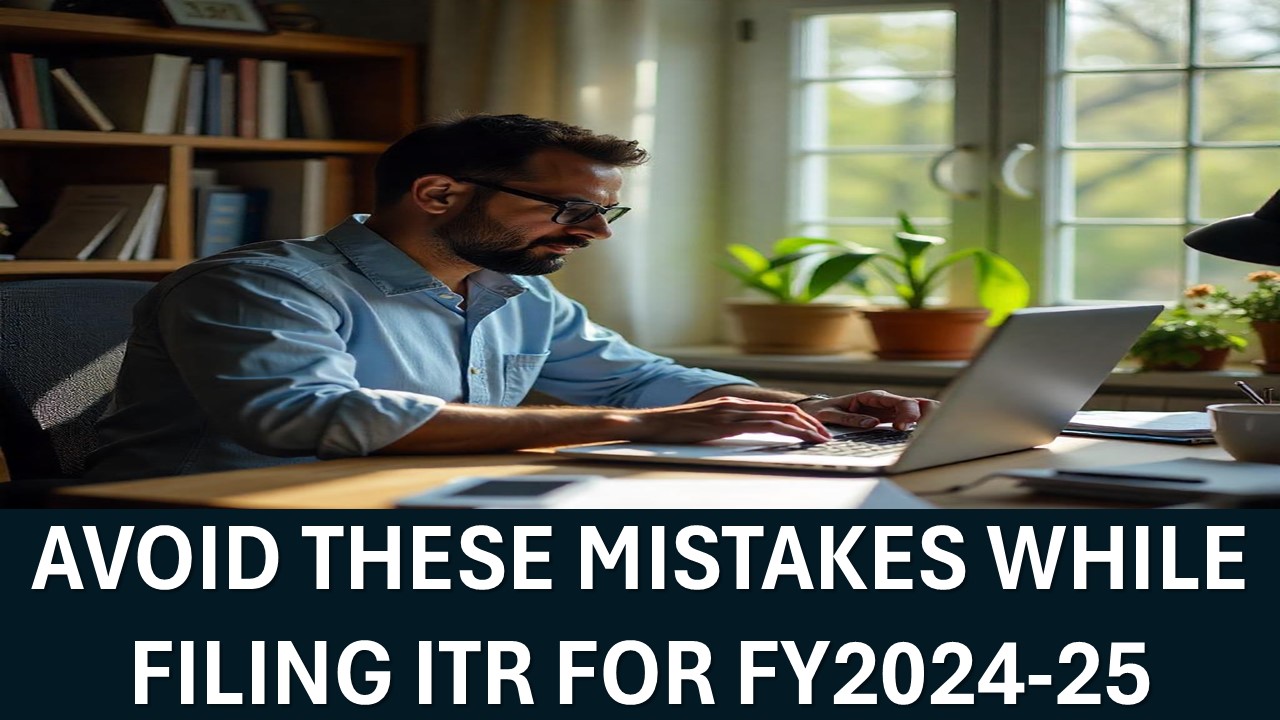
Here is a simple guide to filing your ITR for FY 2024–25, key changes from Budget 2024, common mistakes to avoid, and important deadlines to remember.
ITR Filing Tips for FY 2024-25: Avoid Errors and Meet Deadlines
 Saloni Kumari
 Jun 3, 2025
Table of Contents

Filing ITR for FY2024- 25? Avoid These Mistakes While Filing ITR
As the tax filing season begins, taxpayers have been given a 45-day extra window to file their returns. The deadline has been extended from 31 July to 15 September because Budget 2024 introduced major changes to ITR forms. While this extension is helpful, these changes might still lead to mistakes when filing your return.
Not following the new rules isn’t the only risk. Even with improved online filing, like pre-filled forms and automatic checks, people still make errors. An expert says, "The pre-filled data from Form 16, 26AS, AIS/TIS, real-time validation and auto-calculations have reduced the chances of errors, but if the data you provide and confirm is not correct, it may lead to mistakes in the return."
Some common mistakes include choosing the wrong ITR form, not reporting all sources of income, not matching your income with tax details, and errors in HRA claims or while switching jobs. These issues can cause wrong tax amounts, penalties, notices from the tax department, the need to refile, and delayed refunds.
Below are mentioned few mistakes that should be avoided while filing ITR (Income Tax Return).
Using the Wrong ITR Form or Not Filing at All
Numerous people choose the wrong form or skip filing completely. For example, if you earn long-term capital gains (LTCG) up to Rs. 1.25 lakh from stocks or equity mutual funds, you can now file ITR-1 instead of ITR-2 or 3. Even if your tax is zero, you might still need to file, like if you've spent over Rs. 2 lakh on foreign travel or want to claim a refund. Only people with a total income below Rs. 2.5 lakh (old regime) or Rs. 3 lakh (new regime) are fully exempt.Ignoring Amendments Introduced in Budget 2024
The Budget has altered the method of taxing capital gains. Long-term gains from shares and equity mutual funds, from 23 July 2024, will be taxed at 12.5% without indexation; short-term gains will be taxed at 20% (was 15%). You must also split capital gains into "before" and "after" 23 July 2024 in your ITR. And if you want to use the old tax regime, you need to file Form 10-IEA—the new regime is now the default.Not Checking AIS and Form 26AS
Always check your Annual Information Statement (AIS) and Form 26AS before filing. They show income earned, tax deducted (TDS), and high-value transactions. Compare these with your bank statements, Form 16, and investment proofs. If there are errors, contact the source (like your employer or bank) to fix them.
Not Reporting All Sources of Income
Numerous people forget to include some incomes such as interest from savings accounts, fixed deposits, rent below Rs. 50,000, freelance work, crypto gains, or foreign income. Lastly, don't forget about your spouse's income (if assets were gifted), and any income from minor children would also be taxable in your name.Important Tax Filing Dates:
- 15 Sep 2025: The last date to file ITR applicable to most people.
- 31 Oct 2025: Last date for those who need a tax audit.
- 31 Dec 2025: Last date to file revised or late return.
- 31 Mar 2030: Last date to file an updated return for FY 2024-25.
Missed the deadline?
You can still file your tax return after the due date, until 31 December 2025. However, you’ll have to pay the same penalty as if you missed the 15 September deadline. On top of that, the tax officer may charge an extra penalty of up to Rs. 1.5 lakh or 0.5% of your total business turnover—whichever amount is less.Who needs to file a return?
You are required to file an ITR as per these conditions: You're exempt from filing if: Your annual income before deductions and exemptions is:- Less than Rs. 2.5 lakh in the old tax regime.
- Less than Rs. 3 lakh in the old tax regime if you are between 60 and 80.
- Less than Rs. 5 lakh in the old tax regime if you are over 80.
- Less than Rs. 3 lakh in the new tax regime.
- You are over 75, with only income being pension and interest from the same bank, and the bank has deducted tax.
- You have a tax refund due.
- You have a TDS/TCS refund due.
- You need to apply for a loan, a passport or a visa.
- You want to carry forward losses from business/profession or under the capital gains head in the future.
- You have a foreign income or hold foreign assets.
- You are a company or a firm, regardless of profit or loss.
- You have deposited Rs. 50 lakh or more in a savings account, or Rs. 1 crore or more in a current account.
- You have spent Rs. 2 lakh or more on foreign travel.
- Your electricity consumption is over Rs. 1 lakh.
- Your aggregate TDS/TCS is more than Rs. 25,000 (Rs. 50,000 for senior citizens).
- You have a business turnover of over Rs. 60 lakh, or a professional turnover of more than Rs. 10 lakh.
About Author


Saloni Kumari
Content Writer
Saloni is a Content Writer with 2+ years of experience at studycafe.in. She writes legal, taxation, and finance related content including GST, Income Tax etc. Skilled in translating complex judicial pronouncements and regulatory developments into clear, and reader-friendly articles. Experienced in covering judgements of ITAT, High Court, GSTAT, and news related to Income Tax, GST, and corporate law. She can be reached at [email protected].
Saloni is a Content Writer with 2+ years of experience at studycafe.in. She writes legal, taxation, and finance related content including GST, Income Tax etc. Skilled in translating complex judicial pronouncements and regulatory developments into clear, and reader-friendly articles. Experienced in covering judgements of ITAT, High Court, GSTAT, and news related to Income Tax, GST, and corporate law. She can be reached at [email protected].
 StudyCafe
 Delhi, Delhi, India
 2924
2924My Recent Articles
- Major Relief in Arbitration Case: MCIA Denies Rs 908 Crore Statement Claim Made by Allied Silica Against Tata Chemicals
- MCA and ICSI to Hold User Awareness Session on Form AOC-4 Filing Amid Glitches on MCA-21 Version-3 Portal
- GSTN Introduces New E-Invoicing Facility for Self-Invoices Under Reverse Charge Mechanism
- Flexi Cap vs Multi Cap Funds: What's the Real Difference?
- IBA Recommends Public Sector Banks to Reduce Ambit of Physical Branch Audits to 50% of Total Business
Up Next
Loading suggestions…


Recent Posts

All Posts


Tags
No tags yet.
Recent Posts
All Posts
Tags
No tags yet.