Govt. Releases Frequently Asked Questions (FAQs) on Decisions of 56th GST Council Held in New Delhi:
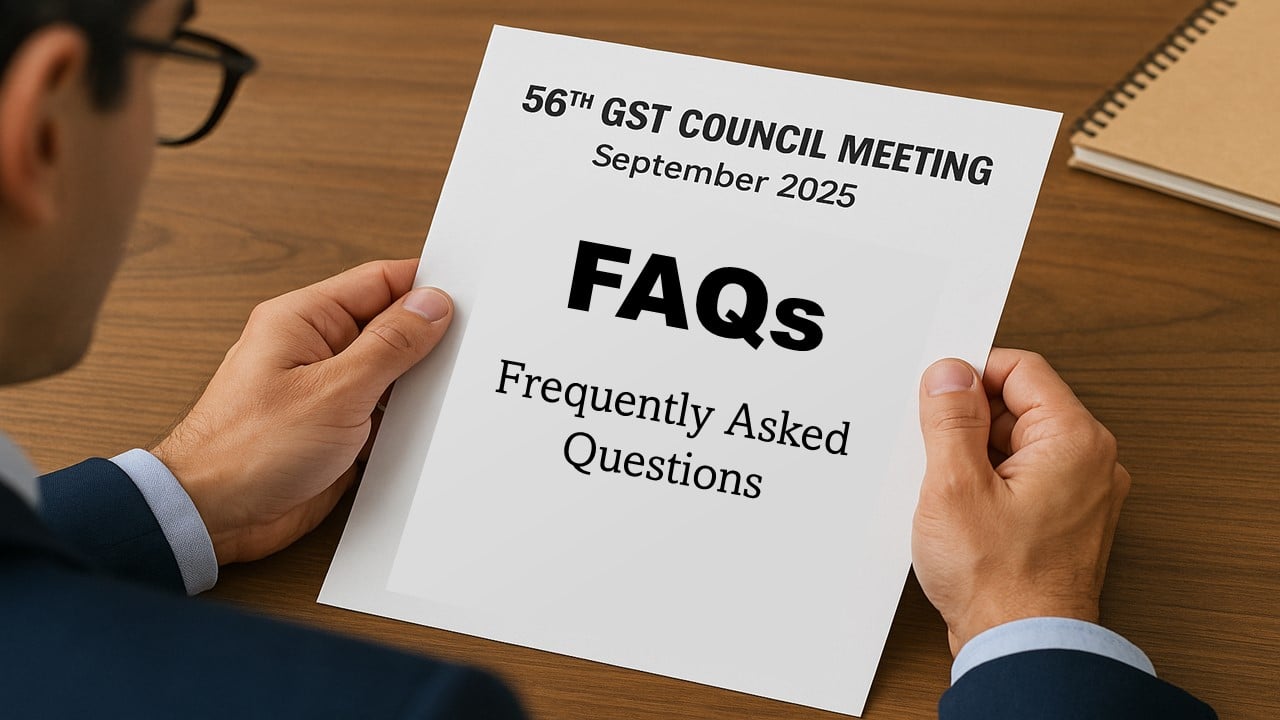
The Government has released a comprehensive FAQ document clarifying the decisions of the 56th GST Council Meeting, effective from September 22, 2025.
Key Highlights and Clarifications from the 56th GST Council Meeting FAQs
 Saloni Kumari
 Sep 4, 2025
Govt. Releases Frequently Asked Questions (FAQs) on Decisions of 56th GST Council Held in New Delhi
The 56th GST council meeting, which was scheduled for September 3-4, 2025, in New Delhi, has been successfully conducted for the first day. In the meeting, the council discussed several key amendments to the Goods and Services Tax (GST) structure. These changes are aimed at GST rate rationalisation, creating a transparent economy, reducing compliance burdens, and benefiting small businesses.
These discussed proposals are set to take effect from September 22, 2025, excluding certain chewing tobacco products such as zarda, unmanufactured tobacco, and beedi, which will continue under existing rates until further notice. On the basis of the GST council meeting held on September 3, 2025, the government has released the Frequently Asked Questions (FAQs); these include 75 questions addressing the common concerns. These FAQs provide clarity on the applicability of new rates, input tax credit (ITC), transitional provisions, and sector-specific impacts.
According to the released FAQs, no amendments are introduced in the threshold of the registration required for goods under the CGST Act, 2017. The amendments made to the GST rates will be notified in the rate notification that will be uploaded to the official website of CBIC.
Some of the recommendations made at the GST council meeting are:
1. Rationalisation of the current 4-tiered tax rate structure into a citizen-friendly ‘Simple Tax’ - a 2-rate structure with a Standard Rate of 18% and a Merit Rate of 5%; a special de-merit rate of 40% for a select few goods and services.
2. Reduction of GST from 18% OR 12% to 5% on a host of common man items such as hair oil, toilet soap bars, shampoos, toothbrushes, toothpaste, Bicycles, Tableware, kitchenware, other household articles, etc.
3. Reduction of GST from 5% to NIL on Ultra-High Temperature (UHT) milk, Prepackaged and labelled chena or paneer; All the Indian Breads will see NIL rates (Chapati or roti, paratha, parotta, etc)
4. Reduction of GST from 12% OR 18% to 5% on almost all of the food items, such as packaged namkeens, Bhujia, Sauces, Pasta, Instant Noodles, Chocolates, Coffee, Preserved Meat, Cornflakes, Butter, Ghee, etc.
To access the Frequently Asked Questions (FAQs), refer to the link below.
About Author


Saloni Kumari
Content Writer
Saloni is a Content Writer with 2+ years of experience at studycafe.in. She writes legal, taxation, and finance related content including GST, Income Tax etc. Skilled in translating complex judicial pronouncements and regulatory developments into clear, and reader-friendly articles. Experienced in covering judgements of ITAT, High Court, GSTAT, and news related to Income Tax, GST, and corporate law. She can be reached at [email protected].
Saloni is a Content Writer with 2+ years of experience at studycafe.in. She writes legal, taxation, and finance related content including GST, Income Tax etc. Skilled in translating complex judicial pronouncements and regulatory developments into clear, and reader-friendly articles. Experienced in covering judgements of ITAT, High Court, GSTAT, and news related to Income Tax, GST, and corporate law. She can be reached at [email protected].
 StudyCafe
 Delhi, Delhi, India
 2923
2923My Recent Articles
- MCA and ICSI to Hold User Awareness Session on Form AOC-4 Filing Amid Glitches on MCA-21 Version-3 Portal
- GSTN Introduces New E-Invoicing Facility for Self-Invoices Under Reverse Charge Mechanism
- Flexi Cap vs Multi Cap Funds: What's the Real Difference?
- IBA Recommends Public Sector Banks to Reduce Ambit of Physical Branch Audits to 50% of Total Business
- ITAT Directs AO to Reconsider Rs 16.44 Lakh Capital Gains and Rs 25.87 Lakh Stamp Duty Value Addition
Up Next
Loading suggestions…


Recent Posts

All Posts

Tags
Recent Posts
All Posts