Income Tax Section 149: Escaped Income Refers to Real Income, Not Gross Transactions:
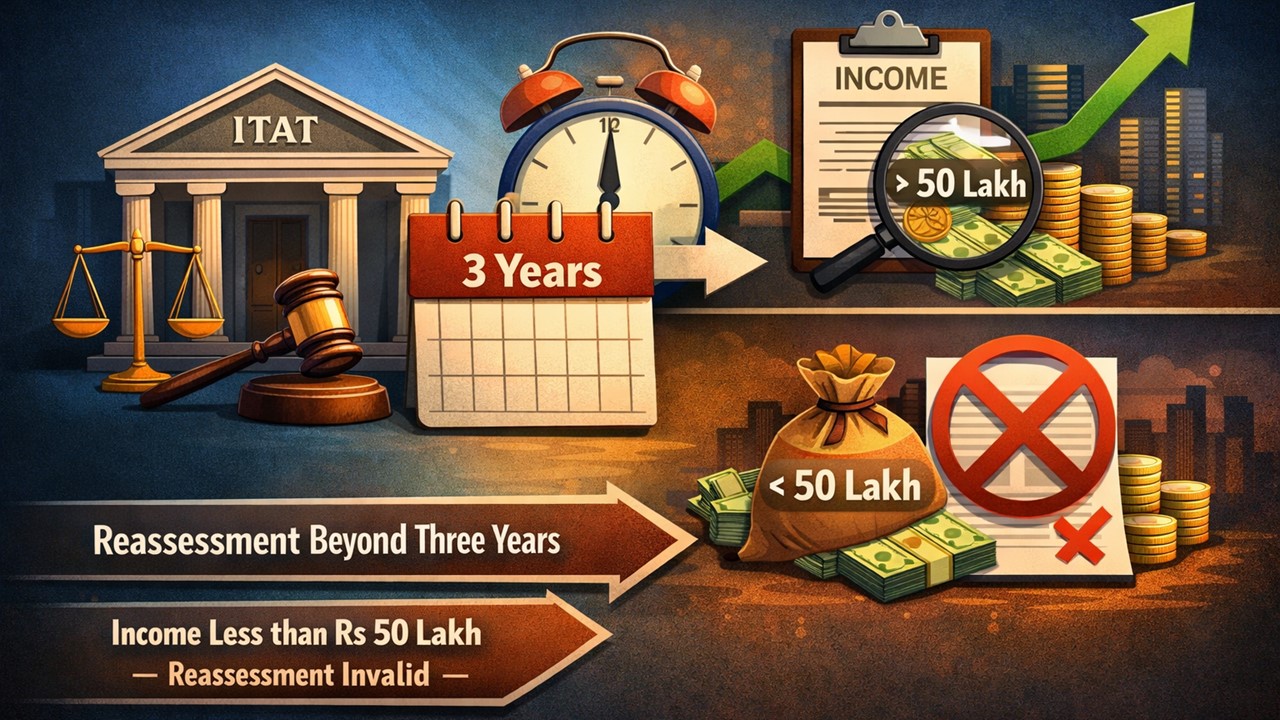
ITAT held that reassessment beyond three years is invalid if the alleged escaped income does not exceed the statutory Rs 50 lakh threshold under Section 149(1)(b).
ITAT Quashes Entire Reassessment Proceedings
 Saloni Kumari
 Mar 20, 2026
Income Tax Section 149: Escaped Income Refers to Real Income, Not Gross Transactions
The ITAT Ahmedabad held that to reopen an assessment on the grounds of income escapement, the alleged amount of escapement should be within the legal minimum limit required for reopening the cases beyond three years under Section 149(1)(b). The limit is Rs 50 lakh.
The Income Tax Appellate Tribunal (ITAT), Ahmedabad “SMC” Bench, has announced its decision on an appeal filed by Rupinder Singh Duggal against the Income Tax Officer, challenging an order passed by the CIT(A), NFAC Delhi, on September 15, 2025. The case concerns the Assessment Year 2017-18. The judgement was delivered on March 16, 2026. The impugned order had confirmed additions made to the assessee's income.
The assessee did not file his income tax return (ITR) for the year in question, despite earning a salary of Rs 10.49 lakh, and he also sold one of his immovable properties worth Rs 32 lakh. Also, the assessee had purchased equity shares of Rs 14.42 lakh and sold shares of Rs 12.54 lakh. In conclusion, the tax authorities issued a show cause notice (SCN) to the assessee under Section 148A(b) of the Act. In reply to the notice, the assessee furnished relevant documents explaining the sources of the same, like copies of Form 16, copies of the Sale Deed, and the Purchase Deed. However, the tax authorities issued an order dated March 12, 2024, alleging that the assessee had escaped income of Rs 69.49 lakh and also issued another notice.
In response, the assessee filed its Income Tax Return (ITR), declaring a total income of Rs 8.98 lakh. However, the tax officer completed the assessment, making various additions to the assessee's income, and declared the total income at Rs 29.92 lakh. The aggrieved assessee filed an appeal before the ITAT Ahmedabad, arguing the reassessment was invalid because the alleged amount of income escapement was within the statutory minimum limit required for reopening the cases beyond three years under Section 149(1)(b), i.e., Rs 50 lakh. The tribunal endorsed the raised assessee's argument and set aside the entire reassessment proceedings.
Relevant Text:
5. We have given our thoughtful considerations and perused the materials available on record including Paper Book filed by the assessee. The reassessment in the present case has been initiated on the basis of information received from the insight portal of the department that the assessee has not filed regular Return of Income though there were salary income of Rs.10,49,754/- and sold immovable property for Rs.32 lakhs and the assessee purchased equity shares of Rs.14,42,420/- and sold shares of Rs.12,54,275/-. The assessee explained that the escaped income is Rs.44,37,899/= which is below the monetary limit of Rs.50 lakhs as prescribed u/s.149(1)(b) of the Act and requested to drop the reassessment proceedings. However, the Ld AO in the reassessment order confined the additions to salary income of Rs.8,98,920/=; LTCG of Rs. 20,93,414/= and denial of section 80C of Rs.1 lakh and determined the total income of Rs.30,92,334/=, which is admittedly below the monetary threshold of Rs.50 lakhs as prescribed u/s.149(1)(b) of the Act.
5.1. In our considered view, the expression “income chargeable to tax which has escaped assessment” used in section 149 refers to the real income sought to be brought to tax and not the gross value of transactions. Since the alleged escaped income in the present case does not satisfy the statutory threshold of Rs.50 lakhs as prescribed u/s.149(1)(b) of the Act, the very assumption of jurisdiction under section 148 is invalid in law and the consequential reassessment proceeding is liable to be quashed. Since the reassessment is quashed on lack of jurisdiction, the other grounds raised by the assessee are not adjudicated.
6. In the result the appeal filed by the assessee is allowed.
About Author


Saloni Kumari
Content Writer
Saloni is a Content Writer with 2+ years of experience at studycafe.in. She writes legal, taxation, and finance related content including GST, Income Tax etc. Skilled in translating complex judicial pronouncements and regulatory developments into clear, and reader-friendly articles. Experienced in covering judgements of ITAT, High Court, GSTAT, and news related to Income Tax, GST, and corporate law. She can be reached at [email protected].
Saloni is a Content Writer with 2+ years of experience at studycafe.in. She writes legal, taxation, and finance related content including GST, Income Tax etc. Skilled in translating complex judicial pronouncements and regulatory developments into clear, and reader-friendly articles. Experienced in covering judgements of ITAT, High Court, GSTAT, and news related to Income Tax, GST, and corporate law. She can be reached at [email protected].
 StudyCafe
 Delhi, Delhi, India
 2923
2923My Recent Articles
- MCA and ICSI to Hold User Awareness Session on Form AOC-4 Filing Amid Glitches on MCA-21 Version-3 Portal
- GSTN Introduces New E-Invoicing Facility for Self-Invoices Under Reverse Charge Mechanism
- Flexi Cap vs Multi Cap Funds: What's the Real Difference?
- IBA Recommends Public Sector Banks to Reduce Ambit of Physical Branch Audits to 50% of Total Business
- ITAT Directs AO to Reconsider Rs 16.44 Lakh Capital Gains and Rs 25.87 Lakh Stamp Duty Value Addition
Up Next
Loading suggestions…


Recent Posts



All Posts


Tags
Recent Posts
All Posts