ITAT Quashes MAT Rectification Order; Debatable MAT Computation Cannot Be Revised u/s 154:
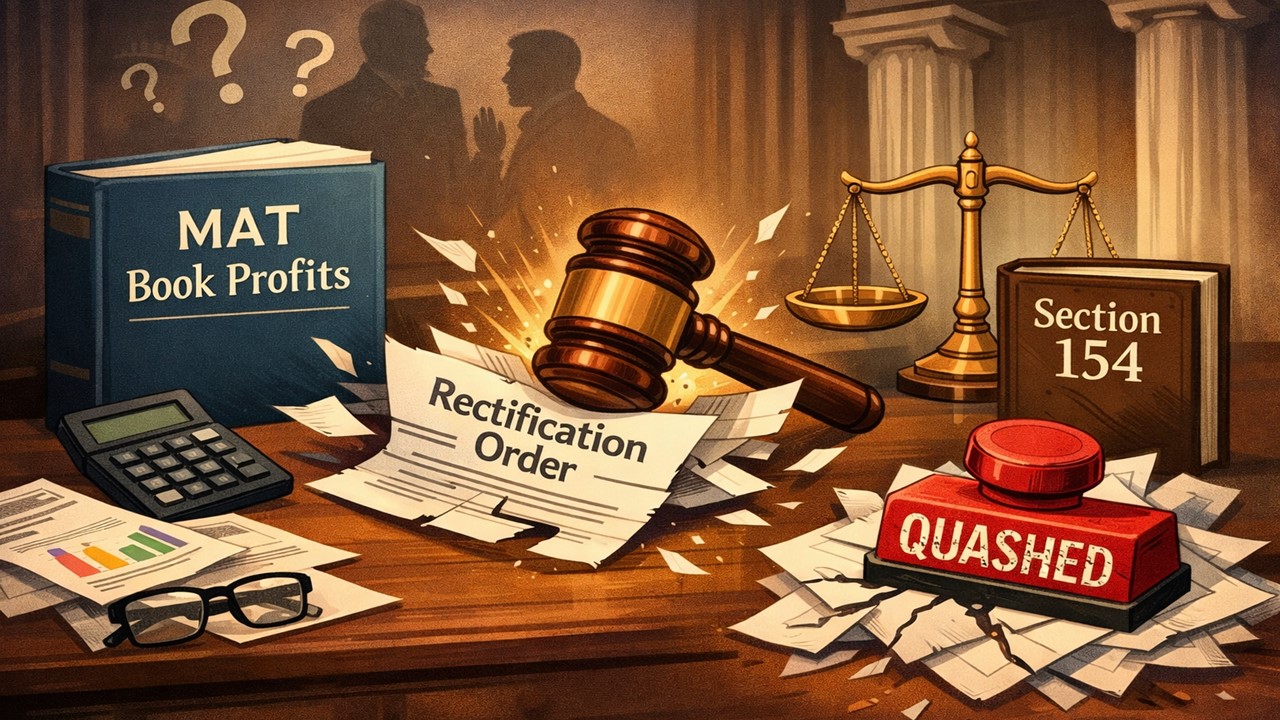
The ITAT held that a debatable issue relating to MAT book profit computation cannot be corrected through rectification under Section 154 and accordingly quashed the rectification order.
ITAT Sets Aside Rectification On MAT Book Profit Computation
 Saloni Kumari
 Feb 4, 2026
ITAT Quashes MAT Rectification Order; Debatable MAT Computation Cannot Be Revised u/s 154
The ITAT quashed the MAT rectification order, holding that issues involving the interpretation of the MAT book profit computation are debatable and cannot be revised through rectification under Section 154. Since the method was earlier accepted, reopening it indirectly was held to be legally impermissible.
Fiat India Automobiles Private Limited and the DCIT, Income Tax Department, have filed cross appeals in the Income Tax Appellate Tribunal (ITAT) Pune, challenging an order dated February 07, 2025, passed by the CIT(A) Pune. The case concerns the Assessment Year 2014-15. The key dispute mainly relates to the computation of book profit under section 115JB (MAT provisions) and whether a rectification under section 154 was valid.
The assessee, Fiat India, involved in the business of manufacturing and selling passenger cars, engines, and gearboxes, filed its income tax return (ITR) for the year in consideration, declaring a loss of Rs. NIL after setting off brought-forward losses amounting to Rs. 22.34 crore.
In conclusion to the scrutiny assessment under Section 143(3) r.w.s. 144C(1) of the Income Tax Act, the Assessing Officer (AO) made an addition of Rs. 308.92 crore to the assessee's income and set off brought forward losses of Rs. 331.61 crore, determining income at Rs. Nil.
In earlier years, the assessee had implemented a capital reduction scheme of Rs. 300 crore, approved by the Bombay High Court, by adjusting accumulated book losses against securities premium and share capital. While computing MAT, Fiat reduced the brought-forward business loss (being lower than unabsorbed depreciation), and this treatment was admitted by the AO in Assessment Year 2013-14 during scrutiny assessment.
For Assessment Year 2014-15, the AO re-admitted this position in the original assessment order. However, it later issued a rectification notice under section 154 holding that no brought-forward loss was available for MAT adjustment. The AO applied a FIFO method and recomputed book profit, resulting in a large tax demand. The assessee aggrieved with the same rectification order challenged the same before the CIT(A).
When the CIT(A) analysed the facts of the case, it allowed the assessee's appeal, endorsing that the capital reduction should not be adjusted only against business loss. The CIT(A) instructed the AO to apply the reduction proportionately between business loss and unabsorbed depreciation, but still upheld the use of FIFO and allowed recomputation.
Fiat appealed to the ITAT, arguing that the issue was debatable, no method is prescribed under the law, and therefore, rectification under section 154 was invalid. The Tribunal agreed with the assessee. It held that once the method was accepted in Assessment Year 2013-14, the AO could not reopen it indirectly through section 154 in a later year. Further, deciding how capital reduction affects book losses under section 115JB involves interpretation and debate, which is beyond the scope of section 154.
The tribunal cited earlier Supreme Court and High Court judgements and accordingly held the impugned rectification order as illegal and hence quashed the same. Consequently, allowed the appeal of the assessee and dismissed the tax authorities' cross-appeal.
About Author


Saloni Kumari
Content Writer
Saloni is a Content Writer with 2+ years of experience at studycafe.in. She writes legal, taxation, and finance related content including GST, Income Tax etc. Skilled in translating complex judicial pronouncements and regulatory developments into clear, and reader-friendly articles. Experienced in covering judgements of ITAT, High Court, GSTAT, and news related to Income Tax, GST, and corporate law. She can be reached at [email protected].
Saloni is a Content Writer with 2+ years of experience at studycafe.in. She writes legal, taxation, and finance related content including GST, Income Tax etc. Skilled in translating complex judicial pronouncements and regulatory developments into clear, and reader-friendly articles. Experienced in covering judgements of ITAT, High Court, GSTAT, and news related to Income Tax, GST, and corporate law. She can be reached at [email protected].
 StudyCafe
 Delhi, Delhi, India
 2924
2924My Recent Articles
- Major Relief in Arbitration Case: MCIA Denies Rs 908 Crore Statement Claim Made by Allied Silica Against Tata Chemicals
- MCA and ICSI to Hold User Awareness Session on Form AOC-4 Filing Amid Glitches on MCA-21 Version-3 Portal
- GSTN Introduces New E-Invoicing Facility for Self-Invoices Under Reverse Charge Mechanism
- Flexi Cap vs Multi Cap Funds: What's the Real Difference?
- IBA Recommends Public Sector Banks to Reduce Ambit of Physical Branch Audits to 50% of Total Business
Up Next
Loading suggestions…


Recent Posts
All Posts

Tags
Recent Posts
All Posts