ITAT Quashes Reassessment as Section 148 Notice Issued Beyond Limitation Period:
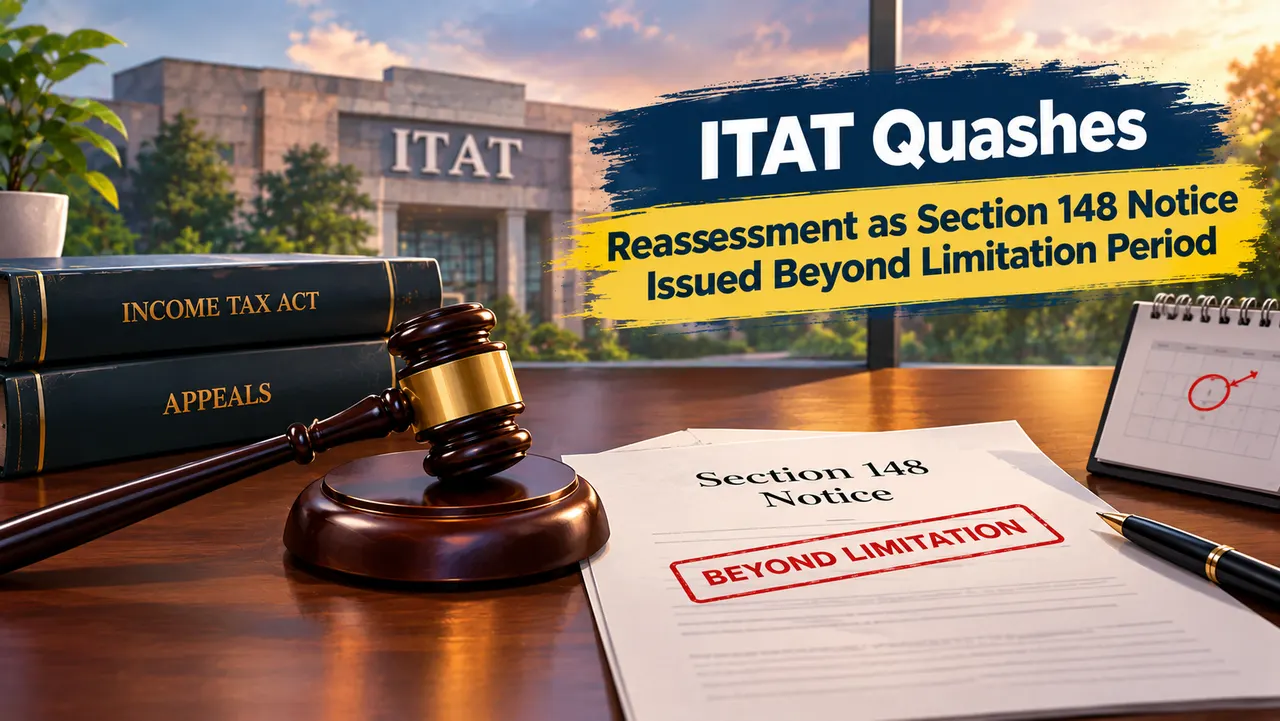
The ITAT Mumbai held that Section 148A(d) timeline cannot extend Section 149 limitation.
ITAT Held Reassessment Invalid
 Saima
Saima Oct 6, 2026
The assessee had filed his return of income for AY 2019-20 declaring total income of Rs.13,62,370/-. During FY 2018-19, he donated Rs.4,00,000/- to Rashtriya Samajwadi Party (Secular) and claimed deduction of the corresponding amount under Section 80GGC of the Income Tax Act, 1961. Subsequently, the AO received investigation information alleging that certain political parties were involved in providing accommodation entries in the guise of political donations.
Based on the information, a notice under Section 148A(b) was issued on 29/03/2023, requiring the assessee to furnish his explanation by 14/04/2023. The assessee maintained that the donation was genuine, had been made through NEFT to a political party registered with the Election Commission of India and that no amount had been returned to him. He also sought copies of the relevant third-party material and approval relied upon by the AO.

The AO rejected the explanation and passed an order under Section 148A(d), followed by issuance of notice under Section 148 on the same date. The reassessment was ultimately completed under Section 147 read with Section 144B, determining total income at Rs.17,62,370 after disallowing the Rs.4,00,000 deduction claimed under Section 80GGC. The CIT(A) upheld the reassessment.
Before the Tribunal, the assessee primarily challenged the validity of the reassessment on the ground that the Section 148 notice dated 24/04/2023 was issued beyond the limitation prescribed under Section 149. He also challenged the reopening procedure and the jurisdiction of the AO, besides disputing the disallowance under Section 80GGC and reliance on third-party statements without cross-examination.

The Tribunal noted that since the alleged escapement involved only Rs.4,00,000/- under Section 80GGC, the monetary threshold of Rs.50 lakh under Section 149(1)(b) was not attracted and the limitation had to be considered under Section 149(1)(a). The Tribunal found that the Section 148A(b) notice was issued on 29/03/2023 and the assessee furnished his reply on 14/04/2023. After excluding the applicable reply period under the fifth proviso to Section 149(1), the remaining period was less than seven days and consequently stood extended to seven days under the sixth proviso. The permissible period for issuing the Section 148 notice therefore expired on 21/04/2023. Therefore, compliance with the one-month period under Section 148A(d) could not save a notice issued beyond the limitation prescribed under Section 149.
Accordingly, the Tribunal held that the notice under Section 148 dated 24/04/2023 was issued beyond the limitation prescribed under Section 149(1)(a), read with the applicable provisos. The notice was therefore invalid and the reassessment founded upon it could not be sustained. The Tribunal set aside the CIT(A)'s order dated and quashed the reassessment order passed under Section 147 read with Section 144B.
About Author


Saima
Content Writer
 StudyCafe
 Delhi, Delhi, India
 582
582My Recent Articles
- GSTAT Upholds Rs 12.55 Lakh Penalty on Undeclared Goods
- GSTAT Upholds GST Demand After Rejecting Manual Invoices Produced Three Months After Inspection
- GSTAT Holds GST Portal Glitches Cannot Defeat Statutory Remedy
- GSTAT Allows ITC of Previous Financial Year to Be Claimed in April 2019
- GSTAT Quashes Rs 1.77 Lakh Penalty on Saraswati Motors for Missing E-Way Bill
Loading suggestions…


Recent Posts


All Posts


Recent Posts
All Posts