Know the Major Financial Reforms Set to Take Effect from April 2026:
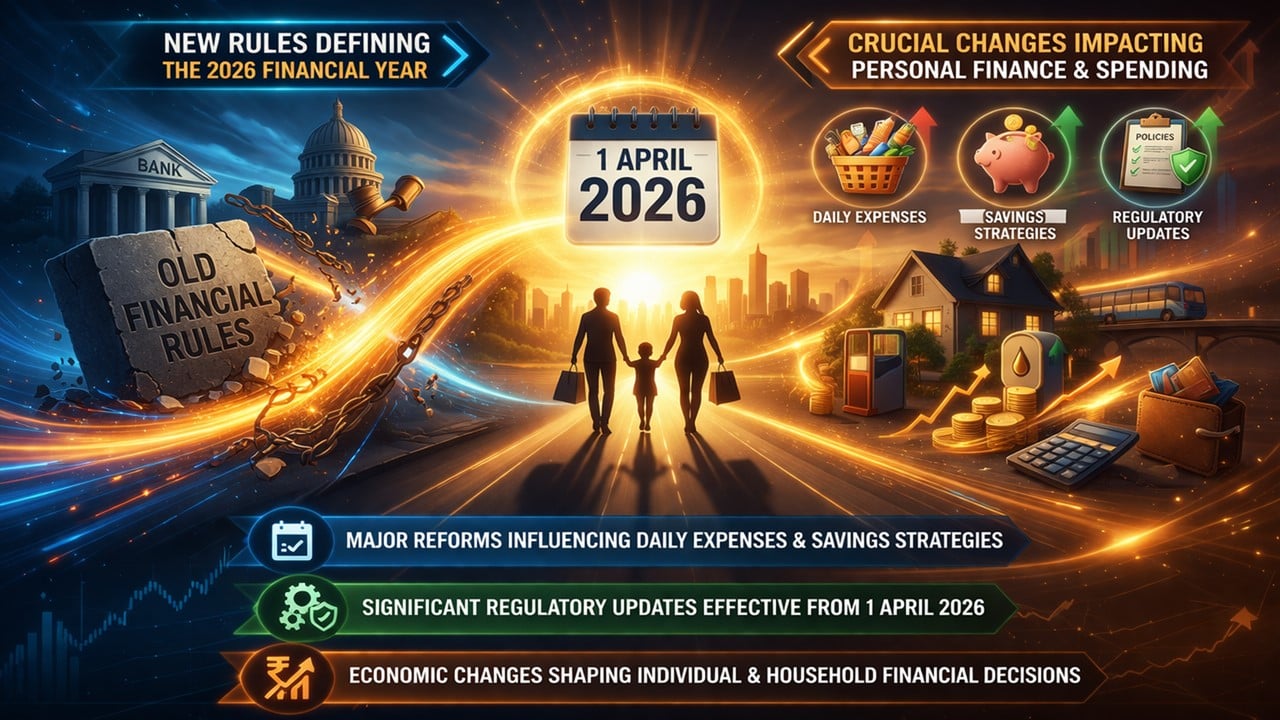
Know the financial and regulatory changes introduced from 1 April 2026 regarding income tax rules, rebate benefits, banking charges, fuel price revisions, and railway tickets and more.
Key Financial Changes Effective from April 2026
 Kashish Bhardwaj
 Mar 28, 2026
Know the Major Financial Reforms Set to Take Effect from April 2026
With the beginning of the new financial year, the government and banks are changing some rules. These changes will have an impact on tax filing, banking, fuel prices, and travel.
1. New Income Tax Law (Income Tax Act 2025)
- The Income Tax Act 2025 will be implemented from April 1, which will replace the old Income Tax Act 1961.
- Tax language will be made simple. Confusing terms like “Assessment Year” and “Previous Year” will be removed.
- Now there will be only one concept - Tax Year. This will make it easier for taxpayers to understand and file.
- In the new tax regime, the government has given relief to the middle class. If your annual income is up to Rs 12 lakh, then you will not have to pay income tax.
- This has become possible due to the Section 87A rebate. In simple terms, salaried individuals and small business owners will see direct benefits from this.
- These changes are meant to make tax-related paperwork more straightforward and less confusing. This will simplify the reporting process of salary and interest income.
- The rules for applying for a PAN card have now become stricter. Aadhaar will no longer be enough to prove your date of birth.
- Applicants will need to provide proper documents like a Class 10 certificate, passport, or birth certificate. This move is intended to make identity verification more reliable and accurate.
- The price of an LPG cylinder can be revised. Domestic LPG rates might be revised on 1st April due to the current US-Israel War.
- Global crude oil prices are impacted by the effect of international geopolitical tensions.
- If prices increase, cab and auto fares may rise, and air ticket prices may increase.
- Daily commuting costs may go up. This could impact overall travel and transportation budgets.

- Banks like HDFC Bank have announced that from April 1, 2026, UPI ATM withdrawals will also count towards the free transaction limit. If you cross 5 free transactions, then Rs 23 will be charged on each transaction.
- Meanwhile, Bandhan Bank will give its customers 3 free transactions in metro cities and 5 free transactions in non-metro cities. Every additional transaction beyond this limit will be charged Rs 23, and if the transaction fails due to insufficient balance, Rs 25 will be charged
- Punjab National Bank has reduced the daily cash withdrawal limit. Earlier withdrawal up to Rs 100,000 was allowed.
- Now, the withdrawal limit has been updated to Rs 50,000 to Rs 75,000. Its impact will be on people who use more cash.
- Railways have changed the rules on ticket cancellations. The railways will now allow zero refund if tickets are cancelled within 8 hours of departure. The earlier limit was 4 hours.
- If you cancel between 8 and 24 hours, you will get 50% money back (the rest will be deducted).
- If you cancel between 24 and 72 hours before, then only 25% of the money will be deducted (which means a 75% refund will be given).
- If you cancel more than 72 hours in advance, cancellation charges will be levied as per the rules of Indian Railways.
About Author


Kashish Bhardwaj
Content Writer
 StudyCafe
 Delhi, Delhi, India
 176
176My Recent Articles
- Supreme Court Judge Strength to Increase from 33 to 37 for Faster Justice
- Builder Cleared of Profiteering Charges After Passing Excess ITC Benefit to Homebuyers: GSTAT
- Jubilant Ingrevia to Challenge Rs 2.03 Crore GST Demand Before GSTAT
- Rs 70 Crore Claim Row: Ex-CFO Gobind Jain Moves Bombay High Court Against IndusInd Bank Over Alleged Wrongful Dismissal
- Dream Sports Launches Dream Street: AI-Powered Entry into India’s Retail Broking Market
Up Next
Loading suggestions…


Recent Posts
All Posts

Tags
Recent Posts
All Posts