Major Changes Introduced to ITR -1 Form; Effective AY 2026-27:
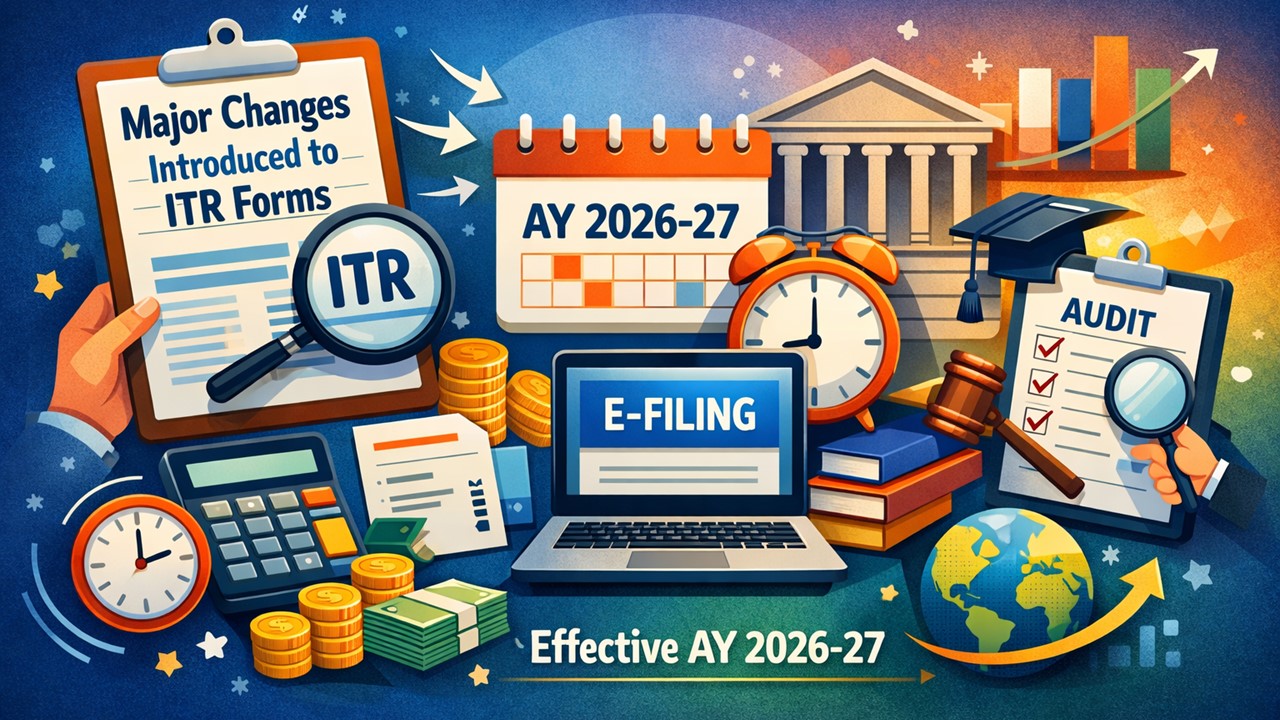
A comprehensive overview of the latest changes in ITR Forms 1-7 for AY 2026–27, covering new disclosures, updated rules, and their impact on taxpayers.
Complete Guide to All New Changes You Must Know
 Saloni Kumari
 Apr 6, 2026
Major Changes Introduced to ITR -1 Form; Effective AY 2026-27
The Central Board of Direct Taxes (CBDT) has notified significant changes to the Income-tax Return (ITR) Forms 1 to 7, along with ITR-V (Income Tax Return - Verification) and ITR-U (Updated Income Tax Return), for the Assessment Year 2026-27 (income earned during the period between April 1, 2025, and March 31, 2026). This tax year, all the ITR forms have been notified promptly, helping taxpayers prepare and file returns without delays. In the previous year, almost all the forms were notified late in the last week of April 2025, which ultimately led to an extension in the ITR filing due dates. Today we will understand all the key changes introduced in all the ITR Forms for the Assessment Year 2026-27. 1. Tax payers with 2 House Property can now file ITR-1. As per new updates in Income Tax Return (ITR) Form 1, Taxpayers with 2 house property can now file ITR one. Earlier it was only for Taxpayers having one house. 2. Reporting Additional Fee under Section 234-I- As per the amended Finance Act 2026, the government has extended the time limit to furnish a revised return to 12 months. Previously, this time limit was 9 months, which used to coincide with that of a belated return. Hence, taxpayers who furnished a belated return were not left with time to file a revised return. To resolve the same issue this extension has been made.
- However, filing a revised return pursuing this extended time limit mandates payment of an additional fee under Section 234-I of the ITA 1961 (Rs 1,000, if your total income does not exceed Rs 5 lakh and Rs 5,000, if total income exceeds Rs 5 lakh). The new ITR forms notified include an extra column to notify of these additional fees (if paid) under Section 234-I for filing a revised return.
- Taxpayers claiming deductions for contributions made to political parties or electoral trusts under Section 80GGC, are now required to provide additional details such as the name and PAN of the political party in their ITR forms.

- Taxpayers claiming deductions for the donations made to specified funds, charitable institutions, or relief organisations under Section 80G are required to provide detailed information regarding the type of donation, the applicable limit, and the allowed deduction percentage under Schedule 80G of their ITR forms.
- Under the said schedule of the new ITR forms, taxpayers are now required to disclose two additional details: Transaction reference number for UPI transfers or the cheque/IMPS/NEFT/RTGS reference number and IFS code of the bank.
- The columns for disclosing income from retirement benefit accounts maintained in both notified and non-notified countries have now been eliminated from the ITR-1 and ITR-4 forms. This change aligns with eligibility rules, as taxpayers with foreign assets are not allowed to use these simplified forms.
- Previously, ITR forms used to seek details such as the assessee's name, capacity, address, and PAN/Aadhaar. Now, the new ITR forms only ask for three key details, including the name, Email ID of the representative assessee, and contact number of the representative assessee. This change reduces unnecessary data collection.
- Earlier, only one address along with two mobile numbers and two email IDs were required to be disclosed under the ITR forms (from 1 to 7) for communication purposes. Now, the newly introduced ITR forms require both primary and secondary addresses, along with corresponding contact details (two mobile numbers and two email IDs).
About Author


Saloni Kumari
Content Writer
Saloni is a Content Writer with 2+ years of experience at studycafe.in. She writes legal, taxation, and finance related content including GST, Income Tax etc. Skilled in translating complex judicial pronouncements and regulatory developments into clear, and reader-friendly articles. Experienced in covering judgements of ITAT, High Court, GSTAT, and news related to Income Tax, GST, and corporate law. She can be reached at [email protected].
Saloni is a Content Writer with 2+ years of experience at studycafe.in. She writes legal, taxation, and finance related content including GST, Income Tax etc. Skilled in translating complex judicial pronouncements and regulatory developments into clear, and reader-friendly articles. Experienced in covering judgements of ITAT, High Court, GSTAT, and news related to Income Tax, GST, and corporate law. She can be reached at [email protected].
 StudyCafe
 Delhi, Delhi, India
 2922
2922My Recent Articles
- GSTN Introduces New E-Invoicing Facility for Self-Invoices Under Reverse Charge Mechanism
- Flexi Cap vs Multi Cap Funds: What's the Real Difference?
- IBA Recommends Public Sector Banks to Reduce Ambit of Physical Branch Audits to 50% of Total Business
- ITAT Directs AO to Reconsider Rs 16.44 Lakh Capital Gains and Rs 25.87 Lakh Stamp Duty Value Addition
- ITAT Remands Rs 3.33 Crore Demonetisation Cash Deposit Case to AO, Directs Rs 10,000 Relief Fund Payment
Up Next
Loading suggestions…


Recent Posts


All Posts
Recent Posts
All Posts