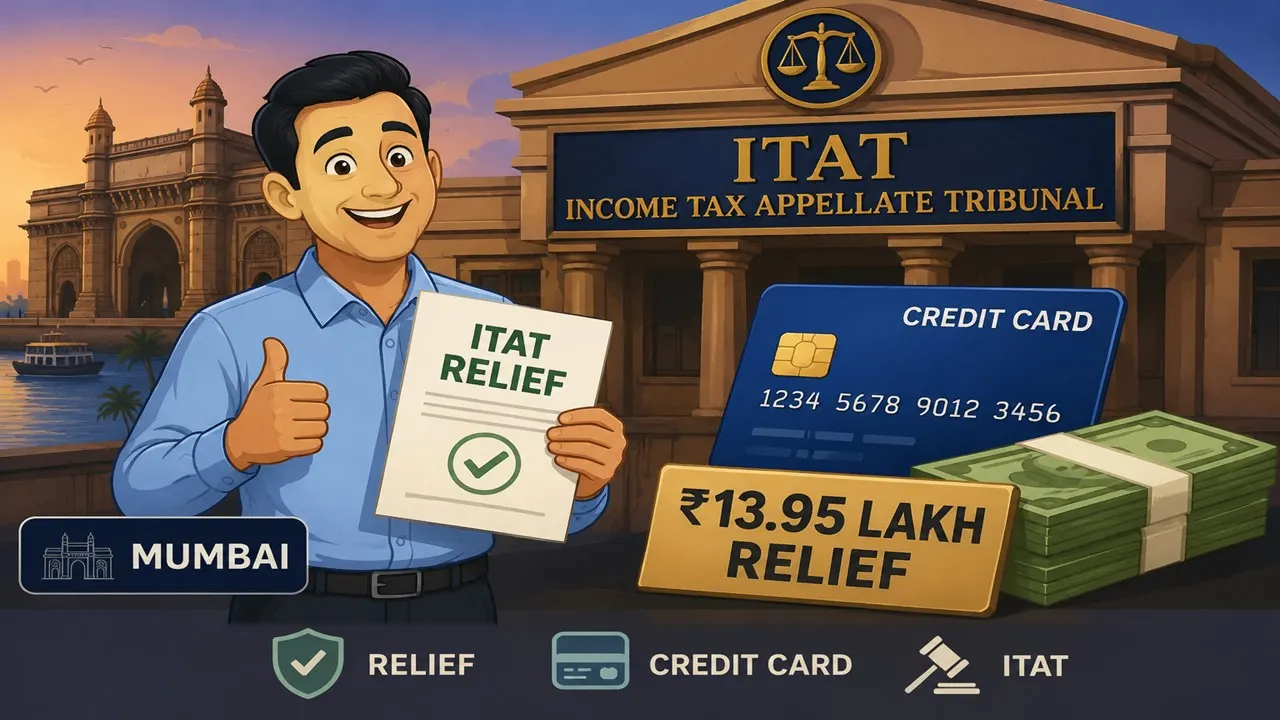
ITAT deleted Rs 9.25 lakh of a tax addition after accepting part of a Mumbai taxpayer's family gift claim for cash credit card payments.
Jasmine | Jun 1, 2026 |
Mumbai Taxpayer Gets ITAT Relief in Rs 13.95 Lakh Credit Card Cash Payment Case
A taxpayer who is from Mumbai had an annual income of Rs 6.30 lakh and was facing a tax addition after Income Tax Department noticed that he had paid credit card bills of Rs 27.65 lakh in a year which included nearly Rs 14 lakh in cash.
The Income Tax Department considered the cash payments as unexplained income and added that amount to his income under Section 69A of the Income Tax Act.The taxpayer and his family members then provided their income tax returns, bank statements, and other documents after which the ITAT gave major relief and removed a significant portion of the tax addition.
This case highlights a common tax issue faced by many taxpayers, which is that large cash transactions that do not match the income reported in tax returns can attract scrutiny from the Income Tax Department.
The dispute started when the Mumbai bench of the ITAT, in the case of Shrenik Manish Mehta vs ITO, the taxpayer filed his income tax return for AY 2023-24 and declared a total income of Rs 6.30 lakh.
During the assessment, the Assessing Officer (AO) found out that the taxpayer had made credit card payments of Rs 27.65 lakh, out of which Rs 13.95 lakh had been made in cash.This case was selected for scrutiny because of the large cash payments made by the taxpayer. The taxpayer was further asked by the AO to explain the source of the cash used for these payments.
The taxpayer explained that the cash used to pay these payments were received from his family members as gifts.He claimed that his father gave him Rs 8 lakh, his mother Rs 4.5 lakh, and his wife Rs 3 lakh, which means the total cash received from family members is Rs 15.5 lakh.
To support this claim, the taxpayer submitted affidavits of his father, mother, and wife.
He stated that his father earned income from an agarbatti business, his mother earned through tuition classes and selling homemade food items, and his wife was engaged in consultancy work.According to him, his family members had the financial capacity to provide the cash.
The Assessing Officer (AO) was not satisfied with the taxpayer’s explanation and said that affidavits alone are not enough evidence to prove the source of the cash and that the taxpayer had failed to provide sufficient evidence showing that his family members had the financial capacity to give such amounts.
As a result, the entire cash payment of Rs 13.95 lakh was treated as unexplained money under Section 69A of the Income Tax Act and was added to the taxpayer’s taxable income.The CIT(A) also agreed with the tax department and confirmed the addition.
The CIT(A) found it difficult to accept the claim of large cash gifts received from family members, and held that the taxpayer did not provide sufficient evidence to prove the sources of income of the family members who had allegedly given the money.
The case was finally heard by the Mumbai bench of the ITAT. The taxpayer submitted additional evidence before the tribunal including affidavits, confirmations, income tax returns, profit and loss accounts and bank statements of his father, mother and wife to support his claim that the cash was given as gift from his family members.A review of the documents showed that the taxpayer’s wife, Meghna Mehta, had filed income tax returns and disclosed professional income under Section 44ADA. Her bank statements also reflected regular income credits. Based on this evidence, the tribunal accepted that the Rs 3 lakh gifted by her was genuine and deleted the corresponding addition.
The tribunal next considered the Rs 4.5 lakh gift claimed to have been received from the taxpayer’s mother, Vidya Mehta. It observed that her bank account reflected regular UPI transactions, indicating that she had some ongoing source of income.The ITAT accepted 50% of the Rs 4.5 lakh gift claimed from the taxpayer’s mother and granted relief of Rs 2.25 lakh. The remaining amount was not accepted and continued to be treated as unexplained.
The tribunal also looked into the Rs 8 lakh gift claimed from the taxpayer’s father. It noted that his bank account showed regular transactions, which means that he was actively engaged in business activities.This supported the taxpayer’s claim that his father had a source of income and the ability to give the gift.
However, the ITAT held that the evidence was not sufficient to fully support the Rs 8 lakh gift claimed from the father. So, the tribunal accepted 50% of the amount, granting relief of Rs 4 lakh, while the remaining Rs 4 lakh continued to be treated as unexplained.
As a final outcome, the ITAT granted relief of Rs 9.25 lakh by accepting a Rs 3 lakh gift from the wife in full, a Rs 2.25 lakh (50% of Rs 4.5 lakh) gift from the mother and an Rs 4 lakh (50% of Rs 8 lakh) gift from the father.
As a result, out of the Rs 13.95 lakh addition made by the tax department, Rs 9.25 lakh was deleted, while the remaining Rs 4.70 lakh was upheld. The taxpayer’s appeal was partly allowed.
This case highlights that large cash deposits or cash payments towards credit card bills can invite income tax scrutiny.
Tax authorities generally look at three things before accepting a gift claim, which are identity of the donor, creditworthiness of the donor and genuineness of the transaction.
Just claiming that money came from family members is often not sufficient. Taxpayers should keep documents such as gift confirmations, bank statements, income tax returns and proof of the donor’s income to support such claims.
The ITAT recognised that genuine family gifts can be a valid source of funds.However, taxpayers must be able to prove not only who gave the money, but also their financial capacity and the genuineness of the transaction. Proper documentation can make a significant difference in tax disputes.
In case of any Doubt regarding Membership you can mail us at [email protected]
Join Studycafe's WhatsApp Group or Telegram Channel for Latest Updates on Government Job, Sarkari Naukri, Private Jobs, Income Tax, GST, Companies Act, Judgements and CA, CS, ICWA, and MUCH MORE!"