Budget 2026 and New Income Tax Act 2025: Why Tax Rules Are Changing Before They Begin:
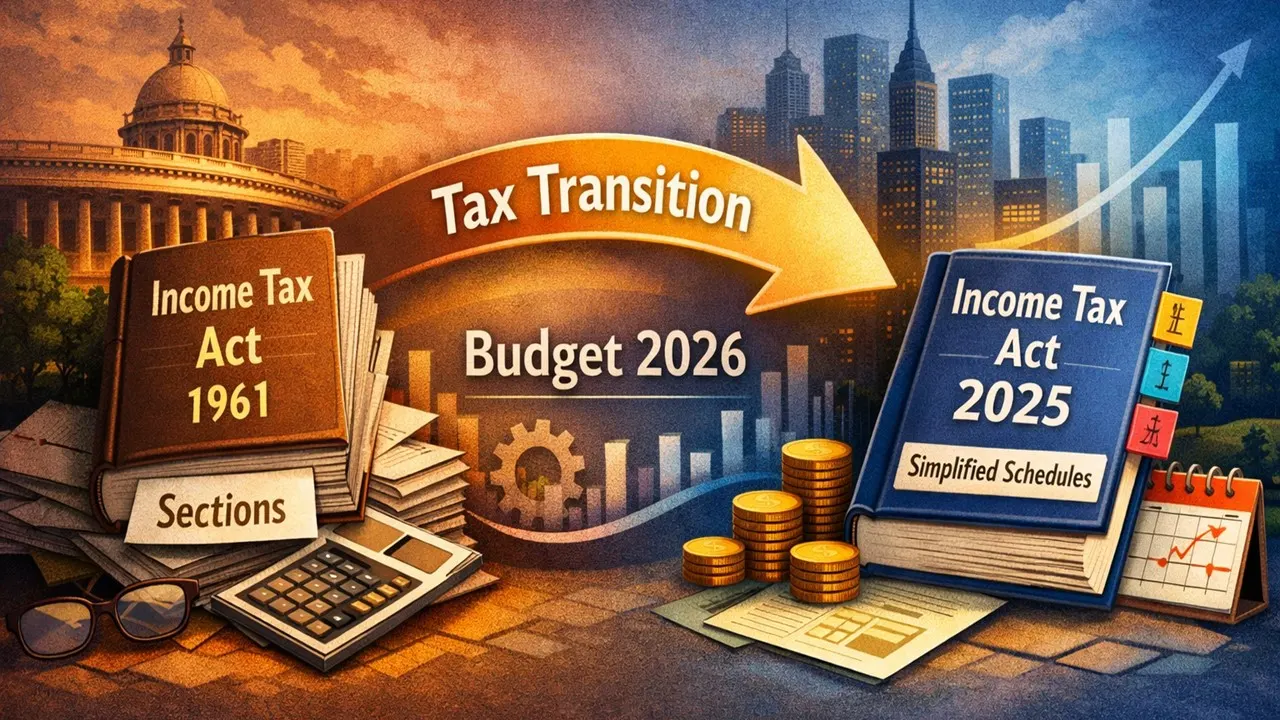
Budget 2026 marks a transition phase where tax changes will be aligned with the new Income Tax Act, 2025, shifting from section-based provisions to a simplified schedule-based structure.
How Budget 2026 Aligns with New Income Tax Act 2025
 Saloni Kumari
 Jan 20, 2026
Budget 2026 and New Income Tax Act 2025: Why Tax Rules Are Changing Before They Begin
As the date for the budget 2026 presentation, i.e., February 01, is approaching, taxpayers are facing an unusual situation. The new Income Tax Act, 2025, is scheduled to take effect on April 01, 2026. The introduction of new income tax rules will replace the existing 1961 law. This creates a temporary issue.
The Finance Bill, 2026, cannot practically make changes to the old law because it is about to disappear. At present, the new income tax rules for 2025 have already been approved by the president in August 2025 and passed by the parliament; however, they have not been made effective yet. So, there is a short gap where the old law is ending and the new law has not fully begun, making tax amendments difficult during this period.
If any changes are implemented in Budget 2026, then ideally, as per legal logic, they should also be made in the Income-tax Act 2025, instead of trying to put changes into a law that no longer exists, i.e., the old 1961 law. The primary reason behind this is that the new 2025 Act has already been passed and is part of the law; only its implementation has been postponed.
Therefore, it becomes essential to ensure that all the key and popular tax provisions of the old 1961 Act have been implemented in the 2025 Act. In simple terms, Budget 2026 may talk in terms of the old 1961 Act, but the actual legal changes will be written into the 2025 Act.
Section numbers to structural codes
For several years, individuals planned their taxes by remembering specific section numbers like Section 80C for savings, 80D for health insurance, Section 10 for HRA and LTA, 24(b) for home loan interest, and 115BAC for the new tax regime. The Income Tax Act 2025 does not change these advantages. Instead, it changes their way of organisation. Rather than spreading benefits across many sections, the new act groups them under income heads, schedules, and summary tables. Now, tax planning will no longer be related to memorising section numbers. Instead, it will be about finding the right table or schedule.
Salary Income
Under the old Income Tax Act 1961, the reliefs related to salary were distributed among sections 10, 16, and 17. Under the Income Tax Act 2025, almost all salary-related deductions and exemptions have been brought together under Section 19 in a single detailed table.
This table covers details like standard deduction, gratuity, commuted pension, leave encashment, retrenchment compensation, voluntary retirement benefits, and the employer’s contribution to retirement funds. In many cases, the calculation rules are built directly into the table. In other words, these limits will be increased with the introduction of Budget 2026; the government will simply need to update this single table, rather than amending multiple sections as previously.
Similar to these, several changes have been introduced in the new income tax rules of 2025, as outlined in Budget 2026, to ease compliance and simplify the law.
About Author


Saloni Kumari
Content Writer
Saloni is a Content Writer with 2+ years of experience at studycafe.in. She writes legal, taxation, and finance related content including GST, Income Tax etc. Skilled in translating complex judicial pronouncements and regulatory developments into clear, and reader-friendly articles. Experienced in covering judgements of ITAT, High Court, GSTAT, and news related to Income Tax, GST, and corporate law. She can be reached at [email protected].
Saloni is a Content Writer with 2+ years of experience at studycafe.in. She writes legal, taxation, and finance related content including GST, Income Tax etc. Skilled in translating complex judicial pronouncements and regulatory developments into clear, and reader-friendly articles. Experienced in covering judgements of ITAT, High Court, GSTAT, and news related to Income Tax, GST, and corporate law. She can be reached at [email protected].
 StudyCafe
 Delhi, Delhi, India
 2948
2948My Recent Articles
- Maharashtra Govt Eases Registration of Jointly Owned Land Sales, ‘KA’ Copy Can Replace Co-Owners’ NOC
- No Separate Section 69C Unexplained Expenditure Addition Allowed After Accepting Section 44AD Income Without Supporting Evidence: ITAT
- RBI Imposes Restrictions on Puducherry Co-operative Urban Bank for Six Months, Caps Cash Withdrawals at Rs 5,000
- ICAI Opens Application Window for Empanelment of Members to Act as Observer at CA January 2027 Exams
- ICAI CA Inter Sept 2026 Result OUT at caresults.icai.org, Check Steps to Download
Up Next
Loading suggestions…


Recent Posts


All Posts



Recent Posts
All Posts