Gujarat HC Refuses to Interfere with GST Registration Cancellation Filed Beyond Statutory Appeal Period:
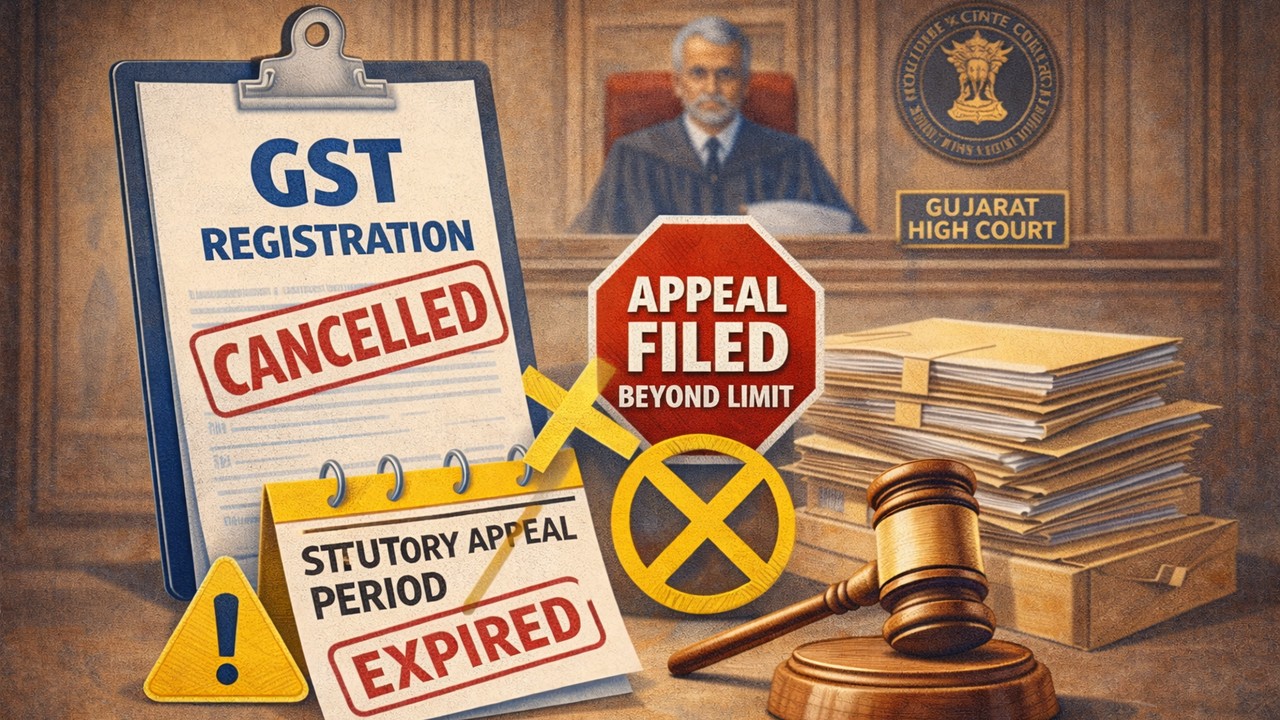
High Court holds delay beyond 120 days under Section 107 CGST Act is uncondonable; writ jurisdiction cannot dilute legislative limitation
Gujarat High Court: GST Appeal Filed Beyond 120 Days Cannot Be Revived Through Writ Jurisdiction
 Meetu Kumari
 Feb 9, 2026
Gujarat HC Refuses to Interfere with GST Registration Cancellation Filed Beyond Statutory Appeal Period
The petitioner, M/s. Ravi Plumbing and Construction, was issued a show cause notice in Form GST REG-17 on 13.08.2024 for failure to file returns under Section 39 of the CGST Act after the first quarter of FY 2024-25. As no reply was filed and the petitioner did not appear for personal hearing, the GST registration was cancelled ex-parte under Section 29(2)(c) by order dated 13.02.2025.
The petitioner contended that it was unaware of the notice and subsequently faced technical issues while attempting restoration of registration. An appeal under Section 107 of the CGST Act was eventually filed on 12.11.2025, nearly six months after the cancellation order. The Appellate Authority rejected the appeal on 20.11.2025 solely on the ground of limitation. Aggrieved, the petitioner approached the High Court under Article 226 challenging both the cancellation order and the appellate rejection.
Issue Before Court: Whether the High Court can exercise writ jurisdiction under Article 226 of the Constitution to condone delay and set aside rejection of a GST appeal filed beyond the maximum statutory period of 120 days prescribed under Section 107 of the CGST Act, 2017.
HC Held: The Gujarat High Court dismissed the writ petition, holding that once the maximum statutory period of 120 days for filing an appeal under Section 107 of the CGST Act stands exhausted, neither the Appellate Authority nor the High Court has the power to condone further delay. Relying heavily on the Supreme Court’s decision in Assistant Commissioner (CT) LTU, Kakinada v. Glaxo Smith Kline Consumer Health Care Ltd., the Court reiterated that writ jurisdiction cannot be exercised in a manner that defeats legislative intent or renders statutory limitation provisions redundant.
The Court found the reasons cited by the petitioner, including alleged portal and login issues, to be unsatisfactory and termed them a weak excuse. The Court held that any relaxation would have serious cascading effects on revenue administration. Therefore, the appellate order rejecting the appeal as time-barred was upheld, and no relief was granted.
To Read Full Judgment, Download PDF Given Below
About Author


Meetu Kumari
Content Manager
Meetu Kumari is an Experienced Advocate and Content Writer with 4+ years of demonstrated history of working in the law practice industry. Skilled in Developing Content, Researching, and Drafting. Strong professional with a Bachelor of Science (B.Sc.) focused on Law from Gujarat National Law University.
Meetu Kumari is an Experienced Advocate and Content Writer with 4+ years of demonstrated history of working in the law practice industry. Skilled in Developing Content, Researching, and Drafting. Strong professional with a Bachelor of Science (B.Sc.) focused on Law from Gujarat National Law University.
 Studycafe
 Jodhpur, Rajasthan, India
 2264
2264My Recent Articles
- ITAT Condones 302-Day Delay, Restores Salary Assessment for Fresh VerificationPremium
- ITAT Condones Delay After Tax Consultant's Death, Restores Appeals for Fresh HearingPremium
- ITAT Remands Salary Addition, Says Taxability Depends on Salary Becoming Due, Not Mere ReceiptPremium
- ITAT Deletes TP Royalty Adjustment, Orders Fresh Review of Commission BenchmarkingPremium
- ITAT Quashes Reassessment Over Unsigned Section 148 Notice Issued to AssesseePremium
Up Next
Loading suggestions…


Recent Posts
All Posts

Recent Posts
All Posts