New Income Tax Rules 2025: Five Key Amendments in Income Tax Act 1961; Effective April 01, 2026:
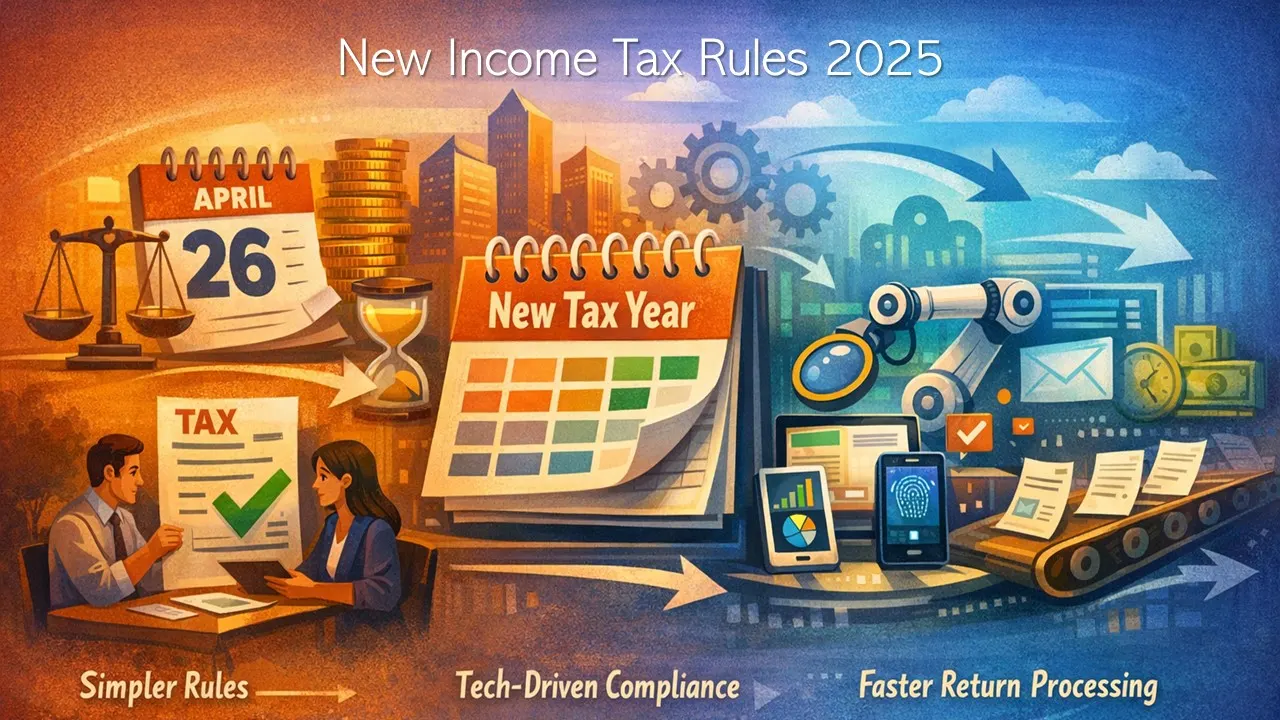
The New Income Tax Act 2025 introduces simpler rules, a new “tax year” concept, tech-driven compliance, and faster return processing to reduce the burden on taxpayers from April 2026.
New Changes in IT Rules to Replace 60-Years Old Income Tax Act 1961
 Saloni Kumari
 Jan 13, 2026
New Income Tax Rules 2025: Five Key Amendments in Income Tax Act 1961; Effective April 01, 2026
With the start of the new financial year 2026-27 from April 01, 2026, the new Income Tax Act 2025 will also come into effect in India. These proposed changes in income tax rules are aimed at simplifying old tax rules, improving clarity, and making compliance easier for taxpayers. These new rules have been formulated with the objective of replacing the earlier Income Tax Act of 1961, which has been in place for over 60 years since its establishment.
Some of the key changes proposed in the Income Tax Rules include the introduction of the new term 'tax year', replacing the earlier terms 'assessment year' and 'financial year ', detailed disclosure options in ITR forms, and simplification of ITR filing through standardisation and technology. Experts believe that these rules will decrease the compliance burden and will make the law's language simpler to understand.
Here is the list of five key income tax changes scheduled to take effect from the Financial Year 2026-27.
1. Introduction of the ‘tax year’ concept
This is one of the key changes proposed in the Income Tax Act 1961. The new concept of 'Tax Year' has been introduced, with an aim to replace earlier confusion between 'Financial Year' and 'Assessment Year.'
In this new concept tax year, income earned within the year in which it is reported and assessed will be amalgamated. Resulted in earlier compliance for taxpayers.
2. Detailed Disclosure Options in ITR Forms
This is another major change taxpayers will experience in the new Income Tax Act 2025. Taxpayers will not be provided with detailed disclosure options in their Income Tax Return (ITR) forms. These options include HRA, home loan interest, and claims under Sections 80C, 80D, and others, along with reconciliation of AIS and Form 26AS data.
3. Taxpayers Encouraged to Shift Towards New Tax Regime
Several experts say that the new Income Tax Act 2025 clearly shows the government’s intention to encourage taxpayers to choose the new tax regime while slowly reducing the importance of the old tax regime.
Further believes that bringing different tax provisions and deductions together in a clearer and more organised manner makes the new law easier to read, understand, and refer to.
4. Tech-enabled Compliances
Simplified tech-enabled compliances are expected in the New Tax Act 2025, including faceless assessments. The key objective of the new act is to make tax laws simpler by using standard rules and technology.
Experts believe that by using pre-filled tax data and limiting investigation to only rare cases, the government is showing that it trusts salaried and genuine taxpayers and wants a more trust-based tax system.
5. Smoother Return Filing and Faster Processing
Tax experts say that since most of the information is already available through AIS and pre-filled returns, the return filing process will become smoother and simpler for compliant taxpayers with the introduction of the new Income Tax Rules 2025.
The requirement of detailed disclosure options in ITR forms, if stretched for a long period, will increase the compliance burden but is likely to reduce discrepancies, notices, and repeated correspondence with the tax department. Experts believe that steps like quicker handling of tax returns, grievances, and refunds, along with fewer legal disputes, will be helpful for taxpayers.

About Author


Saloni Kumari
Content Writer
Saloni is a Content Writer with 2+ years of experience at studycafe.in. She writes legal, taxation, and finance related content including GST, Income Tax etc. Skilled in translating complex judicial pronouncements and regulatory developments into clear, and reader-friendly articles. Experienced in covering judgements of ITAT, High Court, GSTAT, and news related to Income Tax, GST, and corporate law. She can be reached at [email protected].
Saloni is a Content Writer with 2+ years of experience at studycafe.in. She writes legal, taxation, and finance related content including GST, Income Tax etc. Skilled in translating complex judicial pronouncements and regulatory developments into clear, and reader-friendly articles. Experienced in covering judgements of ITAT, High Court, GSTAT, and news related to Income Tax, GST, and corporate law. She can be reached at [email protected].
 StudyCafe
 Delhi, Delhi, India
 2948
2948My Recent Articles
- Maharashtra Govt Eases Registration of Jointly Owned Land Sales, ‘KA’ Copy Can Replace Co-Owners’ NOC
- No Separate Section 69C Unexplained Expenditure Addition Allowed After Accepting Section 44AD Income Without Supporting Evidence: ITAT
- RBI Imposes Restrictions on Puducherry Co-operative Urban Bank for Six Months, Caps Cash Withdrawals at Rs 5,000
- ICAI Opens Application Window for Empanelment of Members to Act as Observer at CA January 2027 Exams
- ICAI CA Inter Sept 2026 Result OUT at caresults.icai.org, Check Steps to Download
Up Next
Loading suggestions…


Recent Posts


All Posts



Tags
Recent Posts
All Posts