New Labour Code 2025: Ten New Labour Law Changes Every Worker in India Must Know:
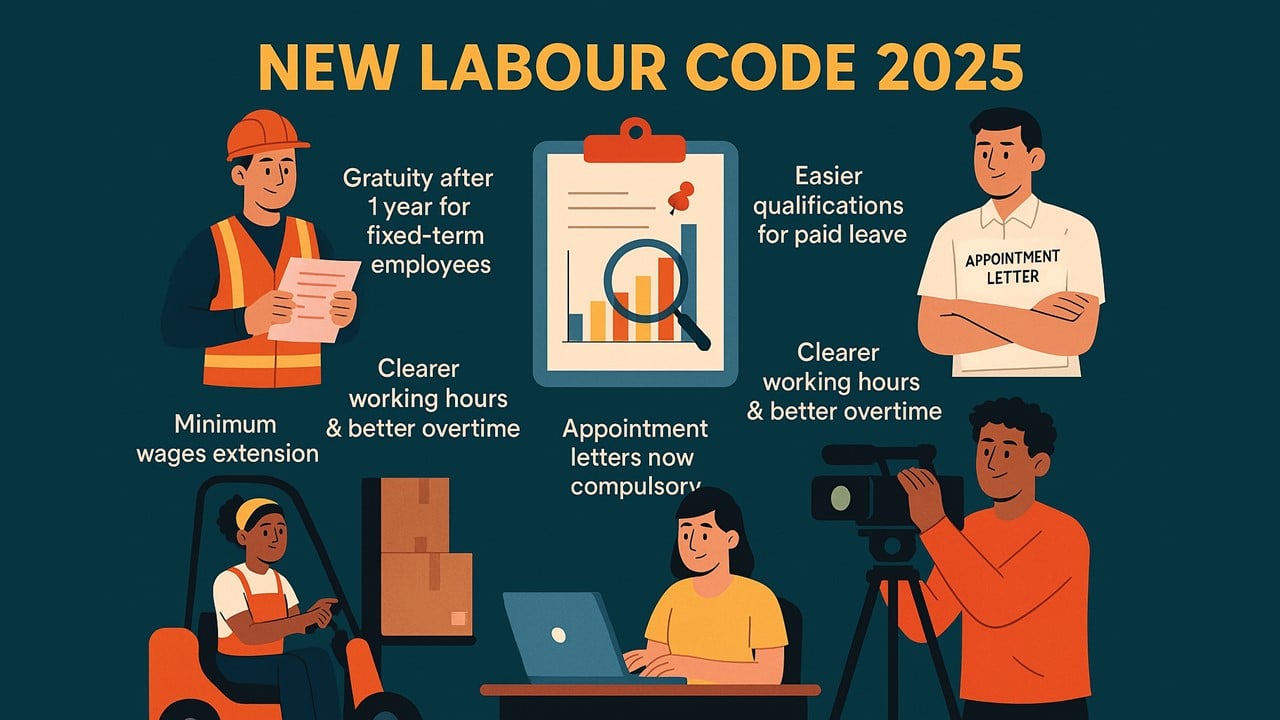
The government of India has made effective new labour codes in the nation, replacing an earlier bunch of older rules with one clearer set of rules.
Major Labour Reforms That Affect Your Daily Worklife
 Saloni Kumari
 Nov 24, 2025
New Labour Code 2025: Ten New Labour Law Changes Every Worker in India Must Know
The government of India has made effective new labour codes in the nation, replacing an earlier bunch of older rules with one clearer set of rules. These amendments are influencing everyday basics like wages, leave, working hours and workplace security.
The new framework of labour laws applies to almost everyone, including individuals working full-time, on a contract, or in sector-specific roles like media, plantations or factories.
Workers should be aware of these key changes made effective recently that have not received enough attention.
1. Gratuity After a Year for Fixed-Term Employees
The government has set a uniform definition of wages that now applies to all labour laws, amending the process of calculating benefits. One of the major changes is gratuity.
Fixed-term employees, workers hired on time-bound contracts commonly seen in IT, manufacturing, media, logistics and services, etc, were earlier required to complete five years of service in order to be qualified. Now, the good news is that this period has been reduced from five to just one year.
2. Easier Qualifications for Paid Leaves
Now, as per the new labour laws, employees should work for atleast 180 days in a year, to be said to qualify for annual paid leave. Earlier, this limit was 240 days in a year. This shorter requirement helps individuals who work in seasonal jobs or jobs with changing shifts, because previously they could not qualify due to the longer time needed.
3. Clearer Working Hours and Better Overtime Pay
The government has not introduced any changes to the earlier working hours. The hours remain unchanged, i.e., the eight-hour workday and forty-eight-hour workweek, but now governments have more flexibility to structure the weekly schedule, whether four long days, five medium days or six standard days.
Overtime work should be done only if the worker agrees, and it must be paid at double the regular wage. States are now allowed to set even higher overtime limits than earlier.
4. Appointment Letters Now Compulsory
The government has not made it compulsory to give an appointment letter on the appointment of any employee, spelling out wages, duties, working hours, and entitlements.
5. Minimum Wages Extension
The central government will set a national floor wage applying to all sectors, and no state will have the authority to fix wages below it. This makes wage protection universal.
6. Will Take-Home Pay Reduce?
In many situations, your take-home salary might become a little lower unless the employer increases your total CTC. This is because a bigger part of your salary will now be counted as ‘basic wages,’ which means higher PF or gratuity deductions.
7. Strict Order to Release Salaries Timely
Previously, the rule of timely wages only applied to individuals working below a certain limit. Delay in salary release can lead to penalties for the employer.
8. Commute-Related Accidents Count as Workplace Incidents
If any worker suffers an accident on the way between his/her home and workplace, then it will be treated as an employment-related accident under certain conditions.
9. ESIC Coverage Expands Across Country
ESIC will now apply to the overall country, not just in selected areas. This means workers in factories, shops, plantations, and even small hazardous units with just one worker can get ESI benefits. Because of this change, more workers will get medical insurance, disability support, and maternity benefits.
10. Formal Protection for Media, Digital and Audio-Visual Workers
People employed in the roles of journalists, OTT staff, digital creators, dubbing artists and crew members must now get a proper appointment letter, clearly mentioning their salary, work hours and benefits. This fixes a long-time problem where creative and digital workers had no clear rules or written job terms.

About Author


Saloni Kumari
Content Writer
Saloni is a Content Writer with 2+ years of experience at studycafe.in. She writes legal, taxation, and finance related content including GST, Income Tax etc. Skilled in translating complex judicial pronouncements and regulatory developments into clear, and reader-friendly articles. Experienced in covering judgements of ITAT, High Court, GSTAT, and news related to Income Tax, GST, and corporate law. She can be reached at [email protected].
Saloni is a Content Writer with 2+ years of experience at studycafe.in. She writes legal, taxation, and finance related content including GST, Income Tax etc. Skilled in translating complex judicial pronouncements and regulatory developments into clear, and reader-friendly articles. Experienced in covering judgements of ITAT, High Court, GSTAT, and news related to Income Tax, GST, and corporate law. She can be reached at [email protected].
 StudyCafe
 Delhi, Delhi, India
 2922
2922My Recent Articles
- MCA and ICSI to Hold User Awareness Session on Form AOC-4 Filing Amid Glitches on MCA-21 Version-3 Portal
- GSTN Introduces New E-Invoicing Facility for Self-Invoices Under Reverse Charge Mechanism
- Flexi Cap vs Multi Cap Funds: What's the Real Difference?
- IBA Recommends Public Sector Banks to Reduce Ambit of Physical Branch Audits to 50% of Total Business
- ITAT Directs AO to Reconsider Rs 16.44 Lakh Capital Gains and Rs 25.87 Lakh Stamp Duty Value Addition
Up Next
Loading suggestions…


Recent Posts


All Posts


Tags
Recent Posts
All Posts