Income Tax Breaking: CBDT Releases Draft Income Tax Rules and Forms 2026:
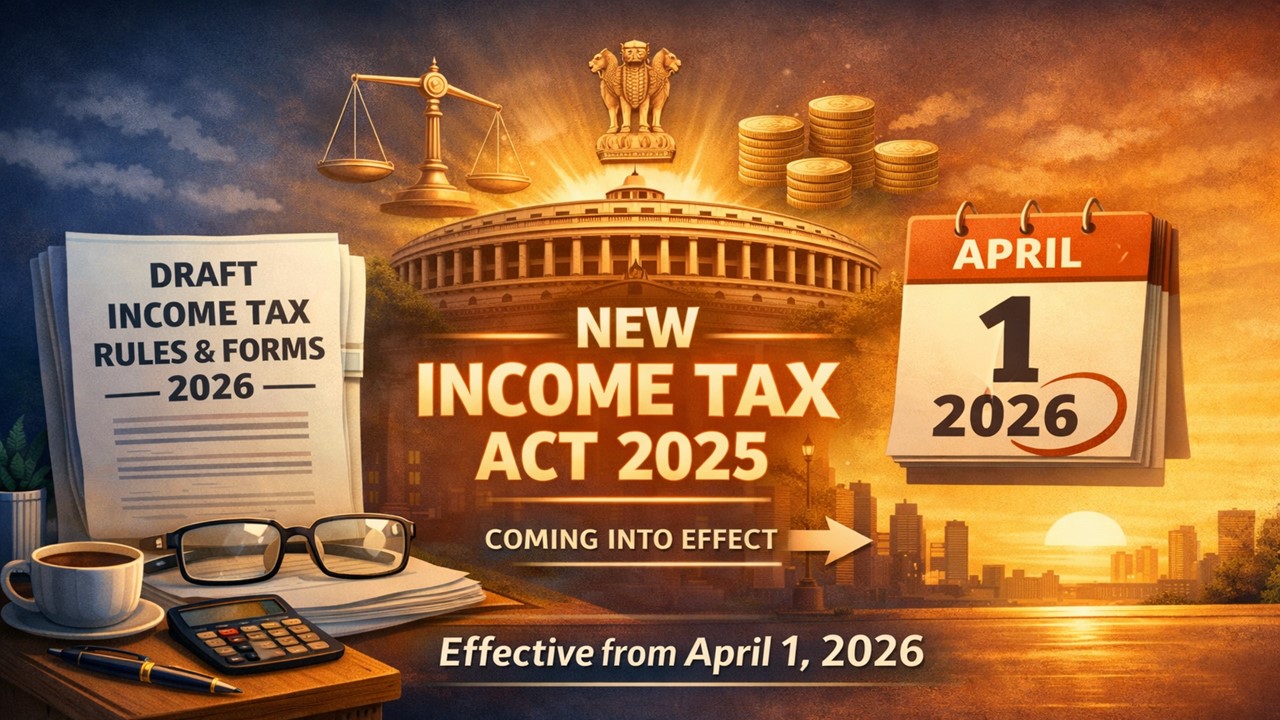
The CBDT has prepared the Draft Income Tax Rules and Forms, 2026, scheduled to take effect along with the New Income Tax Act 2025 from April 01, 2026.
Stakeholders and General Public Allowed to Submit Suggestions upto Feb 22
 Saloni Kumari
 Feb 7, 2026
Income Tax Breaking: CBDT Releases Draft Income Tax Rules and Forms 2026
The Central Board of Direct Taxes (CBDT), Department of Revenue, has prepared the Draft Income Tax Rules and Forms, 2026, which are scheduled to take effect along with the New Income Tax Act 2025 from April 01, 2026. These new rules will replace the earlier 60-year-old Income Tax Act 1961. The government will soon notify these rules officially. Prior to final notification, these draft rules and forms have been placed in the public domain to invite feedback from stakeholders and the general public. Individuals are allowed to give their suggestions on these rules and drafts within 15 days, up to February 22, 2026. All feedback will be deeply analysed, and accordingly, changes will be implemented in the draft version.
These draft rules have been following the same approach as the new Income Tax Act 2025; for example, easy language has been used to make it simpler to understand, and wherever possible, authorities have tried inserting tables and formulas to ensure more clarity. They have also tried removing unnecessary and outdated provisions from the earlier Income Tax Act 1961, keeping the key policy framework unchanged.
These draft rules and forms have been redesigned to make the compliance process easier for taxpayers. With a motive to reduce the compliance burden on taxpayers and repeated disclosures, the concerned authorities have tried standardising common information across the forms. Smart procedure has been used in designing these forms with features like automated reconciliation and pre-filled details to reduce errors and improve user experience.
Overall, the overhaul of income tax rules and forms is likely to simplify procedures, facilitate doing business, and make it easier to understand and comply with. After rationalisation, the total number of rules has been reduced from 511 to 333, and forms from 399 to 190, to reduce complexity.
About Author


Saloni Kumari
Content Writer
Saloni is a Content Writer with 2+ years of experience at studycafe.in. She writes legal, taxation, and finance related content including GST, Income Tax etc. Skilled in translating complex judicial pronouncements and regulatory developments into clear, and reader-friendly articles. Experienced in covering judgements of ITAT, High Court, GSTAT, and news related to Income Tax, GST, and corporate law. She can be reached at [email protected].
Saloni is a Content Writer with 2+ years of experience at studycafe.in. She writes legal, taxation, and finance related content including GST, Income Tax etc. Skilled in translating complex judicial pronouncements and regulatory developments into clear, and reader-friendly articles. Experienced in covering judgements of ITAT, High Court, GSTAT, and news related to Income Tax, GST, and corporate law. She can be reached at [email protected].
 StudyCafe
 Delhi, Delhi, India
 2924
2924My Recent Articles
- Major Relief in Arbitration Case: MCIA Denies Rs 908 Crore Statement Claim Made by Allied Silica Against Tata Chemicals
- MCA and ICSI to Hold User Awareness Session on Form AOC-4 Filing Amid Glitches on MCA-21 Version-3 Portal
- GSTN Introduces New E-Invoicing Facility for Self-Invoices Under Reverse Charge Mechanism
- Flexi Cap vs Multi Cap Funds: What's the Real Difference?
- IBA Recommends Public Sector Banks to Reduce Ambit of Physical Branch Audits to 50% of Total Business
Up Next
Loading suggestions…


Recent Posts

All Posts



Tags
Recent Posts
All Posts