Reassessment Order Invalidates When Section 148 Notice Is Issued Beyond Survival Period: ITAT:
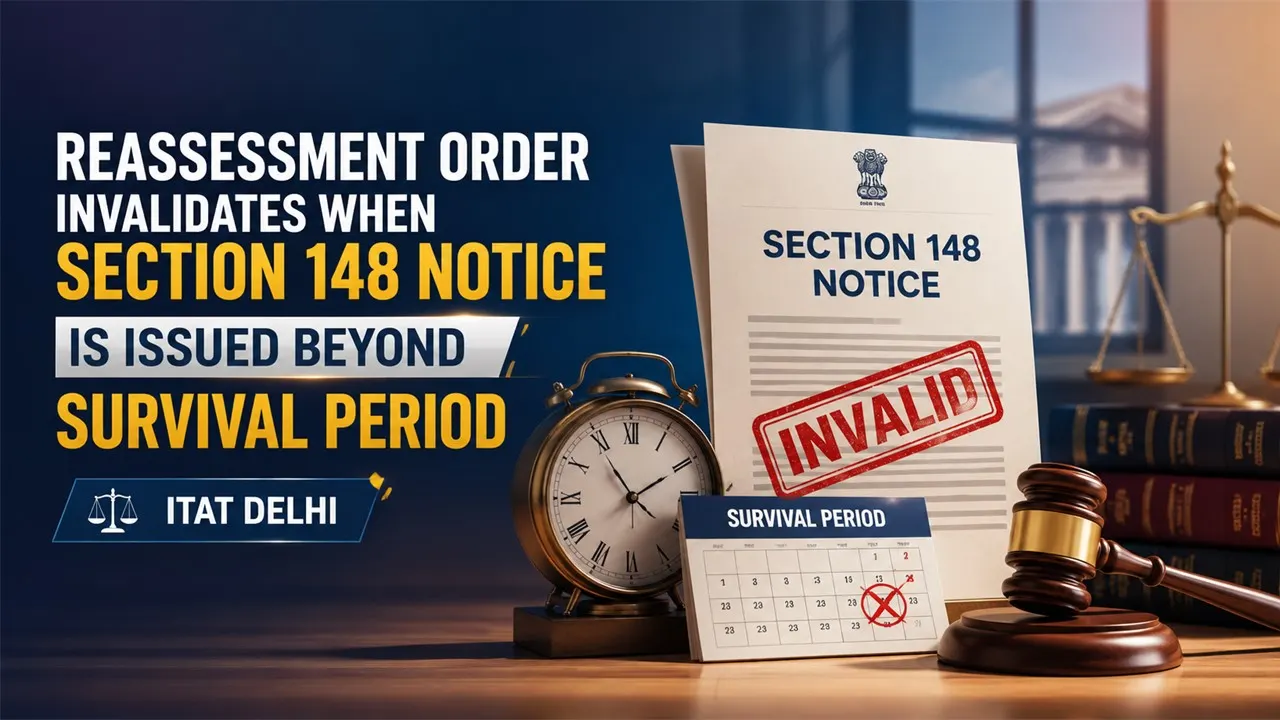
The ITAT Delhi quashed reassessment order, noting that the impugned notice issued under Section 148 was indeed beyond the limitation period and hence invalid in law.
ITAT Quashes Reassessment Proceedings on Limitation Grounds
 Saloni Kumari
 May 25, 2026
Reassessment Order Invalidates When Section 148 Notice Is Issued Beyond Survival Period: ITAT
The ITAT Delhi has quashed the entire reassessment proceedings initiated based on the Section 148 notice against Vedanta Limited, noting the impugned notice was barred by limitation.
The assessee, Vedanta Limited, had claimed that the Section 148 notice dated July 29, 2022, was barred by limitation because it was issued beyond the survival period of one day + 7 days as prescribed under Section 148A(d) of the Act. In the present case, the survival period had already expired on July 25, 2022, and the notice was issued on July 29, 2022. Consequently, the tax proceedings initiated based on the Section 148 notice were invalid as per the law and liable to be set aside.
The assessee had claimed that "the notice dated 29.07.2022 issued u/s.148 of the Act is barred by limitation for the reason that the same is issued Page | 2 beyond the survival period as per the decision of the Hon’ble Delhi High Court in the case of Ram Balram Build Home Pvt. Ltd. Vs. ITO (447 ITR 133) and the decision of the Hon’ble Supreme Court in the case of Union of India Vs. Ashish Aggarwal (444 ITR 1)."
In support of the aforementioned claim, the assessee also cited earlier judgements of the Honourable Delhi High Court in the case titled Ram Balram Build Home Private Limited Vs ITO and the decision of the Honourable Supreme Court in the case titled Union of India Vs. Ashish Aggarwal.
When the case was taken before the ITAT Delhi, the tribunal examined the events and noted that the Tax Department could not effectively dispute the facts and calculations presented by the assessee. Relying on the above judicial precedents, the ITAT concluded that the impugned notice issued under Section 148 was indeed beyond the limitation period and hence invalid in law.
Consequently, the reassessment order passed based on the same notice was declared void ab initio, meaning it was treated as invalid from the beginning. The Tribunal allowed Vedanta’s legal ground challenging the reassessment. Since the reassessment proceedings were quashed on the legal issue of limitation, the Tribunal did not examine the merits of the tax additions or other grounds raised in the appeal. Those issues were left open. The appeal was thus partly allowed.
About Author


Saloni Kumari
Content Writer
Saloni is a Content Writer with 2+ years of experience at studycafe.in. She writes legal, taxation, and finance related content including GST, Income Tax etc. Skilled in translating complex judicial pronouncements and regulatory developments into clear, and reader-friendly articles. Experienced in covering judgements of ITAT, High Court, GSTAT, and news related to Income Tax, GST, and corporate law. She can be reached at [email protected].
Saloni is a Content Writer with 2+ years of experience at studycafe.in. She writes legal, taxation, and finance related content including GST, Income Tax etc. Skilled in translating complex judicial pronouncements and regulatory developments into clear, and reader-friendly articles. Experienced in covering judgements of ITAT, High Court, GSTAT, and news related to Income Tax, GST, and corporate law. She can be reached at [email protected].
 StudyCafe
 Delhi, Delhi, India
 2931
2931My Recent Articles
- Rs 843.97 Crore Bogus Political Party Donation Racket Unearthed in Gujarat, Income Tax Dept Files Complaint With CID (Crime)
- Retired Central GST Commissioner Kidnapped by Unknown Persons, Assailants Nabbed Within Hours
- Madhya Pradesh HC Quashes Section 74 GST Show Cause Notice Passed Against G R Infraprojects
- GSTAT Introduces SOP for Branch Officer-to-Branch Officer (BO-to-BO) Case Transfer Ensuring Seamless Reassignment of Cases
- GSTAT: E-Way Bills Cannot Be Invalidated Merely Because They Were Not Generated by Original Supplier
Up Next
Loading suggestions…


Recent Posts


All Posts
Recent Posts
All Posts