Received arrears of salary, gratuity, pension; understand tax calculation, and ITR Filing compliance:
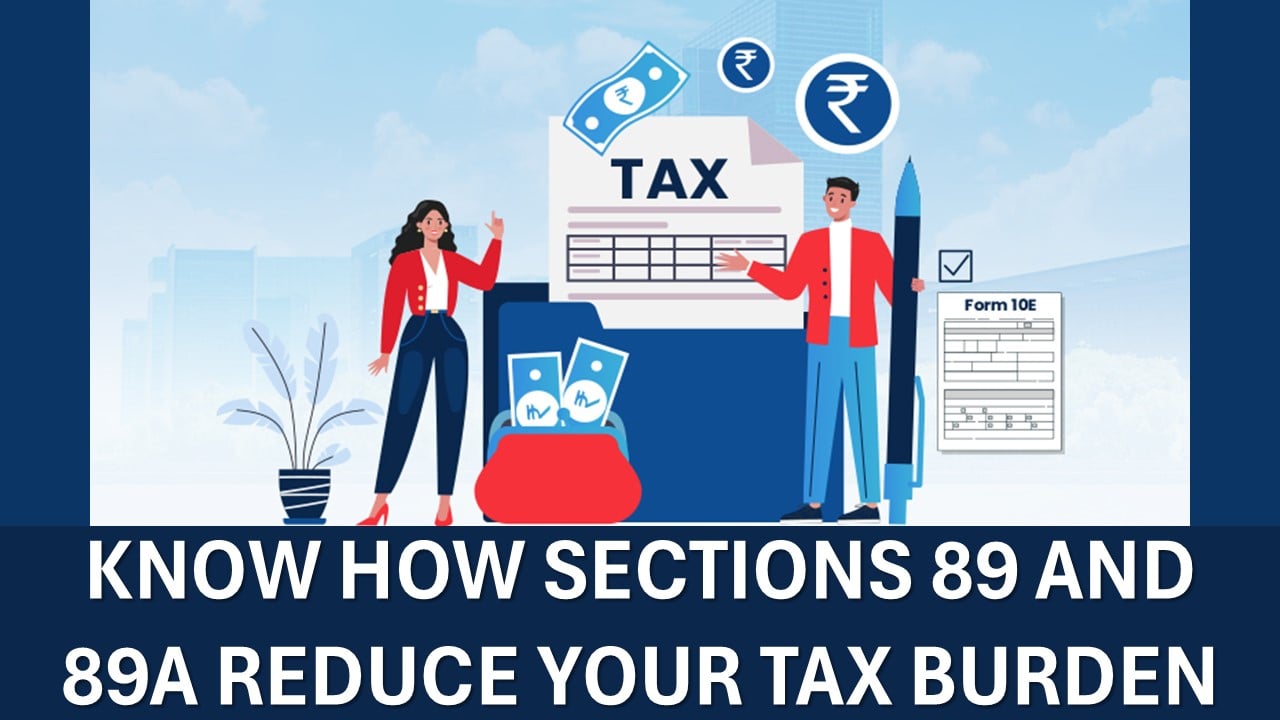
Learn how Sections 89 and 89A of the Income Tax Act help reduce tax on lump-sum income like arrears, gratuity, pension, or foreign retirement benefits.
Claiming Tax Relief on Arrears, Gratuity and Foreign Retirement Income Made Simple
 Saloni Kumari
 Jun 13, 2025
Table of Contents

Received arrears of salary, gratuity, pension; understand tax calculation, and ITR Filing compliance
When an individual receives a large sum of money from sources such as arrears of salary, gratuity, or advance salary, it can increase their tax liability for that year. To reduce this burden, the Income Tax Act provides relief under Section 89 and Section 89A.
What is Section 89 Relief?
Section 89 helps an employee pay less tax when they receive money in the form of:- Salary in arrears (for earlier years)
- Advance salary
- Arrears of family pension
- Early withdrawal from the Provident Fund
- Gratuity
- Commuted pension (lump-sum pension)
- Compensation for job termination
How to Claim Section 89 Relief?
You need to:- Claim relief in the Income Tax Return (ITR) for the year you received the money.
- File Form 10E on the Income Tax Portal before filing the ITR.
When Can You Claim Section 89 Relief?
You can claim this relief if, during the financial year, you received:- Advance salary
- Arrears of salary
- Arrears of family pension
- Withdrawn money from PF before completing 5 years
Steps to Calculate Relief for Advance Salary or Arrears
- Step 1: Calculate tax on total income, including arrears/advance/etc.
- Step 2: Calculate tax on total income, excluding those receipts.
- Step 3: Calculate tax on income of the earlier year to which the arrears relate, excluding those receipts.
- Step 4: Calculate tax on income of the earlier year, including those receipts.
- Step 5: Find the difference between (Step 1 – Step 2) and (Step 4 – Step 3). If the result is positive, you get that amount as relief. If negative, no relief is allowed.
Relief on Gratuity (Section 89)
- Gratuity is usually received when you leave the job or retire. Relief is allowed only if you’ve worked for 5 years or more.
- If gratuity is fully tax-exempt, no relief is allowed.
- Relief is available only on the taxable part of gratuity.
- Step 1: Find the average tax rate for the current year, including gratuity.
- Step 2: Apply this rate to the gratuity to get the tax amount.
- Step 3: Add 1/3rd of gratuity to each of the last 3 years' income and calculate the tax rate for each year.
- Step 4: Find the average of the 3 years' tax rates.
- Step 5: Apply this new average rate to gratuity.
- Step 6: Subtract Step 5 from Step 2. If the result is positive, you get that much as relief. If negative, no relief
- In Step 3, add 1/2 of the gratuity to the income of the last 2 years.
- In Step 4, find the average of the 2 years' tax rates instead of 3.
Relief When You Get Compensation After Losing a Job
If you lose your job after working for 3 years or more, and your job contract had at least 3 more years left, you can get tax relief on the compensation (money) you receive. This relief is calculated the same way as gratuity (a lump sum given at the end of service) for people who have worked for 15 years or more. However, the following points should be noted: If you are taking this tax relief under Section 89 for voluntary retirement, you cannot also claim the separate exemption of Rs. 5,00,000 for voluntary retirement. You have to choose either the relief under Section 89 or the Rs. 5 lakh exemption, not both.
Relief When You Get a Pension
If you take a lump sum from your pension (called commutation of pension), the tax relief is also calculated the same way as gratuity for someone who has served for 15+ years.Relief on Foreign Retirement Accounts (Section 89A)
Section 89A is for Indian residents who earlier lived abroad and have retirement savings in foreign countries. Here’s how it works in simple terms:- You earn income in a foreign retirement account, but you are now living in India.
- In some countries, retirement income is taxed only when withdrawn, not when it’s earned.
- India usually taxes income when it is earned (accrued), but Section 89A lets you delay paying Indian tax until the year you withdraw that money.
Who Can Use Section 89A?
To claim this relief, you must:- Be a resident of India in the year you want to claim relief.
- Have a retirement account in a country listed by the government.
- Have opened that account while you were a non-resident Indian living in that foreign country.
- The foreign country taxes your retirement account only at withdrawal, not on yearly earnings.
Important Points:
- You can choose whether to pay tax in the year you earn the income or delay it to the year you withdraw the money.
- This option is only for income earned on or after April 1, 2021.
- To get this benefit, you must submit Form 10EE online before the due date of filing your tax return.
- Once you opt in, it applies every year automatically and cannot be reversed.
- Income has already been taxed in India before.
- Income that wasn’t taxable earlier because you were a non-resident or due to a tax treaty (DTAA).
- If you paid tax on this income outside India and didn’t include it in your Indian income, you can’t claim foreign tax credit on it in India.
- If you become a non-resident again after opting for Section 89A, your option will be cancelled. It’s treated like you never opted in.
- Pay Indian tax on the income that built up in your retirement account from the time you first opted in until the year before you became a non-resident again.
- This tax must be paid by the deadline for filing your tax return for that year.
About Author


Saloni Kumari
Content Writer
Saloni is a Content Writer with 2+ years of experience at studycafe.in. She writes legal, taxation, and finance related content including GST, Income Tax etc. Skilled in translating complex judicial pronouncements and regulatory developments into clear, and reader-friendly articles. Experienced in covering judgements of ITAT, High Court, GSTAT, and news related to Income Tax, GST, and corporate law. She can be reached at [email protected].
Saloni is a Content Writer with 2+ years of experience at studycafe.in. She writes legal, taxation, and finance related content including GST, Income Tax etc. Skilled in translating complex judicial pronouncements and regulatory developments into clear, and reader-friendly articles. Experienced in covering judgements of ITAT, High Court, GSTAT, and news related to Income Tax, GST, and corporate law. She can be reached at [email protected].
 StudyCafe
 Delhi, Delhi, India
 2898
2898My Recent Articles
- ITAT Says Cash Sales Cannot Be Treated as Bogus Without Proper Enquiry, Deletes Rs 24.59 Lakh Demonetisation Addition
- CIT(E) Cannot Impose Future Litigation Conditions on Section 12AB Registration and Section 80G Approval, Says ITAT
- CBI Arrests Long-Absconding Proclaimed Offender Kavita in Rs 3.63 Crore Bank Fraud Case After 9 Years
- ITAT Remands Rs 44.08 Lakh Creditor Addition and Rs 17.91 Lakh Agricultural Income Claim for Fresh Review
- Voltas Limited Gets Complete Relief as GST Department Withdraws Rs 15.43 Crore Tax Demand SCN
Up Next
Loading suggestions…


Recent Posts


All Posts
Tags
Recent Posts
All Posts