Retrospective Application of Section 149(1)(c): HC Places Matter Before Larger Bench:
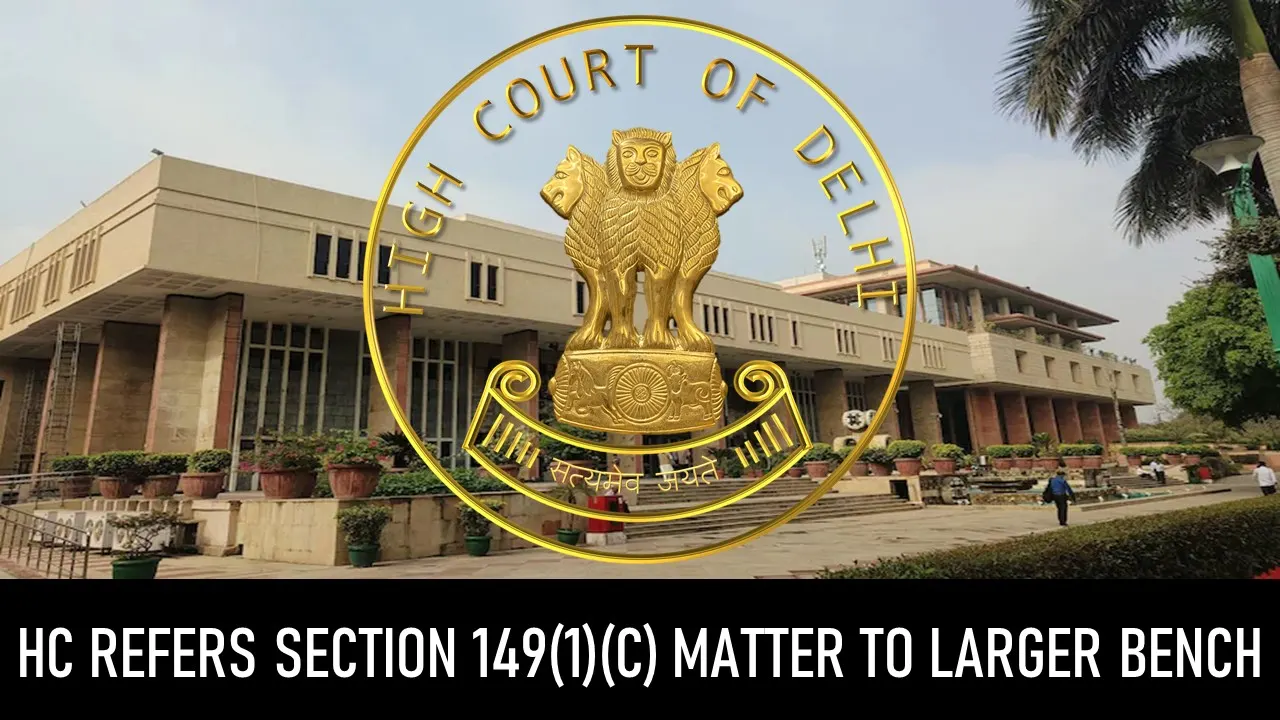
The High Court has referred the retrospective application of Section 149(1)(c) to a larger bench for consideration.
HC Refers Section 149(1)(c) Matter to Larger Bench
 CA Pratibha Goyal
 Jun 4, 2025
Table of Contents

Retrospective Application of Section 149(1)(c): HC Places Matter Before Larger Bench
The petitioners have challenged the impugned notices on several grounds, including: (a) that the notices were issued in the name of a non-existing entity; (b) that the reasons recorded for issuance of the impugned notices did not pertain to the relevant assessment year in respect of which the notices were issued; (c) that the petitioners were non-residents at the material time and, therefore, the information regarding an asset located overseas did not present any reason to believe that the income of the petitioners had escaped assessment; and (d) that the impugned notices are barred by limitation as they were issued beyond the period of six years from the end of the relevant assessment year.
In the present case, arguments were heard solely on the ground of limitation, and the present common order is confined to the question whether the impugned notices were issued beyond the prescribed period from the end of the relevant assessment year.
The controversy, essentially, relates to the application of clause (c) of sub-section (1) of Section 149 of the Act, which was introduced by virtue of the Finance Act, 2012 (Act 23 of 2012). In terms of the said clause, the issuance of notice under Section 148 of the Act, in respect of any income in relation to any asset located outside India, which had escaped assessment, was not proscribed for a period of sixteen years from the end of the assessment year in which such income was chargeable to tax. Clause (c) was inserted by virtue of the Finance Act, 2012 and accordingly, the Assessee contends that it would be apply only to cases where the limitation for re-opening the assessment had not already expired.
The Revenue counters the same and contends that Section 149(1) (c) of the Act would be applicable retrospectively. Thus, the assessments for the assessment years could be opened even where the same stood concluded by expiry of the limitation as was applicable prior to the insertion of said Clause (c).
As stated above, the principal question to be addressed is whether the impugned notices are barred by time insofar as they pertain to assessment years in respect of which income escaping assessment could not be assessed or re-assessed under Section 147 of the Act on account of the period for re-opening such assessments having expired prior to the insertion of clause (c) in sub-section (1) to Section 149 of the Act.
Petitioners argued that section 149(1)(c) cannot be applied retrospectively to reopen concluded assessments. Any assessment already barred by limitation as of 01.07.2012 (date of insertion of clause (c)) cannot be reopened. The right to finality in tax proceedings is a substantive right; thus, reopening after limitation violates this principle.
Petitioner Relied on precedents: K.M. Sharma v. ITO, S.S. Gadgil v. Lal & Co., and Brahm Datt v. ACIT, which affirm the prospective operation of such amendments unless expressly made retrospective.
Matter Places before Larger Bench
As noted above, the decision in Brahm Datt v. Assistant Commissioner of Income-Tax & Others has neither construed the import of the Explanation added to Section 149 of the Act nor the import of Explanation 4 added to Section 147 of the Act as were in force at the material time. The decision in Additional Commissioner (Legal) & Anr. v. Jyoti Traders & Anr. is also instructive. Additionally, the notes to clauses to the Finance Bill, 2012, which we find are material to construing the legislative intent behind the amendments to Sections 147 and 149 of the Act, were not brought to the notice of this Court in Brahm Datt v. Assistant Commissioner of Income-Tax & Others. Thus, the view expressed in the said decision may require consideration by a larger bench of this court.About Author


CA Pratibha Goyal
Co Founder
CA Pratibha Goyal is Chartered Accountant qualified in 2016, is a Member of The Institute of Chartered Accountants of India having wide experience in the field of Auditing, Taxation, ROC, GST and Secretarial matters etc.
She has written over a thousand articles & has made several videos on topics related to Auditing & Taxation. As a Speaker she has delivered various sessions on various branches of NIRC of ICAI.
CA Pratibha Goyal is Chartered Accountant qualified in 2016, is a Member of The Institute of Chartered Accountants of India having wide experience in the field of Auditing, Taxation, ROC, GST and Secretarial matters etc.
She has written over a thousand articles & has made several videos on topics related to Auditing & Taxation. As a Speaker she has delivered various sessions on various branches of NIRC of ICAI.
 Studycafe
 New Delhi, Delhi, India
 1486
1486My Recent Articles
- Biggest Labour Reform in Indian History: 4 Labour Codes Effective from today
- Tax Audit and ITR Due date not extended in this case: Know More
- Government notifies Agreement and Protocol between India and Qatar [Read Notification]
- CA Breaking: Results of ICAI Examination to be announced soon, Know probable Date
- Breaking: GSTR-3B Due Date for September 2025 extended by CBIC amid Diwali Festivities
Up Next
Loading suggestions…


Recent Posts

All Posts

Tags
No tags yet.
Recent Posts
All Posts
Tags
No tags yet.