Supreme Court Clarifies “Same Line of Business” Test for Co-operatives under Section 64(d):
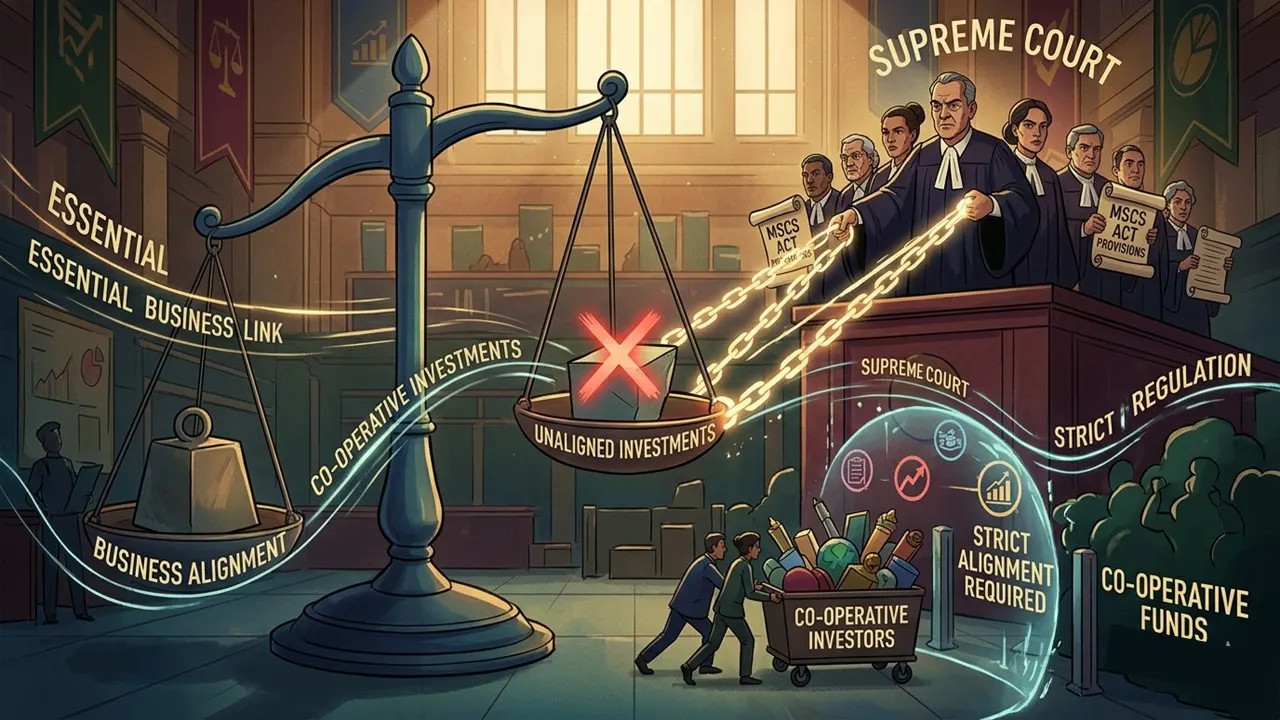
SC restricts co-operative investments, holding business alignment essential under MSCS Act provisions strictly.
Eligibility under IBC depends on strict interpretation of business similarity
 Meetu Kumari
 Apr 17, 2026
Supreme Court Clarifies “Same Line of Business” Test for Co-operatives under Section 64(d)
The appellant, M/s Nirmal Ujjwal Credit Co-operative Society Ltd., a multi-state co-operative society, participated in the CIRP of a textile company by submitting a resolution plan. The Resolution Professional later declared the appellant ineligible on the ground that its bye-laws did not permit such investment and that it was not engaged in the same line of business as the corporate debtor. The appellant contended that it had amended its bye-laws in line with Section 64(d) of the Multi-State Co-operative Societies Act, 2002, and that its textile unit brought it within the same line of business.
However, both NCLT and NCLAT rejected this contention, holding that the appellant’s activities were primarily financial and agro-processing in nature, whereas the corporate debtor was engaged in manufacturing man-made fibre textiles. Before the Supreme Court, the appellant sought to withdraw the appeal, but the Court proceeded to examine the legal issue, considering its wider importance.
Central Issue: Whether a multi-state co-operative society can invest in a corporate debtor under IBC when the entity is not in the “same line of business” as required under Section 64(d) of the MSCS Act, 2002.
SC's Ruling: The Hon'ble Supreme Court clarified that the expression “same line of business” under Section 64(d) must be interpreted narrowly and with reference to the objects and functions stated in the society’s bye-laws. The Court held that the legislative intent behind introducing this restriction was to prevent misuse of funds and ensure investments remain aligned with the society’s core activities. In fact, the Court observed that the appellant was primarily a financial and member-oriented cooperative, with only limited involvement in agro-based processing. In contrast, the corporate debtor was engaged in industrial manufacturing of synthetic textiles. This difference in nature, scale, and activity meant that both entities could not be said to operate in the same line of business.
The Court further held that merely amending the investment clause in the bylaws to mirror statutory language does not expand the actual business objects of the society. Since there was no substantial overlap in core activities, the eligibility condition under Section 64(d) was not satisfied. Although the appeal was ultimately dismissed as withdrawn, the Court authoritatively laid down the governing principles on the interpretation of “same line of business” in the context of the IBC and the MSCS Acts.
To Read Full Judgment, Download PDF Given Below

About Author


Meetu Kumari
Content Manager
Meetu Kumari is an Experienced Advocate and Content Writer with 4+ years of demonstrated history of working in the law practice industry. Skilled in Developing Content, Researching, and Drafting. Strong professional with a Bachelor of Science (B.Sc.) focused on Law from Gujarat National Law University.
Meetu Kumari is an Experienced Advocate and Content Writer with 4+ years of demonstrated history of working in the law practice industry. Skilled in Developing Content, Researching, and Drafting. Strong professional with a Bachelor of Science (B.Sc.) focused on Law from Gujarat National Law University.
 Studycafe
 Jodhpur, Rajasthan, India
 2264
2264My Recent Articles
- ITAT Condones 302-Day Delay, Restores Salary Assessment for Fresh VerificationPremium
- ITAT Condones Delay After Tax Consultant's Death, Restores Appeals for Fresh HearingPremium
- ITAT Remands Salary Addition, Says Taxability Depends on Salary Becoming Due, Not Mere ReceiptPremium
- ITAT Deletes TP Royalty Adjustment, Orders Fresh Review of Commission BenchmarkingPremium
- ITAT Quashes Reassessment Over Unsigned Section 148 Notice Issued to AssesseePremium
Up Next
Loading suggestions…


Recent Posts


All Posts


Tags
Recent Posts
All Posts