Supreme Court to Examine PIL Challenging Digital Search and Seizure Powers of Tax Authorities:

The Supreme Court has agreed to examine a PIL challenging the expanded digital search and seizure powers granted to tax authorities under the new Income Tax Act, 2025.
SC to Review Income Tax Act 2025 Search Provisions
 Saloni Kumari
 Feb 11, 2026
Supreme Court to Examine PIL Challenging Digital Search and Seizure Powers of Tax Authorities
Recently, a public interest litigation (PIL) was filed before the Supreme Court, questioning the powers granted to the Income Tax Authorities under the Income Tax Act, 2025. These powers allow tax authorities to conduct searches of "computer systems" and "virtual digital space". Confiscation of personal digital devices, cloud servers, and electronic communications is also included in these powers.
On Tuesday, the Supreme Court stated that it will examine the public interest litigation (PIL). The newly proposed Income Tax Act 2025, scheduled to take effect from April 01, 2026, has broadened the ambit of search powers granted to the tax authorities under Section 247. The said section allows tax officials to carry out any search if they have any "reason to believe" regarding income that has been escaped or tax that has been evaded. Under power permits, tax authorities have access to emails and social media accounts and can confiscate digital devices.
The bench was led by the Chief Justice of India, Surya Kant. During the hearing, the justice flagged the principle of limited judicial review of income tax search actions and also stated that the said point had earlier been discussed in its earlier judgement of 2022. The justice further emphasised the fact that tax officers are allowed to carry out searches only if they have a valid “reason to believe” that someone has concealed the income.
As per the earlier judgements of various top courts, courts only have the authority to check whether there is a rational connection between the material available to the tax authorities and the belief recorded to justify a search. The court further stated that the said law allows tax authorities to carry out searches based on concern of non-compliance in order to prevent destruction of evidence.
The bench said, "If notice is given for this search and seizure, there is a potential for destroying the evidence. The best way to snub out such an investigation against the digital record is to destroy the device itself." The court further accepted the fact that most of today's evidence is stored in digital form, either on devices or on cloud platforms, and without enough search power, conducting an investigation can be a frustrating task.
The petitioner claimed that the questioned provision has given excessive powers to the tax authorities and not only unearths alleged tax evaders but also subjects third parties to coercive action.
About Author


Saloni Kumari
Content Writer
Saloni is a Content Writer with 2+ years of experience at studycafe.in. She writes legal, taxation, and finance related content including GST, Income Tax etc. Skilled in translating complex judicial pronouncements and regulatory developments into clear, and reader-friendly articles. Experienced in covering judgements of ITAT, High Court, GSTAT, and news related to Income Tax, GST, and corporate law. She can be reached at [email protected].
Saloni is a Content Writer with 2+ years of experience at studycafe.in. She writes legal, taxation, and finance related content including GST, Income Tax etc. Skilled in translating complex judicial pronouncements and regulatory developments into clear, and reader-friendly articles. Experienced in covering judgements of ITAT, High Court, GSTAT, and news related to Income Tax, GST, and corporate law. She can be reached at [email protected].
 StudyCafe
 Delhi, Delhi, India
 2920
2920My Recent Articles
- IBA Recommends Public Sector Banks to Reduce Ambit of Physical Branch Audits to 50% of Total Business
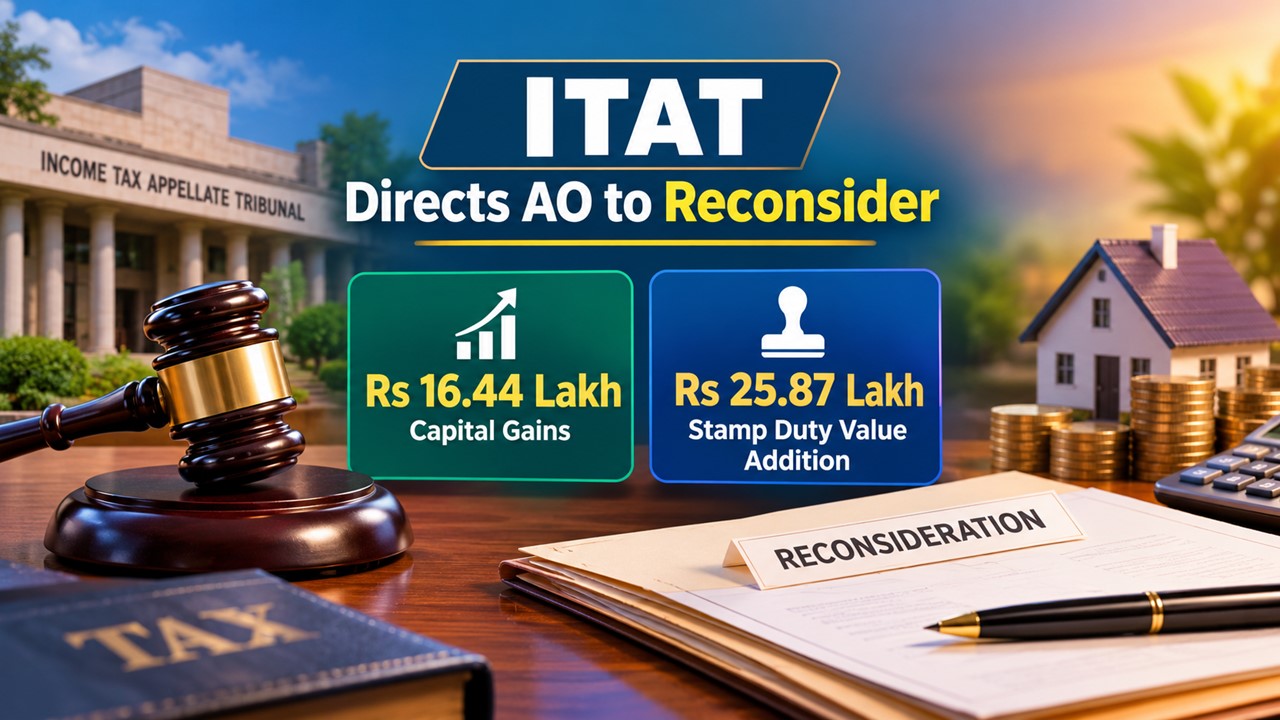
- ITAT Directs AO to Reconsider Rs 16.44 Lakh Capital Gains and Rs 25.87 Lakh Stamp Duty Value Addition
- ITAT Remands Rs 3.33 Crore Demonetisation Cash Deposit Case to AO, Directs Rs 10,000 Relief Fund Payment
- Income Tax Dept Increases Scope for Saksham Nudge Initiative to Further Include Professional Insuring Timely Compliance
- Vedanta Subsidiary ESL Steel Receives GST SCN for Rs. 2.76 Lakh IGST Demand Over Alleged RCM Short Payment
Up Next
Loading suggestions…


Recent Posts



All Posts

Tags
Recent Posts
All Posts