57th GST Council Meeting: New Date Announced And Big GST Changes Expected:
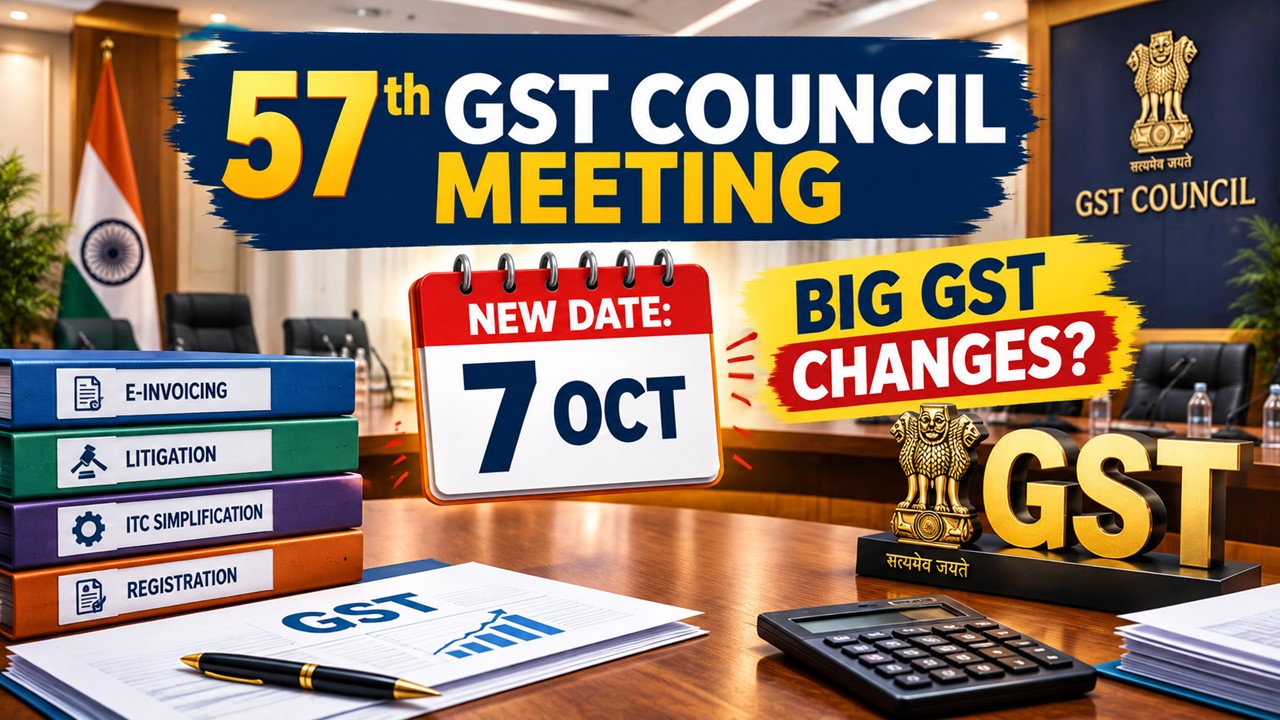
The 57th GST Council meeting on October 7 may bring key reforms on ITC, e-invoicing, registration and GST procedures.
57th GST Council Meeting: Big Changes Expected
 Vanshika verma
 Sep 23, 2026
Table of Contents

The 57th GST Council meeting, which was earlier scheduled for September 12, 2026, has now been rescheduled to October 7, 2026, in New Delhi. The meeting was postponed as it coincided with the BRICS Leaders’ Summit held in New Delhi.
The October meeting is expected to focus mainly on GST process reforms. This comes after the major GST rate changes introduced in 2025. Finance Minister Nirmala Sitharaman has indicated that issues such as e-invoicing, input tax credit (ITC) rules and other procedural difficulties could be discussed.
The government has also invited businesses, tax professionals and industry bodies to point out GST provisions that are causing unnecessary difficulties or creating anomalies.

However, taxpayers should keep one thing in mind: the issues being discussed are proposals and representations at this stage. They are not changes in GST law yet. Any recommendation of the GST Council will need the required notification, rule change or legislative process before it becomes legally effective.
ITC when the supplier does not pay GST
One of the major issues expected to come up is the problem faced by genuine buyers when their suppliers fail to pay GST to the government.

Under the existing Section 16(2)(c), one of the conditions for claiming ITC is that the tax charged on the supply should have been actually paid to the government, subject to the applicable legal provisions.
This can create problems for a genuine buyer who has received the goods or services, obtained a valid invoice and paid the supplier, but later finds that the supplier has not properly reported or deposited the GST.
Industry representatives have been asking for a system that protects a genuine buyer from losing ITC because of a supplier's default.
Possible review of blocked ITC
Another issue under discussion is blocked input tax credit under Section 17(5).
The law currently blocks ITC on certain expenses and transactions, subject to specified exceptions. These include certain motor vehicles, food and beverages, health-related services, club memberships and other notified categories.
Industry has been seeking a review of some of these restrictions. However, taxpayers should not assume that ITC on such expenses will automatically become available after the October 7 meeting. Any change will depend on the Council's recommendation and the subsequent legal process.
Inverted duty structure and refund of ITC
The inverted duty structure is another important issue.
This situation arises when the GST rate paid on inputs is higher than the GST rate charged on the final product or service. As a result, businesses can accumulate excess ITC, which can block working capital.
Industry has been seeking changes in the refund mechanism and rules for dealing with accumulated ITC. These issues could receive attention in the upcoming GST Council meeting.
GST registration process may be simplified
GST registration is also expected to be part of the process-reform discussions.
Businesses have raised concerns about repeated documentation, different requirements in different jurisdictions, physical verification, delays in registration and difficulties in cancellation.
The government has already been working towards making the registration process more uniform, particularly for larger businesses with monthly ITC exceeding Rs 2.5 lakh.
Easier GST cancellation process
The cancellation of GST registration is another area where taxpayers could see procedural changes.
The broader reform agenda is aimed at making registration and cancellation more automated and simpler. The objective is to reduce unnecessary delays and prevent genuine taxpayers from getting stuck in lengthy procedural processes.
E-invoicing may see further changes
E-invoicing is expected to be an important topic at the October meeting.
The Finance Minister has already indicated that e-invoicing will be part of the GST process-reform agenda. There has also been discussion about expanding the e-invoicing system to a wider group of taxpayers and examining further changes in the existing framework.
Any expansion, including possible changes affecting composition taxpayers, will depend on the decisions taken by the GST Council and subsequent notifications.
Can ITC be used across different GST registrations?
Another issue being raised by industry is the problem of unused ITC across different GST registrations.
For example, a company may have GST registrations in Delhi, Haryana, Maharashtra and Punjab. One registration may have a large unused ITC balance, while another registration may have a significant GST liability.
At present, ITC is generally maintained separately for each GST registration. A business cannot simply transfer the electronic credit ledger balance from one State registration to another.
Industry has therefore been seeking greater flexibility to deal with surplus or stranded ITC across different registrations.
Online gaming legacy disputes
Online gaming could also come up for discussion.
The sector continues to face disputes and litigation relating to the earlier GST treatment of online gaming. Industry representatives have been seeking clarity and possible mechanisms to deal with legacy tax positions and ongoing disputes.
The Council may consider whether any steps are required to address these long-running issues.
Compensation cess credit lying with businesses
Another issue relates to compensation cess credit that remains embedded in the inventory of certain businesses following GST rate rationalisation.
The issue is particularly relevant for sectors such as automobiles and other businesses that were affected by compensation cess.
Automobile dealers, for example, have raised concerns about ITC linked to compensation cess that was accumulated before the cess was discontinued. Businesses are seeking clarity on how such stranded credit should be treated.
GST litigation may also be discussed
Reducing GST-related litigation is expected to be an important part of the broader reform agenda.
The government has invited industry and tax professionals to identify provisions that are unnecessarily complicated or create disputes. The aim is to identify areas where the GST system can become simpler and reduce avoidable litigation.
Overall, the October 7 GST Council meeting is expected to focus more on simplifying GST procedures and resolving practical difficulties than on major rate changes.
For taxpayers, however, the key point is to wait for the official decisions and notifications. Issues currently being discussed by industry or reported ahead of the meeting should not be treated as final GST law changes until the required legal process is completed.
About Author


Vanshika verma
Content Writer
 Studycafe
 Delhi, Delhi, India
 2096
2096My Recent Articles
- Pinarayi Vijayan Moves Supreme Court Challenging Kerala High Court Order to Register FIR in CMRL Alleged Bribery Case
- CBI Lays Trap in Srinagar, Arrests SMC Ward Officer Red-Handed While Allegedly Accepting Rs 10,000 Bribe
- NIIT Limited Discloses Income Tax Department’s Appeal Before Delhi ITAT, Says No Adverse Financial Impact Expected
- Fake WhatsApp Boss Dupes Company Accountant of Rs 40 Lakh; Surat Police Arrest Haryana Man in Cyber Fraud Case
- Uttarakhand Tax Department Detects Rs 2.5 Crore Tax Evasion at Ramnagar Resort
Loading suggestions…


Recent Posts


All Posts



Recent Posts
All Posts