The tribunal held that the assessee is liable to give a explanation regarding the source of cash deposits, and just submitting self-serving affidavits without any supporting evidence cannot discharge this burden.
Nidhi | Jan 2, 2026 |
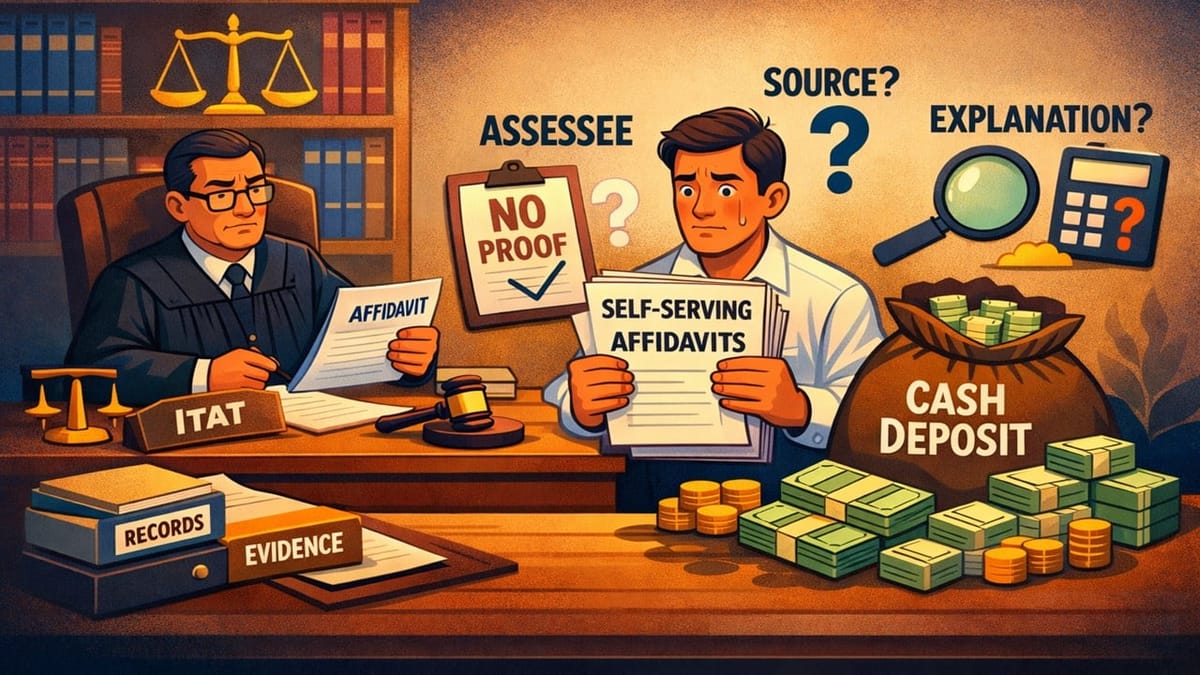

Just Filing Self-Serving Affidavits Without Supporting Evidence Does Not Discharge Assessee’s Onus to Explain Source of Cash Deposit: ITAT
The Income Tax Appellate Tribunal (ITAT), Delhi, upheld a tax addition of Rs 1,37,59,581 as unexplained cash deposits during the financial year 2008-09, as the assessee failed to explain the source and nature of the cash deposits.

The assessee, Salim, had allegedly deposited Rs 1 crore cash in his bank account during the financial year 2008-09, whose source was not explained by him. Additionally, he had not filed his income tax return under section 139, due to which the assessing officer believed that the income had escaped from assessment, and a notice under section 148 of the Income Tax Act was issued. Even after this notice, Salim failed to file his income tax return.
Later notices under section 142(1) were issued, and the assesse, during the proceedings, submitted that the cash deposited in the bank account was the sale proceeds of agricultural land sold during FY 2008-09 by him and his family members. He also submitted the photocopies of the sale deeds, which showed the joint ownership with one more person and the assessee’s share from the sale proceeds of these properties was Rs 16,03,500. However, he did not submit the affidavits from the family members about the deposit of their shares in his bank account, the source of such deposits, the return of income and the explanation for the bank interest income of Rs 33,699. There were also large cash deposits made by third parties, which remained unexplained. The assessee also stopped cooperating with the proceedings, due to which he was issued a show cause notice proposing an ex parte assessment under section 144.
Therefore, the Assessing officer, after accepting the assessee’s claim of Rs 16,03,500, added the remaining amount of Rs 18,213,081 to the assessee’s income as unexplained money under section 69A of the Income Tax Act. The assessee appealed before the CIT(A), which accepted the source of bank deposits of only Rs 60,57,000 as the documented sale consideration, and the balance addition amount of Rs 1,37,59,581 was upheld as unexplained credit. Therefore, the assessee approached the Income Tax Appellate Tribunal (ITAT), Delhi.

The assessee’s advocate did not appear in the tribunal hearing and filed written notes repeating the land sale explanation. The Tribunal disagreed with the assessee’s contention alleging non-service of notice, as the records clearly showed that the assessee had replied to the notice and had also appeared before the assessing officer. Additionally, the tribunal noted that the notices under section 142(1) were also issued and served properly.
The tribunal held that the assessee is liable to give a satisfactory explanation regarding the nature and the source of cash deposits, and just submitting self-serving affidavits without any supporting evidence cannot discharge this burden. The Tribunal agreed with CIT(A)’s decision of lowering the addition to the extent of Rs 1,37,59,581. Therefore, the tribunal upheld the CIT(A)’s order calling it proper, as the assessee did not submit any supporting material.

In case of any Doubt regarding Membership you can mail us at [email protected]
Join Studycafe's WhatsApp Group or Telegram Channel for Latest Updates on Government Job, Sarkari Naukri, Private Jobs, Income Tax, GST, Companies Act, Judgements and CA, CS, ICWA, and MUCH MORE!"