The court holds the extended limitation invalid without evidence of intent to evade tax.
Meetu Kumari | Apr 25, 2026 |
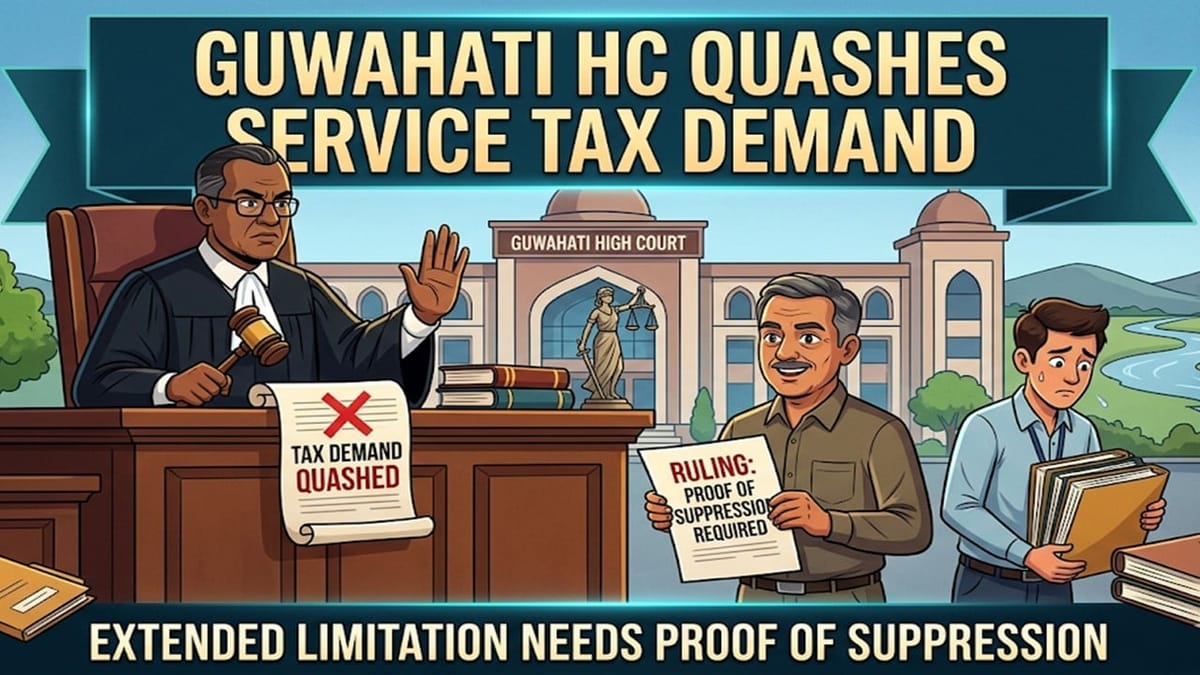

HC Quashes Service Tax Demand; Extended Limitation Needs Proof of Suppression
The petitioner, M/s Frontier Construction Company, a partnership firm engaged in construction activities, was served with a show-cause notice (SCN) in October 2011 for the period of 2006-2011. The GST/Service Tax Department alleged that the firm had under-declared its taxable turnover and failed to pay service tax. Crucially, the Department invoked the “extended period of limitation” under the proviso to Section 73(1) of the Finance Act, 1994, which allows demands for up to five years in cases of fraud or suppression. The petitioner argued that there was no intent to evade tax and that all figures were reflected in their audited balance sheets, making the extended limitation inapplicable. After losing at the Original and Appellate levels, the firm moved the High Court.

Central Issue: Whether the Service Tax Department was justified in invoking the extended five-year limitation period without providing specific evidence of “willful suppression” or “fraudulent intent” by the taxpayer.
HC’s Ruling: The Gauhati High Court allowed the writ petition and quashed the tax demand, interest, and penalties. The Court held that the mere non-payment of tax or non-filing of returns does not automatically qualify as “suppression of facts.” For the Department to invoke the extended period, there must be a positive act of concealment with the specific intent to evade tax. Since the petitioner’s financial data was available in their books of accounts and audited records, the Court found no evidence of fraud. Consequently, the SCN issued beyond the normal limitation period was held to be without jurisdiction. The Court emphasised that while an alternative remedy (Tribunal) was available, it could interfere under Article 226 because the Department had fundamentally misapplied the law on limitation.
To Read Full Judgment, Download PDF Given Below

In case of any Doubt regarding Membership you can mail us at [email protected]
Join Studycafe's WhatsApp Group or Telegram Channel for Latest Updates on Government Job, Sarkari Naukri, Private Jobs, Income Tax, GST, Companies Act, Judgements and CA, CS, ICWA, and MUCH MORE!"