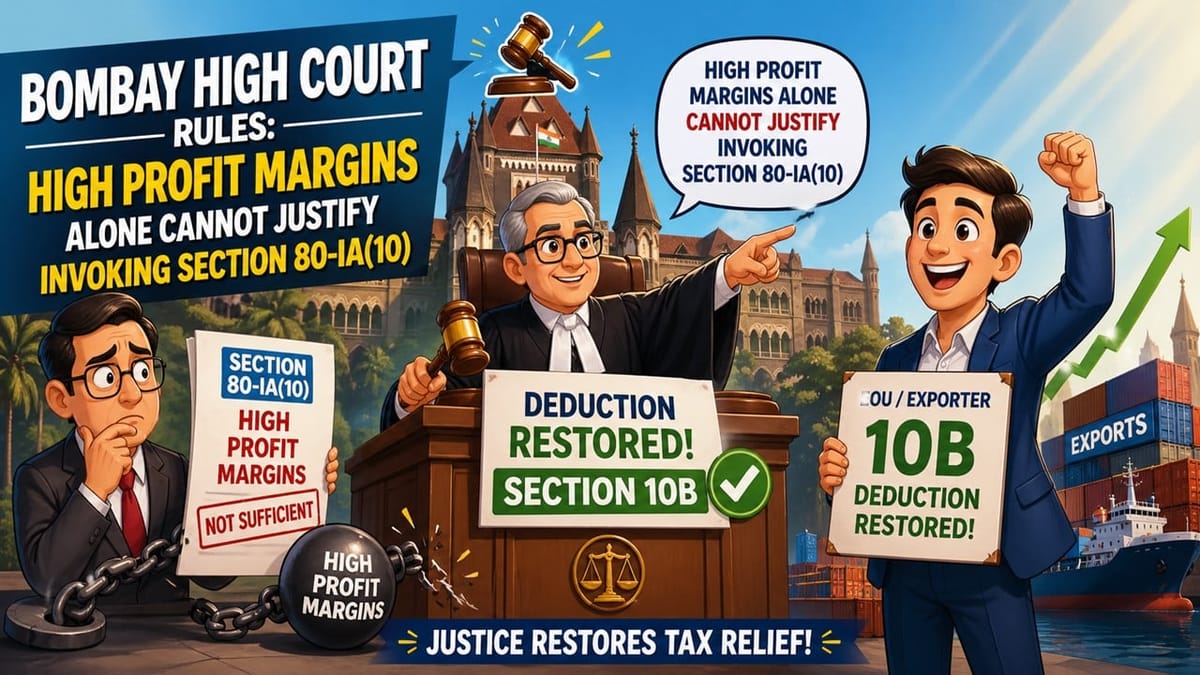
Section 10B Benefit Restored; High Profit Allegation Not Sustainable: HC

The Bombay High Court rules that high profit margins alone cannot justify invoking Section 80-IA(10), restoring the Section 10B deduction for EOU.

HC Rules That High Profit Margins Alone Cannot Justify Invoking Section 80-IA(10)

Meetu Kumari | Apr 27, 2026 |

Section 10B Benefit Restored; High Profit Allegation Not Sustainable: HC

Section 10B Benefit Restored; High Profit Allegation Not Sustainable: HC

This case at the High Court level explores a common friction point in tax law: the line between a highly efficient business and one that is “artificially” profitable to avoid taxes. The assessee, Pragati Aroma Oil Distillers, operated as a 100% export-orientated undertaking. Because of this status, they were eligible for a massive tax break under Section 10B. However, the tax department (DCIT) cried foul, invoking Section 80-IA(10). The government’s argument was essentially that the company’s profits were “too good to be true”.

They alleged that Pragati Aroma had deliberately structured its dealings with related businesses to park extra profits in the tax-exempt unit, thereby shielding them from the taxman. The Income Tax Appellate Tribunal (ITAT) initially sided with the government, agreeing that the profits looked suspicious enough to restrict the tax deduction. Now, the High Court must decide a critical question for corporate India: Does a high profit margin automatically prove tax manipulation? The company’s defence rests on the idea that superior business tactics, lower overheads, or better market timing shouldn’t be penalised just because they result in “more than ordinary” profits.

Central Issue: Whether a Section 10B deduction can be curtailed under Section 80-IA(10) merely due to high profit margins and the absence of formal related-party agreements.

HC Decided: The High Court allowed the appeal and restored the deduction under Section 10B. The High Court’s ruling in this case is a significant win for high-performing businesses, essentially telling the tax department that “being too good at your job” isn’t a crime.

The Court made it clear that a high profit margin, on its own, isn’t proof of a tax scam. To slash a company’s deductions under Section 80-IA(10), the government can’t just point at a balance sheet and say, “That looks like too much money.” They need “clear and cogent evidence” that there was an actual, deliberate plot to shift profits around. The High Court set aside the restriction on the deduction, reminding the authorities that statutory tax breaks are meant to be a reward for successful exports, not a trap for those who happen to be highly profitable.

To Read Full Judgment, Download PDF Given Below

StudyCafe Membership

Join StudyCafe Membership. For More details about Membership Click Join Membership Button
Join Membership

In case of any Doubt regarding Membership you can mail us at [email protected]

Join Studycafe's WhatsApp Group or Telegram Channel for Latest Updates on Government Job, Sarkari Naukri, Private Jobs, Income Tax, GST, Companies Act, Judgements and CA, CS, ICWA, and MUCH MORE!"





Author Bio
My Recent Articles
ROC imposes penalty of 3.67 Cr for Violation of Separate Bank Account Rule in Private Placement High Court Upholds Attachment Under PMLA; No Final Guilt Determination High Court Denies Anticipatory Bail in NDPS Case Involving Commercial Quantity Section 10B Benefit Restored; High Profit Allegation Not Sustainable: HC No Concealment Without Evidence; ITAT Deletes PenaltyView All Posts