Mumbai Tribunal invalidates 153C proceedings as seized documents lacked nexus with assessee’s income.
Meetu Kumari | Apr 28, 2026 |
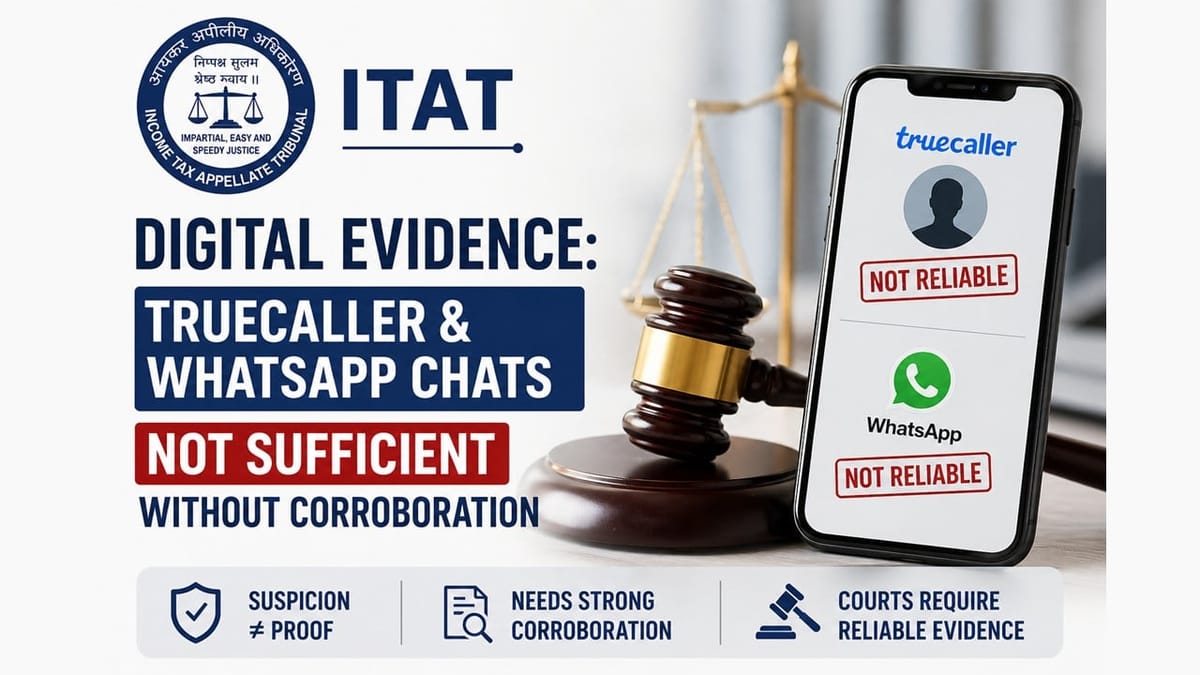

ITAT on Digital Evidence: Truecaller & WhatsApp Chats Not Sufficient Without Corroboration
The Income Tax Appellate Tribunal, Mumbai Bench, dealt with an appeal filed by the Revenue against the order of the Commissioner of Income Tax (Appeals), which had quashed the assessment framed against the assessee, Mrs Sunetra Ajit Pawar, under Section 153C of the Income Tax Act, 1961. The proceedings were initiated on the basis of documents seized during a search conducted on third parties.
Revenue sought to make a massive addition of Rs. 32.14 crore based on entries found in diaries and digital material seized from third parties. The department attempted to link these entries to the assessee by interpreting the code “DD” and relying on mobile data, WhatsApp chats, and Truecaller identification. However, the assessee argued that there was no direct evidence connecting him to the seized documents or the alleged transactions.

The Assessing Officer recorded a satisfaction note alleging that the seized material pertained to the assessee and warranted action under Section 153C. However, the assessee challenged the validity of such initiation on the ground that the documents neither belonged to her nor contained any incriminating material impacting her income. The CIT(A) accepted the assessee’s contention and held the assessment to be invalid. Aggrieved, the Revenue carried the matter before the Tribunal.
Central Issue: Whether initiation of proceedings under Section 153C is valid in absence of a clear nexus and incriminating material linking the seized documents to the assessee.
Tribunal Decided: The Tribunal upheld the order of the CIT(A) and dismissed the Revenue’s appeal, holding that the jurisdictional requirements under Section 153C were not satisfied. It was observed that the satisfaction note failed to establish any live and cogent nexus between the seized material and the income of the assessee. The documents relied upon by the department were not incriminating in nature and did not justify reopening of assessment. The Tribunal emphasized that mere reference to documents found during a third-party search is insufficient.

Unless such material clearly pertains to the assessee and has a direct bearing on determination of income, proceedings under Section 153C cannot be sustained. Accordingly, since the very foundation for assumption of jurisdiction was defective, the assessment order was held to be unsustainable in law.
Relevant Text:
31. In the present case, the situation is even more stark. In the loose papers referred to by the Assessing Officer, there is no name of the assessee. The expression “DD” is not even an abbreviation of the assessee’s full name. Merely because the assessee is a public figure and may be fondly known in political circles as “Dada” in Maharashtra politics, it cannot by itself justify the inferential leap that the initials “DD” in the diaries necessarily refer to him. Public notoriety, popularity, or colloquial identification cannot be substituted for legal proof. The WhatsApp chats discussed by the Assessing Officer do not contain reference to the specific transaction entries in the seized documents. The author of the papers, in his statement, explained “DD” as a code used for high value transactions. Thus, the very material relied upon by the Revenue fails to establish the most foundational fact necessary to proceed against the assessee.
32. On an overall consideration, therefore, we are of the clear opinion that the entire proceedings initiated against the assessee under section 153C are without the support of legally admissible and credible evidence. The papers referred to by the Assessing Officer do not have such bearing on the income of the assessee as is contemplated by section 153C. The satisfaction recorded by the Assessing Officer does not demonstrate a live, cogent, and legally sustainable nexus between the seized material and the assessee. The Ld. CIT(A), in our view, has rightly appreciated both the facts and the law and was justified in quashing the proceedings under section 153C. Once the very jurisdictional foundation fails, the consequential assessment order cannot survive. We therefore uphold the findings of the Ld. CIT(A), both on fact and in law.
To Read Full Order, Download PDF Given Below

In case of any Doubt regarding Membership you can mail us at [email protected]
Join Studycafe's WhatsApp Group or Telegram Channel for Latest Updates on Government Job, Sarkari Naukri, Private Jobs, Income Tax, GST, Companies Act, Judgements and CA, CS, ICWA, and MUCH MORE!"