Meetu Kumari | May 29, 2026 |
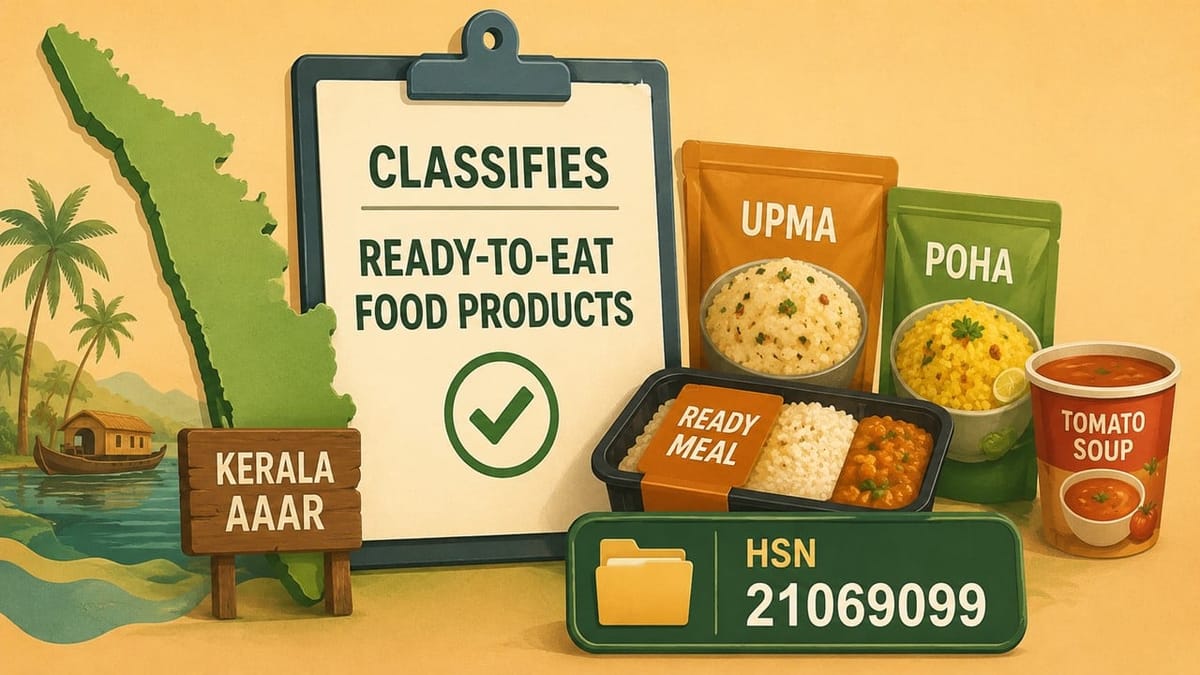

Kerala AAAR Classifies Ready-to-Eat Food Products Under Residuary HSN 21069099
The Kerala Appellate Authority for Advance Ruling (AAAR) has upheld the classification of multiple ready-to-eat packaged food products under HSN 21069099, holding that such items are “edible preparations” falling under Chapter 21 and not merely prepared or preserved vegetables, meat, or fish under Chapters 16 or 20. However, the Authority modified the classification of “Boiled Chinese Potato (Koorka)” and classified it under CTH 20052000. The ruling was delivered by a Bench comprising S.K. Rahman, IRS and Patil Ajit Bhagwatrao, IAS.
The appellant, M/s HIC-ABF Special Foods Pvt. Ltd., engaged in manufacture of various food products, had approached the AAAR challenging the Advance Ruling dated September 13, 2024 relating to classification of 27 food items including curries, biriyanis, fish products, chutney powders, and vegetable preparations.

The appellant contended that several items such as Puli Inji, Sambar Curry, Avial Curry, Mutton Curry, Chicken Biriyani, Tuna Tomato Rice, and Prawn Chutney Powder were wrongly classified by the Authority for Advance Ruling under the residuary entry 21069099. According to the appellant, the products deserved classification under specific entries of Chapters 16 or 20 based on their ingredients and composition, particularly where meat or fish content exceeded 20% by weight.
The appellant relied upon Rule 3(a) of the General Rules for Interpretation of the Customs Tariff Act, arguing that a specific entry must prevail over a general residuary entry. Reliance was also placed on Supreme Court rulings including Dunlop India Ltd., Minwool Rock Fibres Ltd., and STP Ltd.

“Specific descriptions must prevail over general or residuary entries in tariff classification.”
The AAAR observed that while the principle of specific classification is well settled, such principles apply only where ambiguity persists after applying tariff interpretation rules. The Authority held that the products in question were essentially “ready-to-eat packaged food” and not merely prepared or preserved vegetables, meat, or fish.
With respect to items such as curries and biriyanis, the Authority noted that Chapter 21 specifically covers edible preparations intended for direct human consumption. It observed that the products were distinct commercial commodities in the nature of ready-to-eat food preparations.
“A ready-to-eat packaged curry is a distinct product, different from ‘prepared or preserved meat’ in the sense intended by Chapter 16.”
The Bench rejected the appellant’s argument that products containing more than 20% meat or fish must automatically fall under Chapter 16. It held that the overall character and nature of the final product had to be considered instead of merely the percentage composition of ingredients.
However, regarding “Boiled Chinese Potato (Koorka),” the Authority found that the AAR had incorrectly classified the item under non-existent HSN 20041010. After examining the product description and method of preservation through retort technology, the AAAR held that the appropriate classification would be under CTH 20052000 covering “Potatoes prepared or preserved otherwise than by vinegar or acetic acid, not frozen.”
Thus, the appeal was partly allowed only to the limited extent of reclassification of Item No. 27 and correction of GSTIN particulars, while the remaining classifications under HSN 21069099 were upheld.
To Read Full Order, Download PDF Given Below.

In case of any Doubt regarding Membership you can mail us at [email protected]
Join Studycafe's WhatsApp Group or Telegram Channel for Latest Updates on Government Job, Sarkari Naukri, Private Jobs, Income Tax, GST, Companies Act, Judgements and CA, CS, ICWA, and MUCH MORE!"