Taxpayers holding RBI Floating Rate Savings Bonds have been advised to carefully verify the interest income reflected in their AIS before filing ITR for Assessment Year 2026-27.
Saima | Jun 8, 2026 |
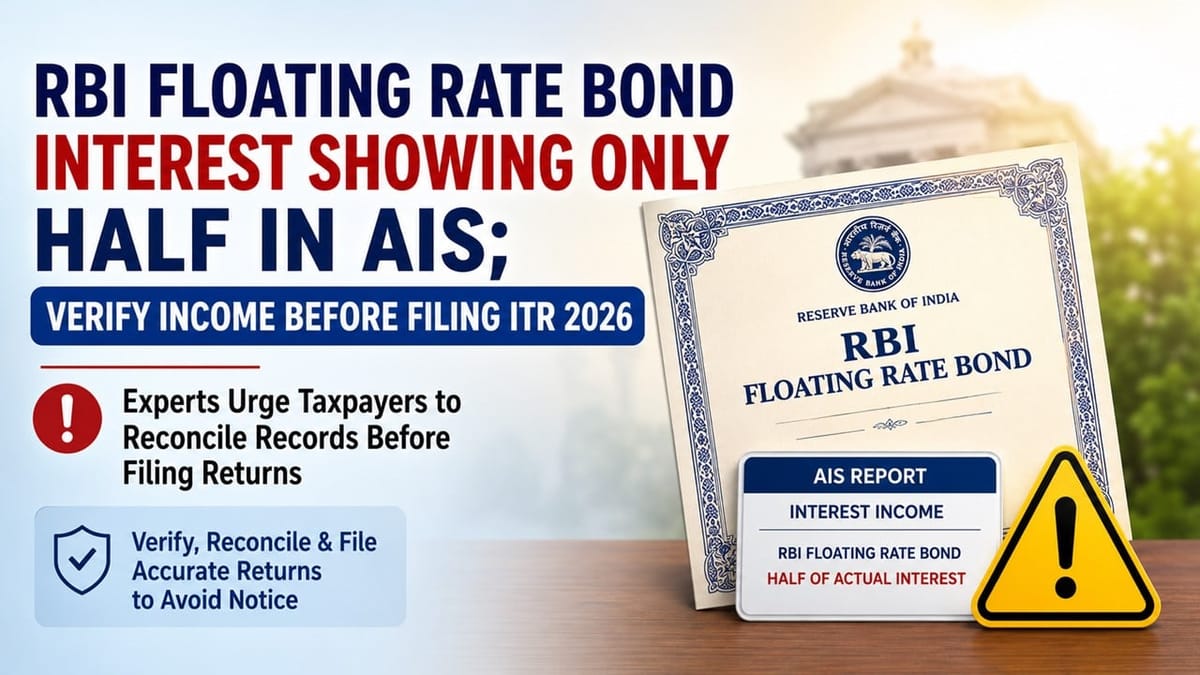

RBI Floating Rate Bond Interest Showing Only Half in AIS; Verify Income Before Filing ITR 2026
Tax professionals have highlighted that some discrepancies have been noticed in the interest earned from RBI Floating Rate Savings Bonds as the filing season for Assessment Year 2026-27 is approaching. Several investors observed that the income reflected in their AIS did not correspond with the total interest actually received or accrued during the relevant financial year. Experts have cautioned taxpayers against depending exclusively on Annual Information Statement (AIS) figures while preparing their returns. Instead, investors should cross-check the information with bond statements, bank records and interest certificates to ensure complete and accurate disclosure of taxable income.
According to tax experts, interest income from RBI Floating Rate Savings Bonds remains fully taxable under the head “Income from Other Sources“. Where the AIS reflects only a part of the interest earned during the year, taxpayers are required to independently determine the correct amount and report it on the return.

Failure to disclose the entire taxable interest may lead to income mismatches, processing adjustments, scrutiny notices or additional tax demands at a later stage. Taxpayers should therefore reconcile AIS data with supporting financial records before submitting their returns.
Before filing ITR 2026, investors who possess RBI Floating Rate Savings Bonds should obtain the relevant interest details from their servicing bank or investment records and are advised to compare them with the numbers appearing in AIS. Where any discrepancy is identified, the return should be filed according to the correct taxable income and should mandatorily be supported by documentary evidence.
Tax experts have reiterated that accurate reporting of interest income remains the taxpayer’s responsibility, irrespective of whether the complete amount is reflected in pre-filled tax records. Proper reconciliation at the filing stage can help prevent notices, refund delays and subsequent tax disputes.


In case of any Doubt regarding Membership you can mail us at [email protected]
Join Studycafe's WhatsApp Group or Telegram Channel for Latest Updates on Government Job, Sarkari Naukri, Private Jobs, Income Tax, GST, Companies Act, Judgements and CA, CS, ICWA, and MUCH MORE!"








![Export proceeds realisation period reduced from 15 to 9 months [Read Notification]](/cdn-cgi/image/width=320,height=195,fit=contain,format=webp,gravity=auto,metadata=none,quality=75/wp-content/uploads/2026/06/RBI-Notifies-Foreign-Exchange-Management-Export-of-Goods-and-Services-First-Amendment-Regulations-2026.jpg)