The Gauhati High Court has held that there is no prohibition under the Central Goods and Services Tax Act, 2017 against issuance of a consolidated show cause notice covering multiple financial years.
Saima | Jun 11, 2026 |
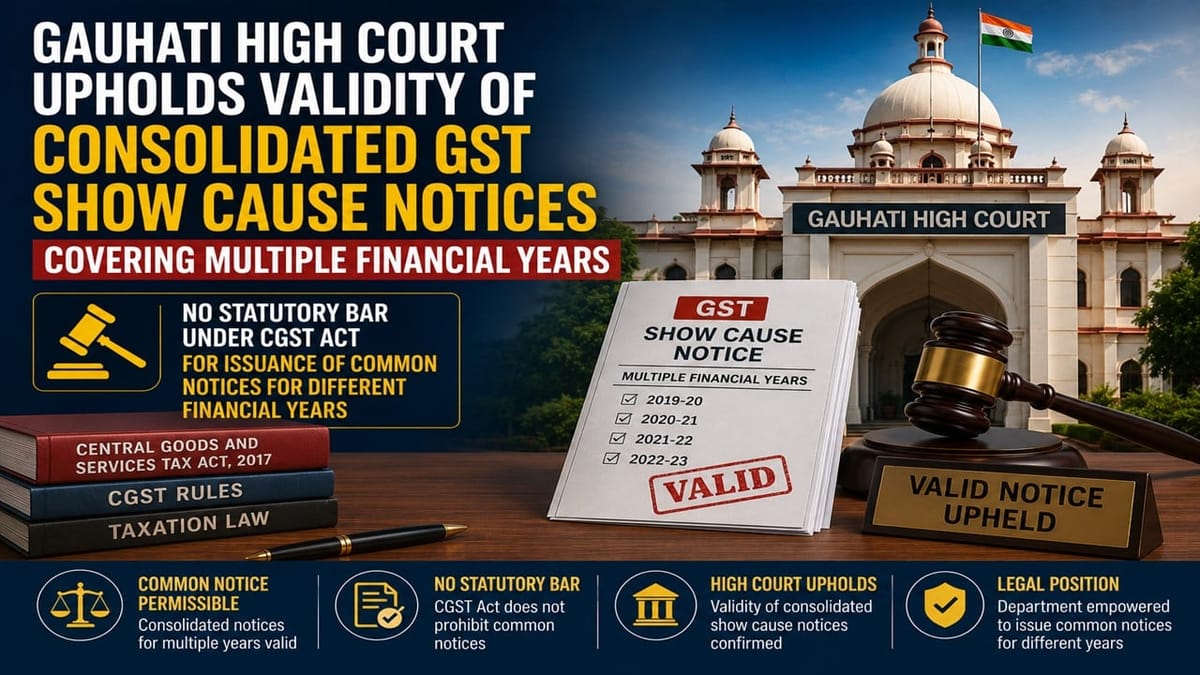

Gauhati High Court Upholds Validity of Consolidated GST SCN Covering Multiple Financial Years in matter of Tata Projects
The Gauhati High Court has ruled that a proper officer under the CGST Act, 2017 possesses the jurisdiction to issue a common show cause notice covering more than one financial year, provided that the proceedings for each year are initiated within the limitation period prescribed under Sections 73(2) and 74(2) of the Act.
There is a batch of writ petitions filed by Tata Projects Limited, Quantum Infratech and Bitchem Asphalt Technologies Limited that challenged the maintainability of proceedings initiated through consolidated show cause notices. The main argument of the petitioners was that every financial year constitutes a distinct unit under the GST framework and, therefore, separate notices should have been issued for each year.

The petitioners contended that returns are filed separately for each tax period and annual returns are to be furnished financial year-wise under Sections 39 and 44 of the CGST Act. It was further contended that the limitation prescribed under Sections 73(10) and 74(10) is calculated independently for every financial year and clubbing several years in one notice is contrary to the statutory scheme. On the other hand, the Revenue submitted that Sections 73(1), 73(3), 74(1) and 74(3) contain phrases such as “for any period” and “for such periods,” which indicate that the legislature intended to permit consolidated proceedings.
After examining the entire statutory framework, the court observed that Sections 73 and 74 do not expressly mandate issuance of a separate notice for each financial year. The Court held that the cause of action to apply these provisions arises from non-payment, short payment, erroneous refund or wrongful availment of input tax credit and not from the financial year itself. The Court further noted that Sections 73(2) and 74(2) merely impose restrictions regarding timelines for issuance of notices, however, Sections 73(10) and 74(10) prescribe the outer limit for passing adjudication orders. These provisions do not prohibit a consolidated notice or a common adjudication order covering several financial years.
Accordingly, the High Court thus rejected the jurisdictional challenge raised by the petitioners and held that common notices and common orders covering different financial years are legally permissible under Sections 73 and 74 of the CGST Act, 2017.


In case of any Doubt regarding Membership you can mail us at [email protected]
Join Studycafe's WhatsApp Group or Telegram Channel for Latest Updates on Government Job, Sarkari Naukri, Private Jobs, Income Tax, GST, Companies Act, Judgements and CA, CS, ICWA, and MUCH MORE!"