July 31 is no longer the default ITR deadline for everyone - find out which filing date applies to you for AY 2026-27.
Vanshika verma | Jun 16, 2026 |
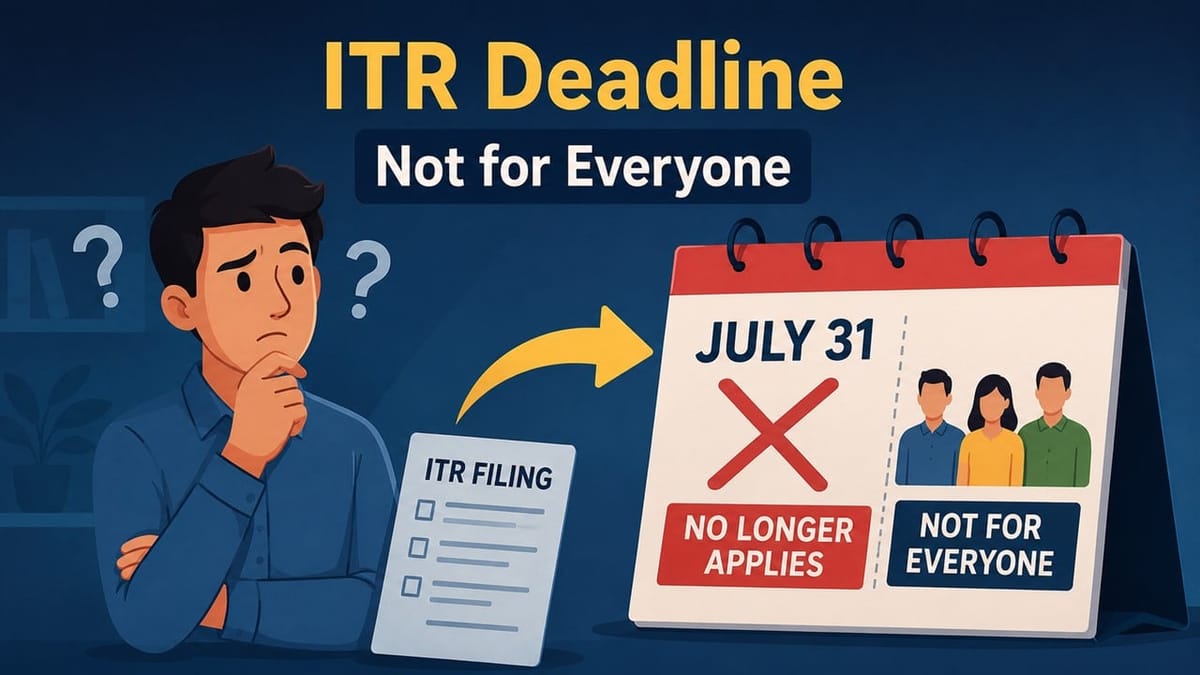

ITR Filing Deadline for AY 2026-27: Why July 31 No Longer Applies to Everyone
For a long time, most taxpayers in India have linked Income Tax Return (ITR) filing to a single date – July 31. In particular, salaried workers became so used to the deadline that many assumed it was universal.
But this assumption may not be true for Assessment Year (AY) 2026-27 which is for income for Financial Year (FY) 2025-26.

The income tax filing calendar now has different deadlines for different categories of taxpayers. Your due date may be later than July 31, depending on factors such as your source of income, whether your accounts require an audit, or whether you are a partner in a firm.
At the same time, some taxpayers may mistakenly believe they have extra time and end up missing their actual filing deadline.
Because of these changes, it is important for every taxpayer to check the specific ITR due date that applies to their situation instead of relying on the traditional July 31 deadline.

Let’s see what has changed:
For Assessment Year (AY) 2026-27, the government has extended the income tax return (ITR) filing due date from 31 July 2026 to 31 August 2026 for eligible non-audit business taxpayers and professionals filing ITR-3 or ITR-4. However, salaried individuals and other taxpayers filing ITR-1 or ITR-2 must generally continue to file their returns by 31 July 2026.
Announcing this change in the Union Budget 2026 on 1 February 2026, Finance Minister Nirmala Sitharaman said that a staggered filing schedule is being introduced, with individuals filing ITR-1 and ITR-2 retaining the 31 July deadline, while non-audit business cases and trusts will have a due date of 31 August.
| ITR Form | Category | Due Date |
| ITR-1 & ITR-2 | Salary income, Capital gains income | 31st July 2026 |
| ITR-3 & ITR-4 | Business income – Non-audit cases | 31st August 2026 |
| ITR-3 & ITR-4 | Business income – Cases requiring audit | 31st October 2026 |
| Belated Return | Late filing | 31st December 2026 |
| Revised Return | Correction of earlier filed return | 31st March 2027 |
| Updated Return (ITR-U) | Within 4 years from end of relevant AY | 31st March 2031 |
ITR-1 (Sahaj): For salaried employees or pensioners with total income up to Rs 50 lakh and simple income sources.
ITR-2: For individuals or HUFs who have capital gains (e.g., from shares or property), foreign assets, multiple houses, or higher income, but no business income.
ITR-4 (Sugam): For small business owners, freelancers, and professionals who choose the presumptive taxation scheme under Sections 44AD, 44ADA, or 44AE.
If you file your Income Tax Return (ITR) late, you may have to pay a late fee, interest on unpaid taxes, face delays in getting your tax refund, and lose some tax benefits.
Section 234F of the Income Tax Act imposes a fee if you file your ITR after the due date.
| Total Income | Late Filing Fee |
| Up to Rs 5 lakh | Up to Rs 1,000 |
| Above Rs 5 lakh | Up to Rs 5,000 |
Filing your ITR on time helps you avoid extra charges and ensures faster processing of refunds.
If you file your Income Tax Return (ITR) on or before the due date, you do not have to pay any late-filing fee.
If you file after the due date, you may have to pay:
For example:
But before you put July 31 on your calendar as the day to file your taxes, make sure you know what category you fall under. The due date for filing the return for FY 2026-27 may be different and knowing the correct due date can help you avoid penalties and compliance issues.

In case of any Doubt regarding Membership you can mail us at [email protected]
Join Studycafe's WhatsApp Group or Telegram Channel for Latest Updates on Government Job, Sarkari Naukri, Private Jobs, Income Tax, GST, Companies Act, Judgements and CA, CS, ICWA, and MUCH MORE!"