Air Purifiers to Remain at 18% GST? Centre Tells Delhi HC That Only GST Council Can Decide on GST Rates:
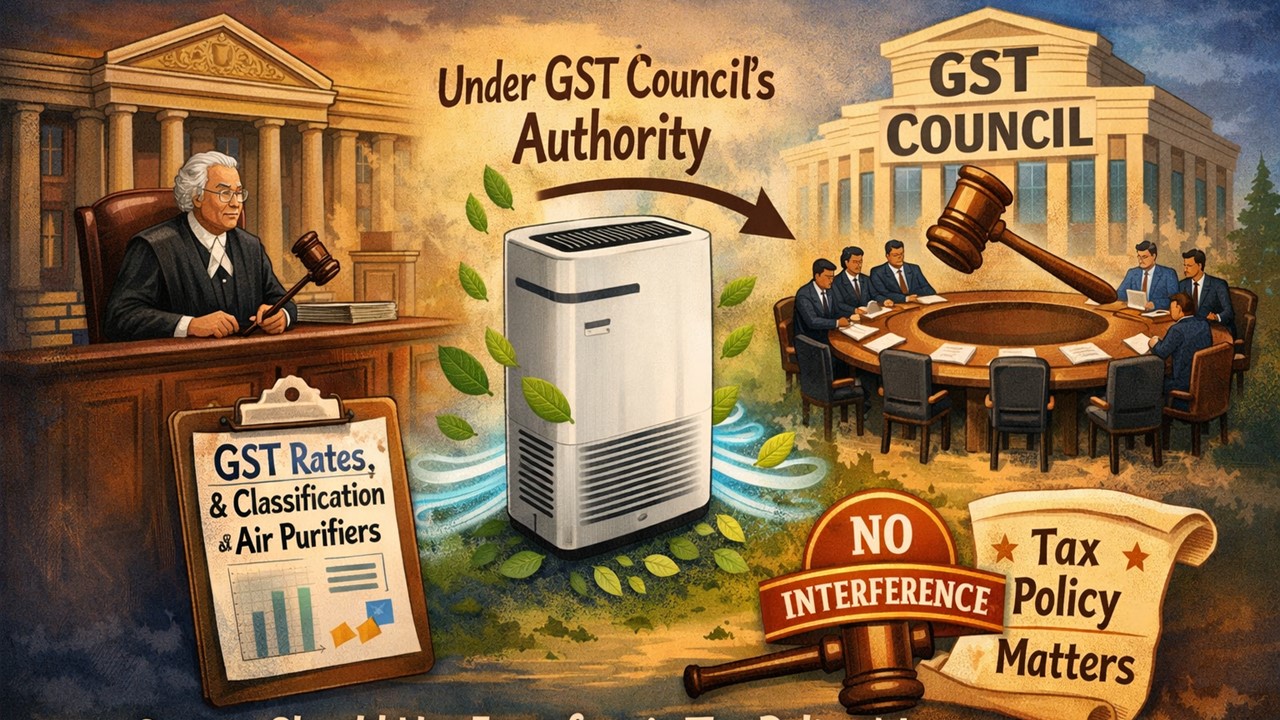
The Centre told the High Court that GST rates and classification of air purifiers fall solely under the GST Council’s authority and courts should not interfere in tax policy matters.
Air Purifiers Not Medical Devices, Says Centre
 Saloni Kumari
 Jan 9, 2026
Air Purifiers to Remain at 18% GST? Centre Tells Delhi HC That Only GST Council Can Decide on GST Rates
During the hearing before the Delhi High Court, the government stated that the cases related to the rate, classification, and reduction of Goods and Services Tax (GST) on air purifiers should fall under the ambit of the GST Council. Additionally, it highlighted its concern that any judicial action in this regard will not only contravene the framework of cooperative federalism but also be considered impermissible under the Indian Constitution.
The petitioner had filed a comprehensive counter-affidavit in answer to the public interest litigation (PIL), requesting the Delhi High Court to reduce the GST rate on air purifiers and also declare the goods in question under the category of "medical devices." On this request, the Union Government claimed that the GST department has been constituted under Article 279A of the Indian Constitution and is the "sole constitutionally designated authority"; any decision in relation to GST rates, exemptions, and classifications should be controlled by the GST department only, as it is empowered for the same.
The affidavit reads, "It is settled law that courts do not substitute themselves for constitutionally designated decision-makers, particularly in matters involving economic policy and fiscal structuring." The reply of the affidavit reads, "GST decisions, particularly on rates, are the outcome of a complex process of cooperative federalism, balancing competing fiscal interests of the Union and States. Judicial interference in such matters would necessarily bypass this constitutionally mandated process and disturb the federal equilibrium."
The Union Government also asserted that any decision by the Delhi High Court releasing favours to the petitioner or amending the rates of GST on air purifiers will compel the GST Council to call a meeting or tell the Council what decision it should take; it would be acting like the GST Council itself. This would go against the principle of separation of powers, which means that courts should not do the work meant for the executive or policy-making bodies.
The government claimed that, as per the GST classification framework, the good in question, i.e., the air purifier, falls under the tariff heading 8421 and attracts GST at 18%. On the other hand, goods falling under the category of "medical devices" attract GST at 5% under headings 9018 to 9022, as per the recent reforms introduced by the GST department in conclusion to the 56th GST Council meeting.
The furnished affidavit clarified that air purifiers are not being taxed at a higher tax bracket/slab. They are attracting GST at an 18% rate, while the highest tax slab under GST is at 40%. The Union government said that the question of GST on air purifiers is already being decided by Parliament, based on the suggestions made by the Department-related Parliamentary Standing Committee on Science and Technology, Environment, Forests and Climate Change.
The affidavit further reads, "Entertaining the present petition at this stage would amount to parallel consideration of issues presently pending consideration in accordance with parliamentary procedure." The next hearing on the present matter is scheduled for tomorrow. The last hearing on the matter took place on December 26, 2025.
About Author


Saloni Kumari
Content Writer
Saloni is a Content Writer with 2+ years of experience at studycafe.in. She writes legal, taxation, and finance related content including GST, Income Tax etc. Skilled in translating complex judicial pronouncements and regulatory developments into clear, and reader-friendly articles. Experienced in covering judgements of ITAT, High Court, GSTAT, and news related to Income Tax, GST, and corporate law. She can be reached at [email protected].
Saloni is a Content Writer with 2+ years of experience at studycafe.in. She writes legal, taxation, and finance related content including GST, Income Tax etc. Skilled in translating complex judicial pronouncements and regulatory developments into clear, and reader-friendly articles. Experienced in covering judgements of ITAT, High Court, GSTAT, and news related to Income Tax, GST, and corporate law. She can be reached at [email protected].
 StudyCafe
 Delhi, Delhi, India
 2920
2920My Recent Articles
- Flexi Cap vs Multi Cap Funds: What's the Real Difference?
- IBA Recommends Public Sector Banks to Reduce Ambit of Physical Branch Audits to 50% of Total Business
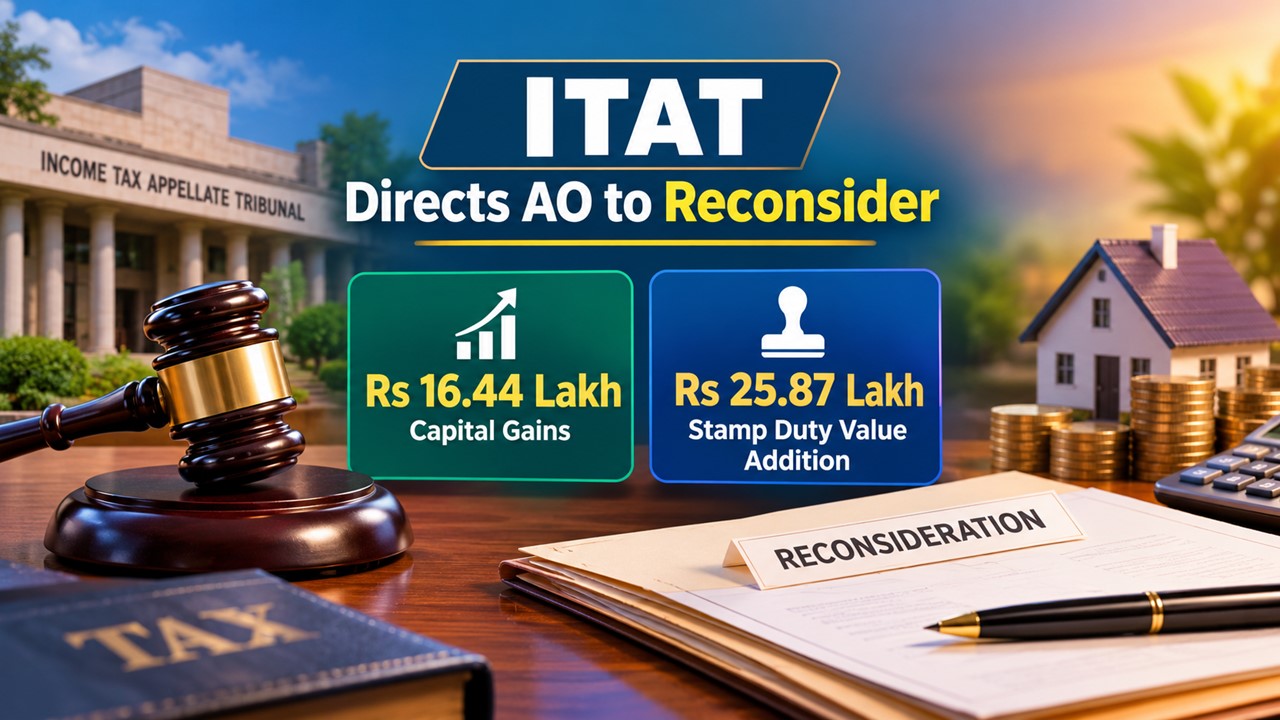
- ITAT Directs AO to Reconsider Rs 16.44 Lakh Capital Gains and Rs 25.87 Lakh Stamp Duty Value Addition
- ITAT Remands Rs 3.33 Crore Demonetisation Cash Deposit Case to AO, Directs Rs 10,000 Relief Fund Payment
- Income Tax Dept Increases Scope for Saksham Nudge Initiative to Further Include Professional Insuring Timely Compliance
Up Next
Loading suggestions…


Recent Posts
All Posts
Recent Posts
All Posts