Final Tax Countdown: Essential Actions, Key Deadlines, And Smart Moves Before 31 March:
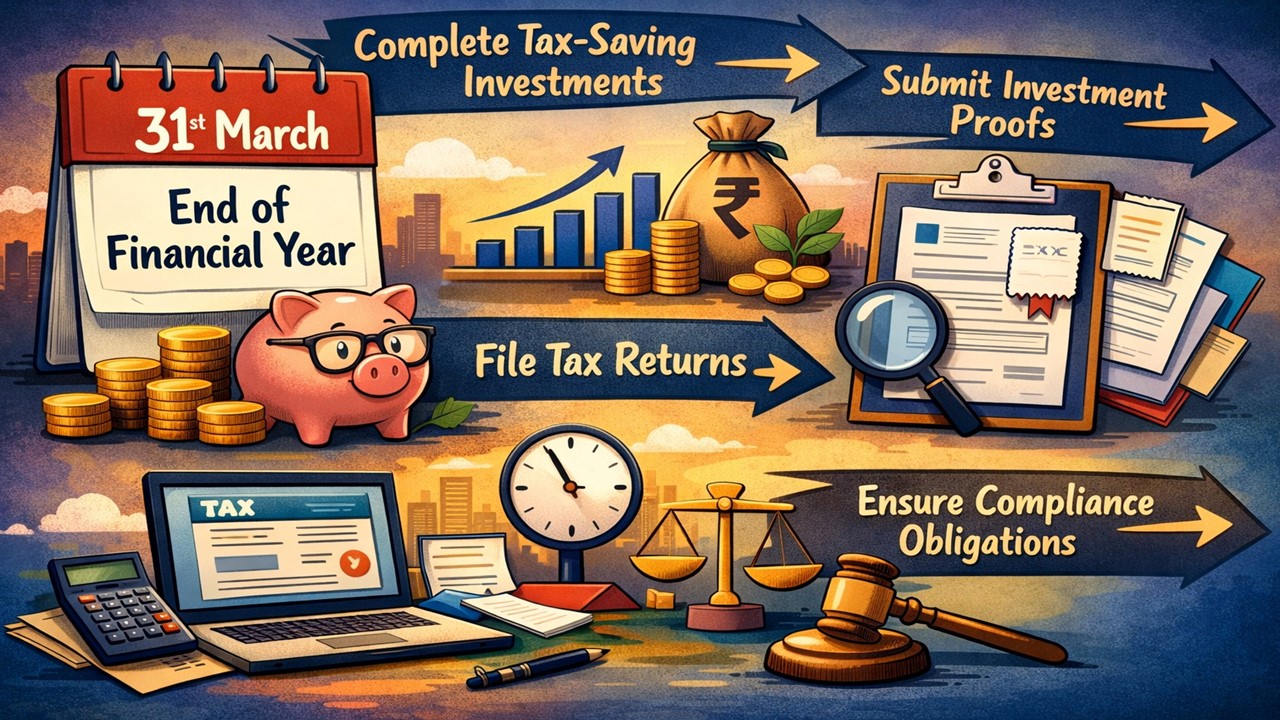
As the financial year ends on 31 March, individuals and businesses must complete key tax-saving investments, submit proofs, file returns, and ensure compliance obligations are met.
Critical Year End Tax Deadlines And Strategies To Maximise Savings
 Kashish Bhardwaj
 Mar 31, 2026
Final Tax Countdown: Critical Steps, Key Deadlines, And Smart Moves Before 31 March
The financial year is about to end, and 31 March 2026 is a very important last date, where individuals and businesses have to complete all their tax-related work by then. If work is not done by this date, you may have to pay extra tax, a penalty may be imposed, or a refund may be delayed.

 Apart from this, 31 March 2026 is the last date to file an updated ITR (ITR-U), which is for the Assessment Year 2021-22. If someone has not reported their income correctly or has missed any income, you can correct it now. This involves extra tax and penalty, but you will avoid further notices or problems in the future.
Adjust Capital Gains and Losses Before Year-End
Taxpayers should also check their capital gains and losses. If there is profit somewhere and loss somewhere, the overall tax can be adjusted. It is necessary to do all this before the end of the financial year.
Apply for Lower or Nil TDS Certificate (Form 13)
People who are in the low tax slab can apply for a lower or nil TDS certificate through Form 13.
Depreciation Benefit for Businesses Before 31 March
Another important thing for businesses is that if they want to avail themselves of the depreciation benefit, then whatever machines or assets they have purchased must be put into use before March 31, 2026; only then can they claim depreciation in the current year.
GST Reconciliation: GSTR-1, GSTR-3B & GSTR-2B
A lot of work has to be done on the GST side also. Businesses should match (reconcile) their GSTR-1, GSTR-3B, and GSTR-2B with their accounts and correct any mismatch in the March return to avoid GST notices.
Review the Input Tax Credit (ITC) Carefully
It is important to review the Input Tax Credit (ITC) carefully. According to Section 17(5), nothing is allowed, so if a claim is made by mistake, then it will have to be reversed.
Exporters Must File LUT for FY 2026-27
Exporters are required to file an LUT (Letter of Undertaking) for the next financial year, i.e., FY 2026-27, before 1 April 2026, so that they can export without paying IGST.
E-Invoicing Mandatory for Turnover Above Rs 5 Crore
Those businesses whose turnover is more than Rs 5 crore in FY 2025-26, e-invoicing will be mandatory from April 1, 2026, so they will have to prepare their systems and team in advance.
In simple words, 31 March 2026 is a final deadline where all tax planning, compliance, and correction work should be completed by then; otherwise, financial loss or legal issues may occur.
Apart from this, 31 March 2026 is the last date to file an updated ITR (ITR-U), which is for the Assessment Year 2021-22. If someone has not reported their income correctly or has missed any income, you can correct it now. This involves extra tax and penalty, but you will avoid further notices or problems in the future.
Adjust Capital Gains and Losses Before Year-End
Taxpayers should also check their capital gains and losses. If there is profit somewhere and loss somewhere, the overall tax can be adjusted. It is necessary to do all this before the end of the financial year.
Apply for Lower or Nil TDS Certificate (Form 13)
People who are in the low tax slab can apply for a lower or nil TDS certificate through Form 13.
Depreciation Benefit for Businesses Before 31 March
Another important thing for businesses is that if they want to avail themselves of the depreciation benefit, then whatever machines or assets they have purchased must be put into use before March 31, 2026; only then can they claim depreciation in the current year.
GST Reconciliation: GSTR-1, GSTR-3B & GSTR-2B
A lot of work has to be done on the GST side also. Businesses should match (reconcile) their GSTR-1, GSTR-3B, and GSTR-2B with their accounts and correct any mismatch in the March return to avoid GST notices.
Review the Input Tax Credit (ITC) Carefully
It is important to review the Input Tax Credit (ITC) carefully. According to Section 17(5), nothing is allowed, so if a claim is made by mistake, then it will have to be reversed.
Exporters Must File LUT for FY 2026-27
Exporters are required to file an LUT (Letter of Undertaking) for the next financial year, i.e., FY 2026-27, before 1 April 2026, so that they can export without paying IGST.
E-Invoicing Mandatory for Turnover Above Rs 5 Crore
Those businesses whose turnover is more than Rs 5 crore in FY 2025-26, e-invoicing will be mandatory from April 1, 2026, so they will have to prepare their systems and team in advance.
In simple words, 31 March 2026 is a final deadline where all tax planning, compliance, and correction work should be completed by then; otherwise, financial loss or legal issues may occur.
Last Chance to Save Tax Under Section 80C
For those who follow the old tax regime, this is the last chance for them to save tax under Section 80C. It includes investments like PPF, SSY, and NPS. The investment must not only be made but also credited to the account before 31st March; otherwise, its benefit will be available in the next financial year. Employees Must Submit Investment Proof to Avoid Higher TDS This time is also important for employees because if they have declared tax-saving investments in their company, it is necessary to submit proof. If proof is not submitted, the company will charge more TDS from the salary, which will reduce the salary received in hand, even if you get a refund later.Deadline for Filing Updated ITR (ITR-U) for AY 2021-22
About Author


Kashish Bhardwaj
Content Writer
 StudyCafe
 Delhi, Delhi, India
 176
176My Recent Articles
- Supreme Court Judge Strength to Increase from 33 to 37 for Faster Justice
- Builder Cleared of Profiteering Charges After Passing Excess ITC Benefit to Homebuyers: GSTAT
- Jubilant Ingrevia to Challenge Rs 2.03 Crore GST Demand Before GSTAT
- Rs 70 Crore Claim Row: Ex-CFO Gobind Jain Moves Bombay High Court Against IndusInd Bank Over Alleged Wrongful Dismissal
- Dream Sports Launches Dream Street: AI-Powered Entry into India’s Retail Broking Market
Up Next
Loading suggestions…


Recent Posts


All Posts



Recent Posts
All Posts