GSTAT: No Profiteering Where Post-GST ITC Ratio Declines; DGAP Report Accepted:
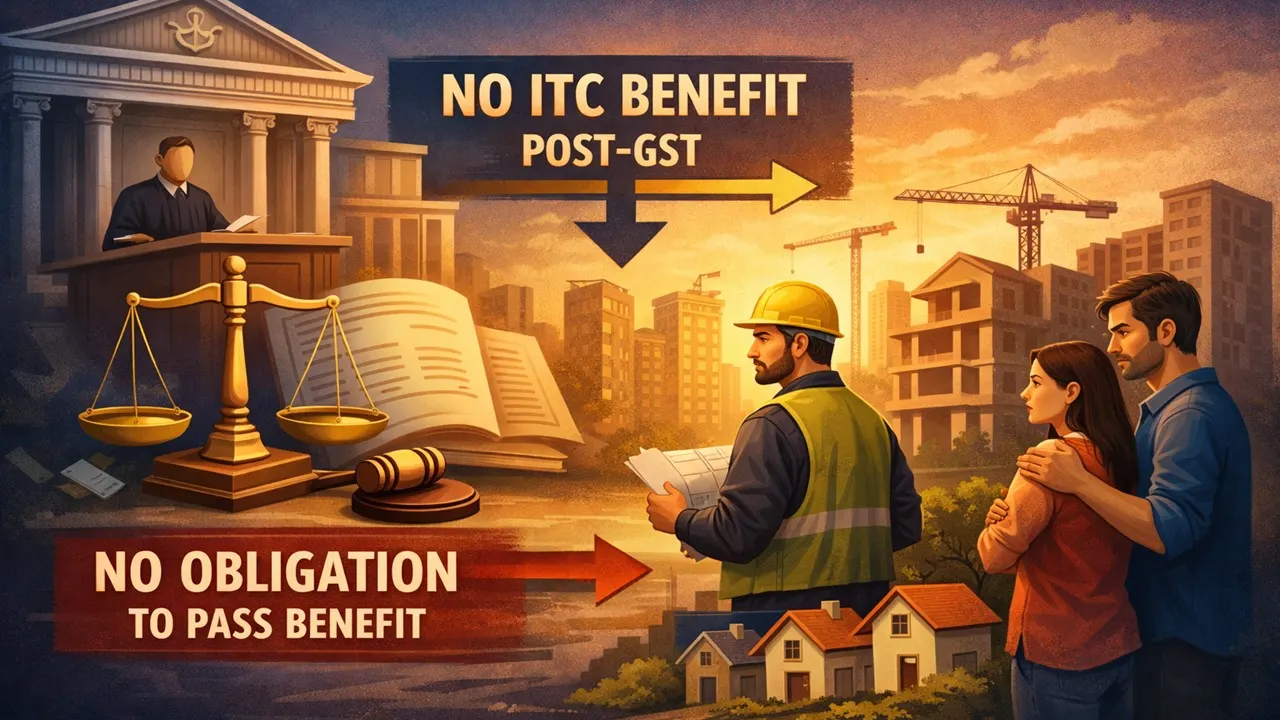
GSTAT upholds DGAP findings and rules that no ITC benefit accrued to the builder post-GST; hence, there is no obligation to pass the benefit to homebuyers under Section 171 of the CGST Act.
GSTAT Rules No Profiteering if Post-GST ITC Declines
 Meetu Kumari
 Apr 17, 2026
GSTAT: No Profiteering Where Post-GST ITC Ratio Declines; DGAP Report Accepted
The proceedings arose from a complaint filed by a homebuyer alleging that the developer, IJM Raintree Park Pvt. Ltd., had failed to pass on Input Tax Credit (ITC) benefits after the introduction of GST in respect of a residential flat booked prior to GST but partly paid during the GST regime. The matter was initially investigated by the DGAP, which, in its earlier report (2020) had concluded that the Respondent had profiteered.
Thereafter, in light of judicial developments and directions from higher authorities, including re-investigation orders and the ruling in Reckitt Benckiser, the DGAP revisited the methodology and issued a fresh report in 2025. In this report, it was concluded that the ratio of ITC to purchase value had actually declined in the post-GST period, indicating that no additional benefit had accrued to the developer.
Main Issue: Whether the Respondent was liable under Section 171 of the CGST Act for profiteering by not passing on ITC benefits to homebuyers after the introduction of GST.
GSTAT Held: The GST Appellate Tribunal rejected the objections of the Complainant and upheld the DGAP report dated 08.01.2025, holding that no profiteering had occurred.
The Tribunal observed that the methodology adopted by the DGAP, based on the comparison of ITC to purchase value, was in line with the principles laid down by the Delhi High Court in Reckitt Benckiser. It emphasised that in real estate projects, ITC cannot be directly correlated with turnover, and the correct approach is to assess overall savings at the project level.
The Tribunal noted that the ITC ratio declined from 6.81% in the pre-GST period to 3.34% in the post-GST period, resulting in a negative differential of 3.47%. This clearly showed that no additional benefit accrued to the Respondent due to GST, and therefore, the requirement to pass on such a benefit did not arise.
Therefore, the Tribunal concluded that the Respondent had not contravened Section 171 of the CGST Act, and the DGAP report was rightly accepted.
To Read Full Judgment, Download PDF Given Below
About Author


Meetu Kumari
Content Manager
Meetu Kumari is an Experienced Advocate and Content Writer with 4+ years of demonstrated history of working in the law practice industry. Skilled in Developing Content, Researching, and Drafting. Strong professional with a Bachelor of Science (B.Sc.) focused on Law from Gujarat National Law University.
Meetu Kumari is an Experienced Advocate and Content Writer with 4+ years of demonstrated history of working in the law practice industry. Skilled in Developing Content, Researching, and Drafting. Strong professional with a Bachelor of Science (B.Sc.) focused on Law from Gujarat National Law University.
 Studycafe
 Jodhpur, Rajasthan, India
 2264
2264My Recent Articles
- ITAT Condones 302-Day Delay, Restores Salary Assessment for Fresh VerificationPremium
- ITAT Condones Delay After Tax Consultant's Death, Restores Appeals for Fresh HearingPremium
- ITAT Remands Salary Addition, Says Taxability Depends on Salary Becoming Due, Not Mere ReceiptPremium
- ITAT Deletes TP Royalty Adjustment, Orders Fresh Review of Commission BenchmarkingPremium
- ITAT Quashes Reassessment Over Unsigned Section 148 Notice Issued to AssesseePremium
Up Next
Loading suggestions…


Recent Posts



All Posts


Recent Posts
All Posts