GSTN Introduces E-Way Bill Closure Facility for Goods Delivery Tracking:
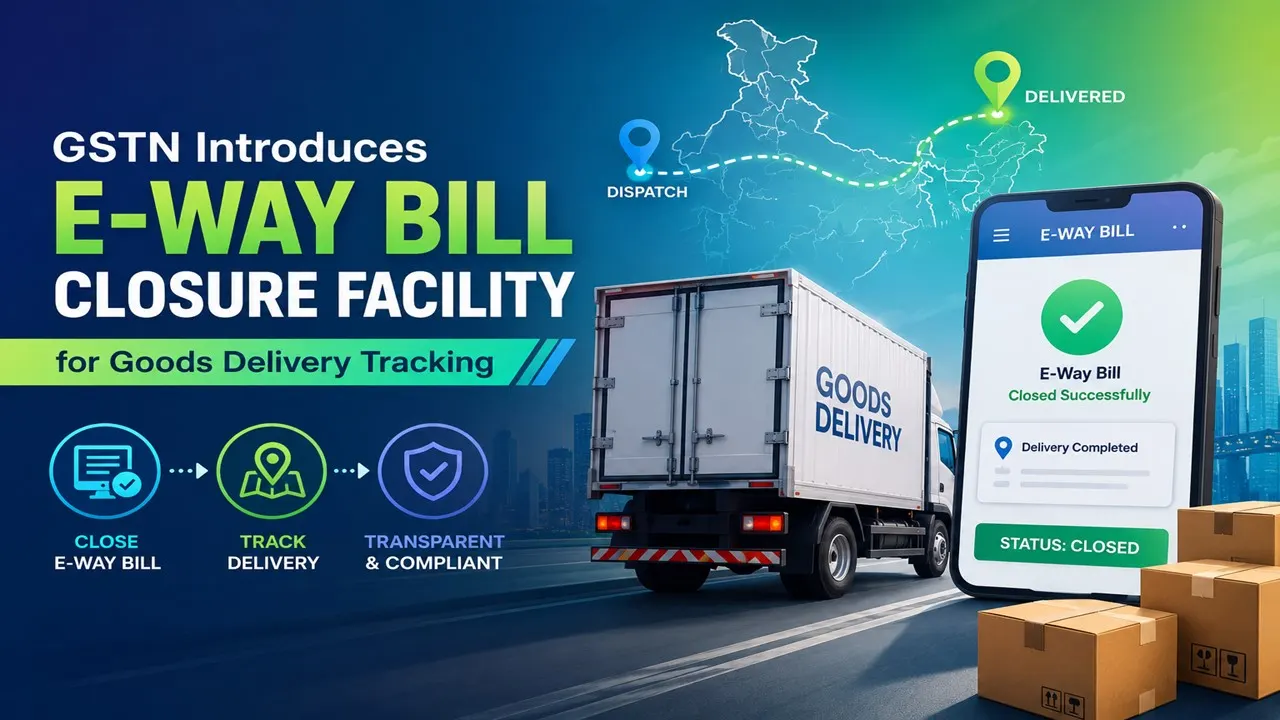
Goods and Services Tax (GST) and GST-registered businesses can now digitally record the delivery of goods.
GST E-Way Bills Can Now Be Closed After Delivery Completion
 Jasmine
 May 23, 2026
GSTN Introduces E-Way Bill Closure Facility for Goods Delivery Tracking
Goods and Services Tax (GST) and GST-registered businesses can now digitally record the delivery of goods for which an e-way bill has been generated on the portal by the government on 21 May (Thursday).
Until now, the e-way bill framework was just tracking initiation and transit of goods movement. A new e-way bill facility has been introduced to enable closure of the e-way bill once delivery of goods is completed.
An individual carrying goods valued over Rs 50,000 has to carry an e-way bill. The document must be generated from the GST Portal by a GST-registered person or transporter before transporting the goods.
GSTN said, "An e-way bill may be closed by either the supplier or the recipient or the transporters involved in the transaction or the driver or any authorised person whose mobile number has been provided for closure."
GSTN also said that the changes are being made to strengthen data integrity, improve traceability of goods movement, and enable system-driven closure of transactions.
It also asked taxpayers, transporters, ERP/API integrators, and other stakeholders to start necessary system readiness measures.
When GST was implemented on July 1, 2017, physical checkpoints were removed, signalling a significant structural shift that facilitated free movement of products and reduced transit times.
According to the experts, this introduction of the e-way bill closure facility marks an important evolution in GST’s digital compliance architecture, and businesses with large supply chains should begin evaluating operational readiness early.
Rajat Mohan (AMRG Global Managing Partner) also said, "While currently introduced as a voluntary mechanism, there is a strong possibility that GSTN may gradually move towards making such closure a mandatory compliance step. If that happens, it could materially strengthen invoice-to-delivery reconciliation and help address concerns around circular trading, round tripping, duplicate invoicing, and fictitious movement of goods."
About Author


Jasmine
Digital Marketing Excutive
 Studycafe
 dwarka, Delhi, India
 108
108My Recent Articles
- ITAT Rules BSNL VRS Compensation Exempt from Tax Under Section 10(10B), Grants Leave Encashment ReliefPremium
- Kerala Headload Workers Welfare Board Granted Income Tax Exemption for Three Tax YearsPremium
- ITR Filing: Why You Shouldn't Rely on a July 31 Deadline Extension
- Meerut Accountant Accused in Rs 65.5 Crore Income Tax Refund Scam
- Professional’s Viral Post on Rs 1 Crore Tax Sparks Debate on India’s Social Security
Up Next
Loading suggestions…


Recent Posts


All Posts



Recent Posts
All Posts