GSTR-1 and GSTR-3B Differences Can’t Automatically Trigger Tax Demand: GSTAT:
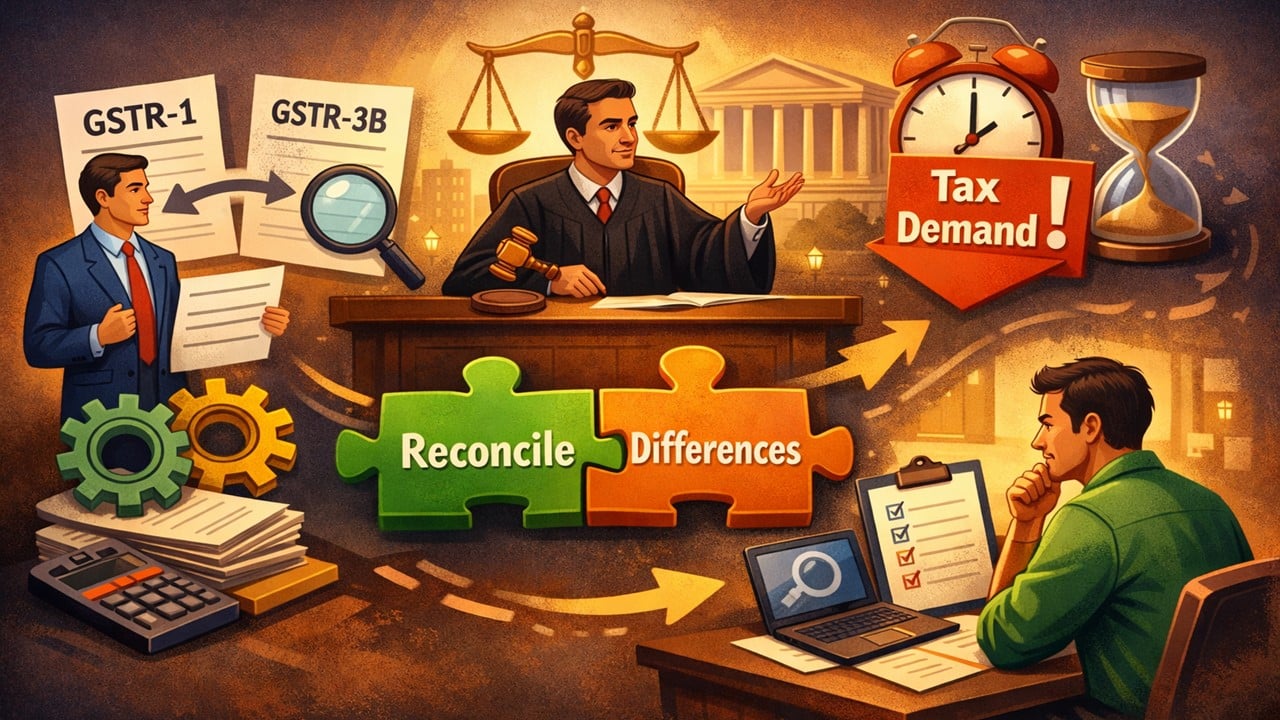
The GSTAT allowed the taxpayer to reconcile GSTR-1 and GSTR-3B differences, holding that timing adjustments cannot automatically trigger tax demand, and ordered fresh review.
GSTAT Stresses Human Errors In Early GST Era
 Saloni Kumari
 Feb 14, 2026
GSTR-1 and GSTR-3B Differences Can’t Automatically Trigger Tax Demand: GSTAT
The Principal Bench of the GST Appellate Tribunal (GSTAT), in its first ruling in the case titled Sterling and Wilson Private Limited vs Commissioner, Odisha, has ruled that the taxpayer should be allowed to file a revised return after clarifying that differences in GST returns caused by credit notes, advances, or timing adjustments recorded in books should not automatically lead to tax demands or penalties. Hence, the taxpayer should be given a chance to reconcile the difference between GSTR-1 and GSTR-3B. The case concerns the financial year 2018-19.
In the present case, a tax demand amounting to Rs. 27 lakh (CGST and SGST amounting to Rs. 27,06,634, along with interest of Rs. 11,04,582 and a penalty of Rs. 27,06,634, aggregating to Rs. 65,17,849) was raised on the appellant company for the Financial Year 2018-19. For the year in consideration, the appellant had declared an output tax liability of Rs. 31.36 Crore in GSTR-1, while the tax liability declared in GSTR-3B was Rs. 31.09 Crore, resulting in a short tax liability amounting to Rs. 27.06 lakh.
This explicitly indicates that the tax liability disclosed in GSTR-1 was much higher than that declared in GSTR-3B. The tax department treated this differently as a short payment of tax and initiated proceedings under Section 74. The First Appellate Authority initially admitted that there was no fraud involved in the present case but still confirmed tax and interest, converted the matter to Section 73, and reduced the penalty amount.
The appellant company thereafter filed and approached the GSTAT. Where it claimed that the discrepancies between GSTR-1 and GSTR-3B were due to timing differences, credit notes, debit notes, and advance adjustments concerning different tax periods. These could not be corrected in GSTR-1 because the GST system had limitations in the early years.
The GSTAT ruled, "We are of the opinion that the CGST/SGST Act is a relatively new act, and professionals may not be thorough in filing returns at the relevant period, together with the fact that, at that particular time, most of the returns were being filed manually, and the technique of auto-population and full online filling was not operational to the fullest extent as it is now. There were chances of human error. In order to obviate any such human error, the matter should be reconsidered by the learned Proper Officer."
The Tribunal ruled that the Appellate Authority could not change proceedings from Section 74 to Section 73 on its own. As per the law and guidelines of the Central Board of Indirect Taxes and Customs (CBIC), any fresh determination must be made by the Proper Officer after giving the taxpayer an opportunity to submit reconciliation and revised details.
The matter was sent back to the proper officer for fresh review and proper hearing within one month.
About Author


Saloni Kumari
Content Writer
Saloni is a Content Writer with 2+ years of experience at studycafe.in. She writes legal, taxation, and finance related content including GST, Income Tax etc. Skilled in translating complex judicial pronouncements and regulatory developments into clear, and reader-friendly articles. Experienced in covering judgements of ITAT, High Court, GSTAT, and news related to Income Tax, GST, and corporate law. She can be reached at [email protected].
Saloni is a Content Writer with 2+ years of experience at studycafe.in. She writes legal, taxation, and finance related content including GST, Income Tax etc. Skilled in translating complex judicial pronouncements and regulatory developments into clear, and reader-friendly articles. Experienced in covering judgements of ITAT, High Court, GSTAT, and news related to Income Tax, GST, and corporate law. She can be reached at [email protected].
 StudyCafe
 Delhi, Delhi, India
 2924
2924My Recent Articles
- Major Relief in Arbitration Case: MCIA Denies Rs 908 Crore Statement Claim Made by Allied Silica Against Tata Chemicals
- MCA and ICSI to Hold User Awareness Session on Form AOC-4 Filing Amid Glitches on MCA-21 Version-3 Portal
- GSTN Introduces New E-Invoicing Facility for Self-Invoices Under Reverse Charge Mechanism
- Flexi Cap vs Multi Cap Funds: What's the Real Difference?
- IBA Recommends Public Sector Banks to Reduce Ambit of Physical Branch Audits to 50% of Total Business
Up Next
Loading suggestions…


Recent Posts
All Posts
Recent Posts
All Posts