High Court Permits Videography of CGST Summons and Advocate Presence Beyond Audible Range:
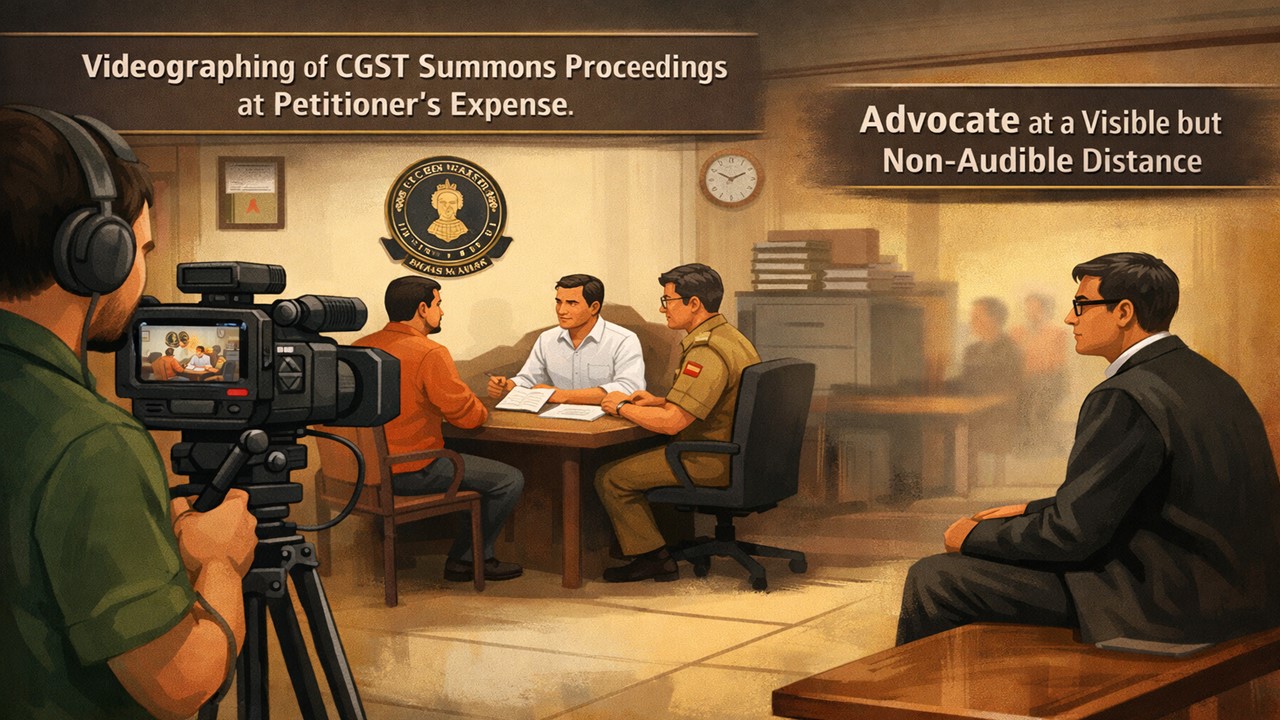
The High Court permitted videographing of CGST summons proceedings at the petitioner’s expense and allowed advocate presence at a visible but non-audible distance.
HC Allows Videographing of CGST Proceedings
 Saloni Kumari
 Feb 23, 2026
High Court Permits Videography of CGST Summons and Advocate Presence Beyond Audible Range
On February 12, 2026, the Bombay High Court allowed videographing of CGST summons proceedings at the petitioner’s expense and permitted the advocate's presence beyond audible distance, citing its own earlier ruling.
The Honourable Justices G. S. Kulkarni and Aarti Sathe of the High Court of Judicature at Bombay have announced their decision on a petition filed by Tuesonpower International Pvt. Ltd. and another against the Union of India and another. The final decision on the matter was announced on February 12, 2026.
The key request raised in the present petition is that Petitioner No. 2, who had received a summons under Section 70 of the Central Goods and Services Tax (CGST) Act, 2017, should be allowed to have an advocate to attend the hearing of the summons proceedings by sitting at a visible but not audible distance. The petitioner should have requested that the hearing be videographed at their own cost. The petitioner had also requested some other reliefs; however, they have not been stressed in the present stage.
The summons concerned an inquiry conducted on an input tax credit (ITC) claimed by the petitioner on purchases from two suppliers, M/s. Zes Stock Enterprises and M/s. New Era Enterprises. As per the petitioner, the said transactions were genuine and were supported by proper tax invoices, were duly reflected in GSTR-2B returns, and all payments were made through proper banking channels. It was further flagged that the GST registrations of the supplier were cancelled, and appeals are pending. Also, the second petitioner is suffering from cancer.
However, the respondents raised arguments on the prayers raised by the petitioner and said they should cooperate and observed that CCTV cameras were already fitted in their premises. However, when the court analysed the facts of the case, it permitted videographing in the current case at the petitioner's own expense and also allowed the petitioner to have an advocate to be present in the hearing of summons proceedings, but not within audible distance. To support this ruling, the court also cited an earlier ruling of its own in a case titled Suumaya Industries Ltd v. Union of India, where a similar arrangement was allowed.
About Author


Saloni Kumari
Content Writer
Saloni is a Content Writer with 2+ years of experience at studycafe.in. She writes legal, taxation, and finance related content including GST, Income Tax etc. Skilled in translating complex judicial pronouncements and regulatory developments into clear, and reader-friendly articles. Experienced in covering judgements of ITAT, High Court, GSTAT, and news related to Income Tax, GST, and corporate law. She can be reached at [email protected].
Saloni is a Content Writer with 2+ years of experience at studycafe.in. She writes legal, taxation, and finance related content including GST, Income Tax etc. Skilled in translating complex judicial pronouncements and regulatory developments into clear, and reader-friendly articles. Experienced in covering judgements of ITAT, High Court, GSTAT, and news related to Income Tax, GST, and corporate law. She can be reached at [email protected].
 StudyCafe
 Delhi, Delhi, India
 2924
2924My Recent Articles
- Major Relief in Arbitration Case: MCIA Denies Rs 908 Crore Statement Claim Made by Allied Silica Against Tata Chemicals
- MCA and ICSI to Hold User Awareness Session on Form AOC-4 Filing Amid Glitches on MCA-21 Version-3 Portal
- GSTN Introduces New E-Invoicing Facility for Self-Invoices Under Reverse Charge Mechanism
- Flexi Cap vs Multi Cap Funds: What's the Real Difference?
- IBA Recommends Public Sector Banks to Reduce Ambit of Physical Branch Audits to 50% of Total Business
Up Next
Loading suggestions…


Recent Posts
All Posts

Recent Posts
All Posts