How Much Cash Can You Deposit in a Savings Account Without Getting Tax Notice?:
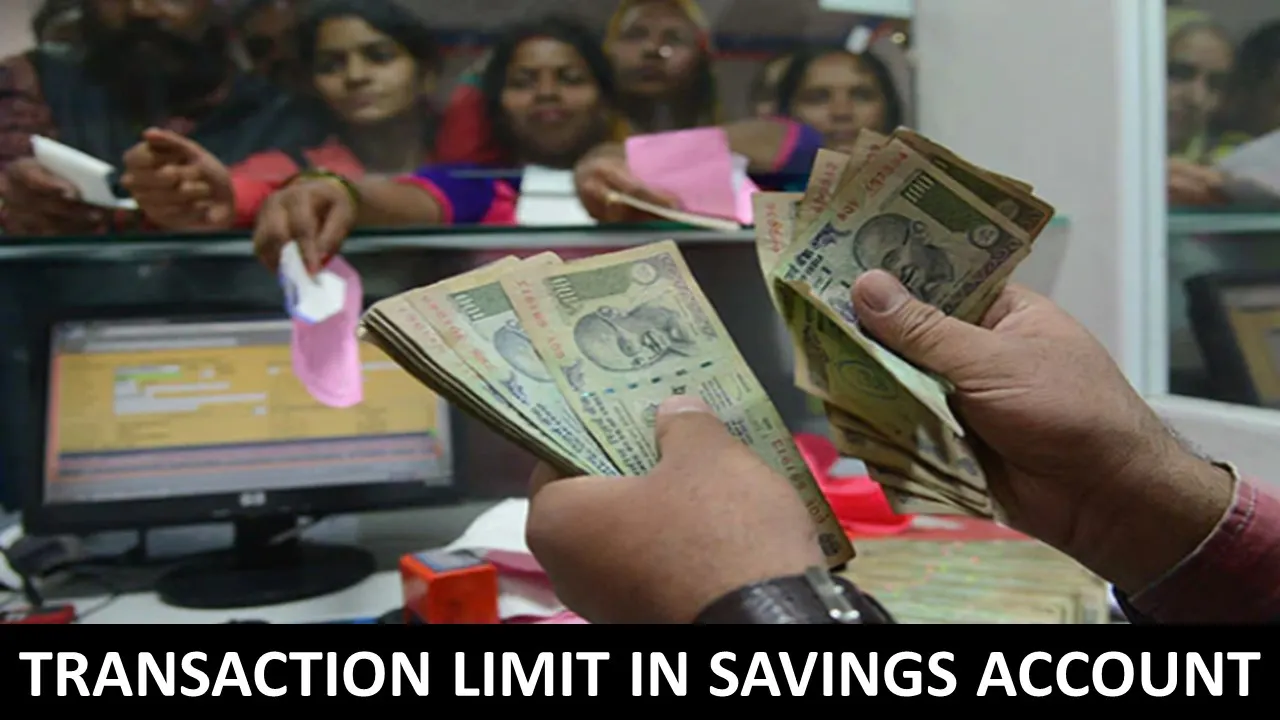
Understanding the cash deposit limit is important to avoid penalties and notices from the Income Tax Department.
Transaction Limit In Savings Account
 Nidhi
Nidhi Jun 25, 2025
Table of Contents

How Much Cash Can You Deposit in a Savings Account Without Getting Tax Notice?
Income Tax authorities issue a notice when they observe that the taxpayer is doing large-value transactions, including depositing or withdrawing large cash amounts. But have you ever wondered how much cash you can deposit or withdraw from your savings account each year without attracting the attention of income tax authorities? Understanding the cash deposit limit is important to avoid penalties and notices from the Income Tax Department.
Experts say that, according to income tax rules, the total cash you put into or take out of your savings account during a financial year must remain below Rs 10 lakh to avoid getting noticed by the income tax department. In case you deposit cash above Rs 10 lakh in all your savings accounts within a financial year, then you should disclose this to the income tax department.
Also, you should not receive Rs 2 lakh or more in cash from the same person in a single day, whether it is one payment or several payments related to the same event or occasion.
Cash Deposit Limit in Savings Account
People often ask about how much cash they can deposit in their bank accounts without facing problems or extra paperwork. While there is no fixed daily cash deposit limit set by the Reserve Bank of India (RBI) for everyone, there are certain limits. If you cross these limits, you will be required to share more information with the bank and tax authorities.Cash Deposit Rules Per Transaction and Per Day
Up to Rs 50,000: You can deposit cash up to Rs 50,000 in a single transaction without providing your PAN details, as long as your bank account is already linked to your PAN. Above Rs 50,000: If you deposit more than Rs 50,000 in cash at once, you must provide your PAN card details. If you don’t have a PAN, you will need to fill out Form 60 or 61. Large Daily Deposits: As per some sources, the cash deposit limit is Rs 1 lakh and up to Rs 2.5 lakh on special occasions. But generally, if you deposit more than Rs 2.5 lakh in a day (Rs 5 lakh for senior citizens), it will be treated as a large deposit. This may lead to the Income Tax Department asking questions about where the money came from.Cash Deposit Annual Limit
Each financial year, you can deposit up to Rs 10 lakh in cash across all your savings accounts without any issues. If your total cash deposits go over this limit, banks are required to inform the Income Tax Department (as per the rules under the Income Tax Act, 1962).What Happens If You Cross This Limit?
If you deposit more than Rs 10 lakh in cash during the year, you might get a notice from the tax department. This does not mean you will be taxed, but you will have to explain where the money came from. It could be from your salary, business income, a loan, a gift, or even inheritance. If you are unable to give a proper explanation or proof, the income tax authorities might treat that money as unexplained income, and you could face taxes or penalties.Cash Withdrawal Limit
Unlike cash deposits, there is no strict daily limit for cash withdrawals from savings accounts set by the government for tax reporting. However, banks and tax laws do have some rules you should know.- ATM Withdrawals: Banks usually set a daily limit on how much you can withdraw from an ATM. This limit depends on your bank, the type of savings account you have, and the debit card you use. The daily ATM limit can be between Rs 10,000 and Rs 1 lakh or more.
- Cash Withdrawals at Bank Branches: If you are withdrawing money yourself at your home branch, there is usually no fixed daily limit if you have enough balance. But, if someone else is withdrawing on your behalf (third party), there may be a daily limit, usually around Rs 50,000. Withdrawals using a withdrawal slip with a passbook at your branch are usually not restricted by a specific limit.

TDS on Big Withdrawals
- Under Section 194N of the Income Tax Act, TDS (Tax Deducted at Source) may apply on large cash withdrawals. If you withdraw more than Rs 1 crore in a financial year, 2% TDS will be deducted.
- If you have not filed income tax returns, 2% TDS will be imposed on withdrawals above Rs 20 lakh, and 5% TDS applies on withdrawals over Rs 1 crore.
Digital Fund Transfer Limits for Savings Accounts: NEFT, RTGS, IMPS and UPI
If you are transferring money digitally, the limits are much higher compared to cash transactions. These limits vary depending on the method you use and the bank's rules. Here's a simple breakdown: NEFT (National Electronic Funds Transfer): Many banks allow individual transactions up to Rs 2 lakh. However, depending on your bank policies, your daily transfer limit can go up to Rs 5 lakh, Rs 10 lakh, or even Rs 50 lakh for online NEFT transactions per day. RTGS (Real Time Gross Settlement): RTGS is for large-value transactions and has a minimum limit of Rs 2 lakh per transaction. Depending on your bank, the per-transaction or daily limit can go up to Rs 5 lakh, Rs 10 lakh, or even higher. RTGS is fast and reliable, especially for business- or property-related payments. IMPS (Immediate Payment Service): IMPS is best for making small- to medium-sized transfers and is available 24 hours, even on holidays.- The per-transaction limit is usually up to Rs 50,000.
- The per-transaction limit is usually up to Rs 2 Lakh.
- The per-transaction limit can go up to Rs 25,000 or Rs 50,000, depending on the bank.
- The per day can range between Rs 50,000 and Rs 1 lakh, though some banks allow more.
- When you add a beneficiary to transfer money to, most banks limit how much you can send to them for the first 24 hours. This is a security feature. The limit is usually Rs 25,000 to Rs 50,000.
Things to Keep in Mind
- Savings Accounts Are Not for Business: Savings accounts are for personal use. If you are using them for regular or large-value business transactions, the bank might ask you to switch to a current account.
- Keep Transaction Records: Always keep details of big deposits or withdrawals. This includes where the money came from and what it was used for.
- Inactive Accounts Can Be Frozen: If your account has had no activity for over two years, it could be marked as dormant. You will need to visit the bank and complete KYC to use it again.
- Consider Minimum Balance Rules: Most savings accounts require a minimum balance each month or quarter. If you do not maintain it, the bank may charge you a fee.
- Keep an Eye on Large Deposits: Even if you stay within daily cash deposit limits, doing it more often may catch the Income Tax Department's attention. It could be seen as suspicious under anti-money laundering rules, and banks may send you alerts for the same.
- Use PAN for Large Cash Deals: If you are handling large amounts of cash, make sure to provide your PAN card. This will maintain transparency and help avoid notices issued by tax authorities.
About Author


Nidhi
Content Writer
Nidhi is a skilled content writer specializing in personal finance. She creates clear, engaging articles on mutual funds, investments, insurance, and wealth-building strategies. With a passion for simplifying complex financial topics, Nidhi helps readers make informed money decisions with confidence. She can be reached at [email protected]
Nidhi is a skilled content writer specializing in personal finance. She creates clear, engaging articles on mutual funds, investments, insurance, and wealth-building strategies. With a passion for simplifying complex financial topics, Nidhi helps readers make informed money decisions with confidence. She can be reached at [email protected]
 Studycafe
 New Delhi, Delhi, India
 1832
1832My Recent Articles
- Karnataka High Court Gives Another Chance in GST Matter Due to Lack of Hearing
- Delay Should Be Condoned if Explanation is Unrefuted: ITAT
- Non-Service of Income Tax Notice, Ill health of taxpayer, ITAT condones Appeal filing delay
- Books of Accounts Cannot be Rejected Without Any Specific Defect: ITAT Kolkata
- Karnataka High Court Sends ITC Matter Back to GST Authorities for Reconsideration
Up Next
Loading suggestions…


Recent Posts


All Posts
Recent Posts
All Posts