ITAT Allows Charitable Trust Appeal: Donations Held Religious, Not Business Income:
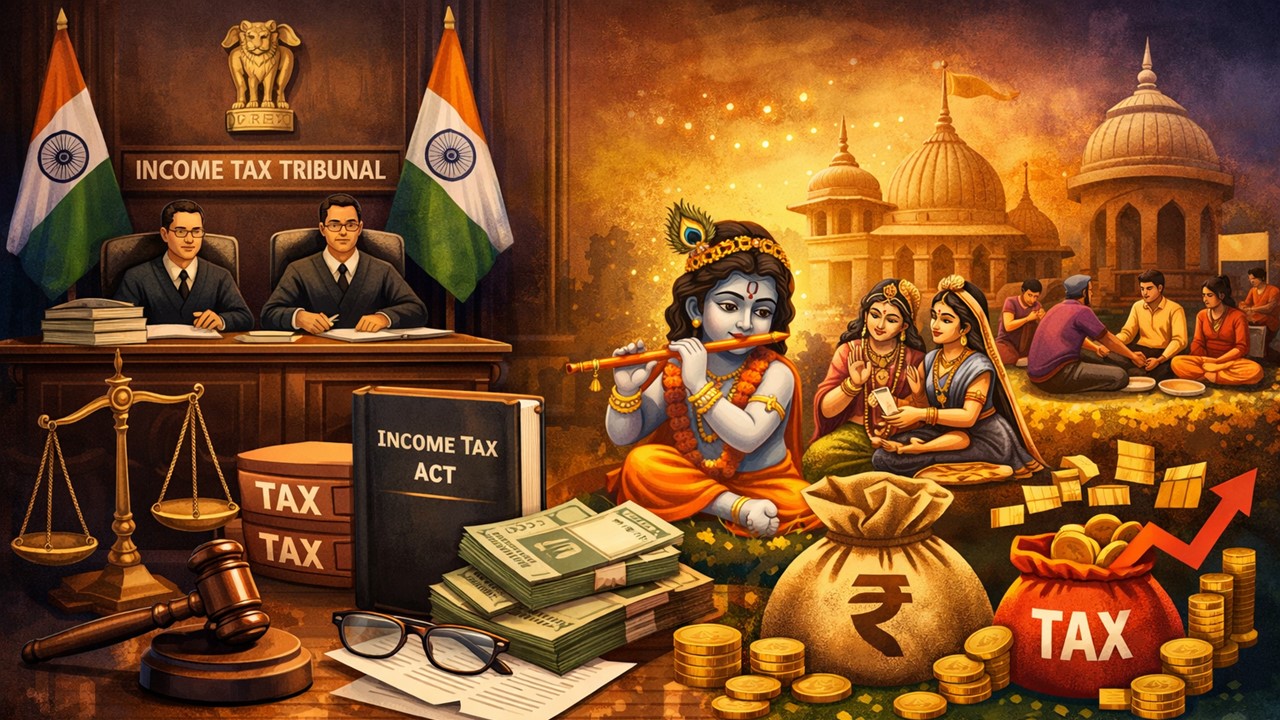
ITAT ruled that donations received by a charitable trust for religious celebrations were not business income and upheld the exemption under Sections 11 and 12 of the Income-tax Act.
Festival Donations Not Taxable as Business Income: ITAT
 Saloni Kumari
 Dec 24, 2025
ITAT Allows Charitable Trust Appeal: Donations Held Religious, Not Business Income
ITAT held that donations received by the charitable trust were used for religious and cultural activities, not business. Since advertisement receipts were below 20%, the Section 11 and 12 exemption was rightly available.
Shri Krishna Janmashtmi Mahotsav Samiti has filed the current appeal in the ITAT Delhi, challenging an order dated May 24, 2024, passed by the NFAC.
The assessee is a charitable trust registered under Section 12A and is also approved under Section 8-G of the Income-tax Act, 1961. For the Assessment Year (AY), the assessee filed his income tax return (ITR), declaring taxable income at NIL, after claiming exemption under Sections 11 and 12 of the Act. The AO started the return assessment under Section 143(3) of the Act and completed the assessment, making an addition of Rs. 50,54,000 to the income of the assessee, claiming "business income liable to tax at the maximum marginal rate under Section 11(4A) of the Act." Additionally, AO claimed that certain donations were made to the assessee during the festival of Janmashtami Mahotsav; they were actually advertisement or business promotion receipts, as per replies given by some donors under Section 133(6) of the Act.
The aggrieved assessee filed an appeal before CIT(A); however, the CIT(A) dismissed the appeal of the assessee and allowed the additions made by the AO. Thereafter, the assessee approached ITAT Delhi, challenging the order of the CIT(A) and AO, wherein it claimed that the AO incorrectly treated the donations received by them as "corpus" and "business income." However, the assessee claimed that the donations in question were never claimed as corpus, and the Income & Expenditure Account clearly mentions that the donations received were voluntary contributions for organising Janmashtami Mahotsav and associated publicity.
When the tribunal heard the arguments of both sides, it noted that the amount of donation was indeed used for religious and cultural purposes and not under "advancement of any other object of general public utility," as mentioned under Section 2(15) of the Act. Under the said section, a trust does not fall under charitable status if it undertakes trade under "general public utility." When examined, it was noticed that the alleged advertisement donations form was less than 20% of the total donation amount received by the trust, which is below the statutory limit.
The second allegation against the trust was that the trust used the donation amount to meet its business objectives. On this claim, the assessee also submitted all the relevant documents, proving the claim incorrect. Furnished documents proved that the trust used the donation receipts to organise Janmashtami Mahotsav, arrange free meals (bhandaras), conduct religious discourses, pay for publicity material like banners and posters, and construct a dharmshala in Vrindavan.
Considering all the aforesaid findings, the tribunal concluded that the Trust never used the donation receipts in commercial or business activity, and all the allegations made against the company were invalid. Hence, as a result, it allowed the appeal of the assessee and set aside the addition made by the AO.
About Author


Saloni Kumari
Content Writer
Saloni is a Content Writer with 2+ years of experience at studycafe.in. She writes legal, taxation, and finance related content including GST, Income Tax etc. Skilled in translating complex judicial pronouncements and regulatory developments into clear, and reader-friendly articles. Experienced in covering judgements of ITAT, High Court, GSTAT, and news related to Income Tax, GST, and corporate law. She can be reached at [email protected].
Saloni is a Content Writer with 2+ years of experience at studycafe.in. She writes legal, taxation, and finance related content including GST, Income Tax etc. Skilled in translating complex judicial pronouncements and regulatory developments into clear, and reader-friendly articles. Experienced in covering judgements of ITAT, High Court, GSTAT, and news related to Income Tax, GST, and corporate law. She can be reached at [email protected].
 StudyCafe
 Delhi, Delhi, India
 2924
2924My Recent Articles
- Major Relief in Arbitration Case: MCIA Denies Rs 908 Crore Statement Claim Made by Allied Silica Against Tata Chemicals
- MCA and ICSI to Hold User Awareness Session on Form AOC-4 Filing Amid Glitches on MCA-21 Version-3 Portal
- GSTN Introduces New E-Invoicing Facility for Self-Invoices Under Reverse Charge Mechanism
- Flexi Cap vs Multi Cap Funds: What's the Real Difference?
- IBA Recommends Public Sector Banks to Reduce Ambit of Physical Branch Audits to 50% of Total Business
Up Next
Loading suggestions…


Recent Posts
All Posts
Tags
Recent Posts
All Posts