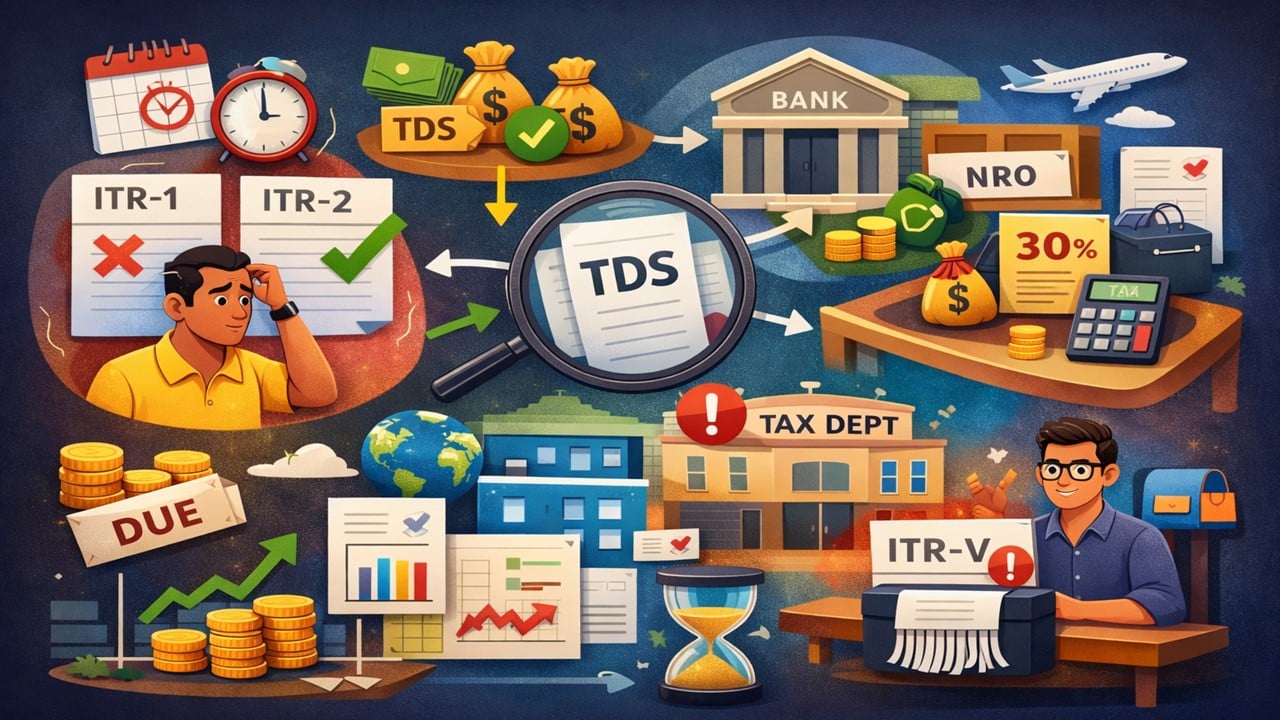
ITR Filing for Non-Residents in India: Rules, Process and FAQs

A comprehensive overview of NRI taxation in India, including ITR process, deductions, benefits, and key deadlines.

Comprehensive Guide to Income Tax Returns for NRIs

Vanshika verma | Jan 29, 2026 |

ITR Filing for Non-Residents in India: Rules, Process and FAQs

ITR Filing for Non-Residents in India: Rules, Process and FAQs

Filing Income Tax in India can be confusing for people living abroad. If you are a non-resident, your tax depends on where your money comes from in India and how long you stay here. Many non-residents earn income from things like Indian bank accounts, property, or business. Knowing which income is taxable in India is important to avoid fines or problems with the tax department.

Below are some frequently asked questions related to filing Income Tax Returns (ITR) for Non-Residents:

Q. Who is considered a resident?

Under the Income Tax Act, residential status determines how you are taxed and is based on your physical stay rather than citizenship. An individual is a Resident if they meet either of these conditions:

  • If he/she stays in the country for 182 days or more during the financial year.
  • If he/she stays for 60 days or more in the current year and at least 365 days or more during 4 years immediately preceding the previous year.

Q. Who is considered a non-resident?

A non-resident is anyone who does not meet the legal criteria to be considered a resident of a specific place. It also includes a person who is not ordinarily resident.

Q. What do you mean by “not ordinarily resident”?

A person is called “Not Ordinarily Resident (NOR) in India” for a year if the person falls into any one of the following cases:

(a) An individual is treated as not ordinarily resident if they stayed outside India for at least 9 out of the last 10 years, or they were in India for 729 days or less in total during the last 7 years.

(b) A Hindu Undivided Family (HUF) is treated as not ordinarily resident if its Karta (manager) stayed outside India for 9 out of the last 10 years, or the Karta stayed in India for 729 days or less during the last 7 years.

(c) A Citizen of India or a Person of Indian Origin (PIO) is treated as not ordinarily resident if their income excluding foreign income is more than Rs 15 lakh, and they stayed in India for 120 days or more but less than 182 days in that year.

(d) Even if you are an Indian citizen living mostly abroad, the law may still treat you as a resident of India for tax purposes for that year under clause (1A) of section 6 of the Income-tax Act, 1961.

Q. What do you mean by income from foreign sources?

Income that is earned outside India is generally not taxable in India, as long as it does not have any direct connection to India. However, if that foreign income comes from a business that is controlled from India or a profession that is set up in India, then it will be considered taxable in India, even if the money is earned abroad.

Q. Is a non-resident’s global income taxable in India?

A non-resident is taxable in India only on income that is earned, received, or arises or is deemed to arise in India. Income earned outside India or received outside India has no tax liability in India for a non-resident.

Q Is it mandatory to file ITR for Non-residents?

If a non-resident earns any income connected to India and that income is more than the tax-free limit, then they must file an Income Tax Return (ITR) in India.

Q. Is interest from Non-Resident External (NRE)/ Foreign Currency Non-Resident Account (FCNR) taxable in India?

Any interest you earn on NRE or FCNR bank accounts is completely tax-free in India as per the provision of section 10(4) of the Income-tax Act.

Q. Is interest from Non-Resident Ordinary (NRO) accounts taxable in India?

Interest earned on an NRI/NRO account is taxable in India. The bank deducts tax directly at 30%, and on top of that, surcharge and cess are also added.

Q. Whether Non-residents claim deductions under section 80C?

Yes, even Non-Residents (NRIs) can claim tax deductions under Section 80C, but only for certain investments.

Q. What is the due date for filing ITR for Non-residents?

You’re supposed to file your Income Tax Return (ITR) by July 31 each year. But you can file a belated return up to December 31 of the same year, but it may come with a late fee or penalty.

Q Which forms are to be used for filing ITR by Non-residents?

NRIs must choose between the following two forms:

  • ITR-2: Use this if you have income from salary, one or more house properties, capital gains (from shares, mutual funds, or real estate), or other sources like bank interest.
  • ITR-3: Use this if you have income from a business or profession in India, or if you are a partner in an Indian partnership firm.

Q What is the ITR filing process for Non-residents?

Non-resident taxpayers can file their income tax return (ITR) online through the official Income Tax e-filing website, or they can use other online tax filing services. After filing, the return needs to be verified. This can be done easily online using an Aadhaar OTP or a digital signature. If you prefer, you can also verify it by sending a signed copy of the ITR-V form to the Centralised Processing Center (CPC) in Bangalore via email, speed post, or registered post.

Q: How to receive a refund from income-tax department at the earliest?

When you file your Income Tax Return (ITR) in India, you should provide your details such as Name of Bank, Bank Account Number, IFSC Code etc. more carefully so that any refund from the Income Tax Department goes directly into your account.

Q What are the benefits of filing an Income Tax Return (ITR) for a non-resident?

Below are the benefits of filing ITR for a non-resident:

  • Carry forward of capital losses for future tax benefits
  • Claiming refunds of excess TDS deducted
  • Avoid double taxation (via DTAA benefits)
  • Maintain financial credibility for loans, visas, investments etc.

Q What are the steps to file ITR for Non-resident

Non-resident status in India depends on how many days you stay in India in a financial year (April 1 to March 31). Following is the step-by-step guide to ITR Filing for NRIs:

1. Determine Your Residential Status calculate the number of days you spent in India during the financial year to confirm your NRI status. Generally, a stay of less than 182 days in the financial year qualifies you as an NRI for tax purposes.

2. Gather Necessary Documents Collect essential documents like your PAN card, passport (for travel details), NRO/NRE bank statements, TDS certificates (Form 16/16A), and Form 26AS/Annual Information Statement (AIS) to reconcile all income and tax deductions.

3. Calculate Taxable Income as certain your total taxable income accrued or received in India, including salary, rental income, capital gains, and interest from NRO accounts. Note that interest from NRE and FCNR accounts is exempt from tax in India but must still be reported as exempt income.

4. Claim DTAA Relief (If Applicable) If you are a resident of a country that has a Double Taxation Avoidance Agreement (DTAA) with India, you can claim relief to avoid paying tax twice on the same income. You may need to submit a Tax Residency Certificate (TRC) and Form 10F on the Income Tax e-Filing Portal to claim benefits.

5. Choose the Correct ITR Form NRIs cannot use ITR-1 (Sahaj) or ITR-4 (Sugam) forms

  • Use ITR-2 if you have income from salary, house property, capital gains, or other sources (excluding business/profession income).
  • Use ITR-3 if you have income from a business or profession in India.

6. File Your Return Online

Step 1: Log in to the Income Tax e-Filing Portal using your PAN and password.

Step 2: Navigate to the e-File section and select “File Income Tax Return”.

Step 3: Select the correct Assessment Year and ITR form.

Step 4: Fill in all the required personal, income, deduction, and bank account details.

7. Verify Your ITR After submitting the form, you must verify it electronically (e-Verification using Aadhaar OTP, Net banking, or a Digital Signature Certificate) or by sending a signed physical copy of the ITR-V to the Centralised Processing Centre (CPC) in Bengaluru within 30 days.

Q. Common Mistakes to Avoid While Filing ITR

Using the Incorrect Form: Don’t pick the wrong ITR form. If you’re a non-resident, ITR-I won’t work. Use ITR-2 or ITR-3. Using the wrong form can make your filing invalid.

Missing Deadlines: Normally, you should file your ITR by July 31, 2025. For some people like salaried employees or non-residents whose accounts don’t need auditing, the deadline is extended to September 15, 2025. If you file late, you might have to pay a penalty of Rs 5,000 and Rs 1,000 if your income is equal to or below Rs 5 lakh, plus interest for the delay.

Ignoring TDS Mismatches: Check Form 26AS carefully. It shows tax deducted at source (TDS). If TDS is shown but you didn’t report that income in your ITR, the Income Tax Department may send a notice asking why.

Not Reporting Exempt Income: Interest earned from NRE or FCNR accounts is completely tax-free. On the other hand, interest earned from an NRO account is taxable, usually at 30% plus additional charges like surcharge and health/education cess.

Capital gain reporting: Long-term capital gains (LTCG) from listed shares up to Rs 1.25 lakh are tax-free, but you still need to report them under “Exempt Income” in your tax return. From July 2024 onwards, capital gains are calculated under a dual regime: gains earned before 23rd July 2024 are taxed according to the old rules, while gains after this date follow the new rates.

Skipping verification: An unverified ITR is like submitting your tax form but not signing it. Even though you uploaded it, the government doesn’t accept it. It is treated the same as if you never filed your ITR. So, skipping the verification step makes your ITR invalid.

StudyCafe Membership

Join StudyCafe Membership. For More details about Membership Click Join Membership Button
Join Membership

In case of any Doubt regarding Membership you can mail us at [email protected]

Join Studycafe's WhatsApp Group or Telegram Channel for Latest Updates on Government Job, Sarkari Naukri, Private Jobs, Income Tax, GST, Companies Act, Judgements and CA, CS, ICWA, and MUCH MORE!"