Only Profit Can be Taxed in Bogus Purchase Case: ITAT Rejects Revenue Appeal:
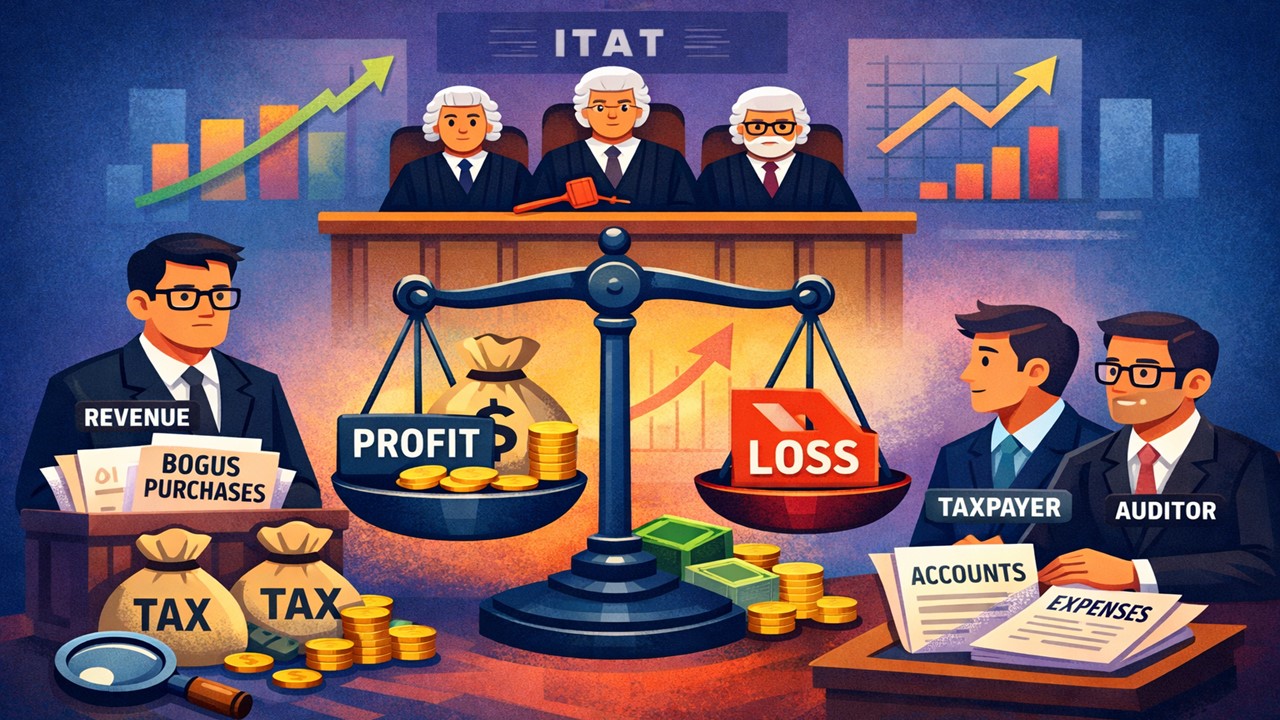
The ITAT upheld CIT(A)'s order ruling that once the sales are accepted, the entire purchases cannot be treated as non-existent.
ITAT Rejects Revenue Appeal in Alleged Bogus Purchases
 Nidhi
Nidhi Jan 24, 2026
Only Profit Can be Taxed in Bogus Purchase Case: ITAT Rejects Revenue Appeal
The Income Tax Appellate Tribunal (ITAT), Mumbai, rejected the Income Tax Department's appeal, ruling that only the profit element embedded in the alleged bogus can be taxed rather than the entire purchase.
Based on the information received from the DGIT (Investigation), the AO alleged that the assessee, Ashokkumar Kothari, had received fake purchasing invoices amounting to Rs 9,26,170 from three parties, whose TIN was found to be cancelled by the sales tax department. These parties were accused of being involved in offering accommodation entries without any actual supply of goods.
The AO asked the assessee to submit documentary evidence to prove that the purchases were genuine. The assessee submitted that the payments for the purchases were made through banking channels. However, the AO was not satisfied with this and proceeded to make the additions. The AO observed that the purchases from one of the parties had been subjected to addition in an earlier reassessment order. So he made an addition amounting to Rs 5,31,723 under section 69C of the Income Tax Act in respect to the remaining two parties. The assessee challenged this addition before the CIT(A).
Since the assessee did not appear during the proceedings, the CIT(A) decided the matter on its merits. The CIT(A) observed that since the sales made by the assessee were accepted by the Assessing Officer, the entire purchases cannot be disallowed. It was held that only the profit part embedded in the alleged bogus purchases can be taxed. Relying on previous judgements, the CIT(A) restricted the addition to 20% of the bogus purchases.
The Income Tax Department filed an appeal before the ITAT Mumbai, arguing that the full amount should be disallowed.
The ITAT upheld CIT(A)'s order ruling that once the sales are accepted, the entire purchases cannot be treated as non-existent. It explained that the assessee had made purchases from the grey or open market and obtained accommodation entries, and in such cases, the benefit availed by the assessee is limited to suppression of profit or savings on taxes, not the entire purchases.
The ITAT concluded that only the profit element can be taxed, not the entire purchase value. Accordingly, the Revenue’s appeal was dismissed, and the order of the CIT(A) was confirmed.
About Author


Nidhi
Content Writer
Nidhi is a skilled content writer specializing in personal finance. She creates clear, engaging articles on mutual funds, investments, insurance, and wealth-building strategies. With a passion for simplifying complex financial topics, Nidhi helps readers make informed money decisions with confidence. She can be reached at [email protected]
Nidhi is a skilled content writer specializing in personal finance. She creates clear, engaging articles on mutual funds, investments, insurance, and wealth-building strategies. With a passion for simplifying complex financial topics, Nidhi helps readers make informed money decisions with confidence. She can be reached at [email protected]
 Studycafe
 New Delhi, Delhi, India
 1832
1832My Recent Articles
- Karnataka High Court Gives Another Chance in GST Matter Due to Lack of Hearing
- Delay Should Be Condoned if Explanation is Unrefuted: ITAT
- Non-Service of Income Tax Notice, Ill health of taxpayer, ITAT condones Appeal filing delay
- Books of Accounts Cannot be Rejected Without Any Specific Defect: ITAT Kolkata
- Karnataka High Court Sends ITC Matter Back to GST Authorities for Reconsideration
Up Next
Loading suggestions…


Recent Posts

All Posts

Tags
Recent Posts
All Posts