ITAT Upholds TDS Demand on Rent and Legal Expenses Ruling Sections 201 and 40(a)(ia) Operate Independently:
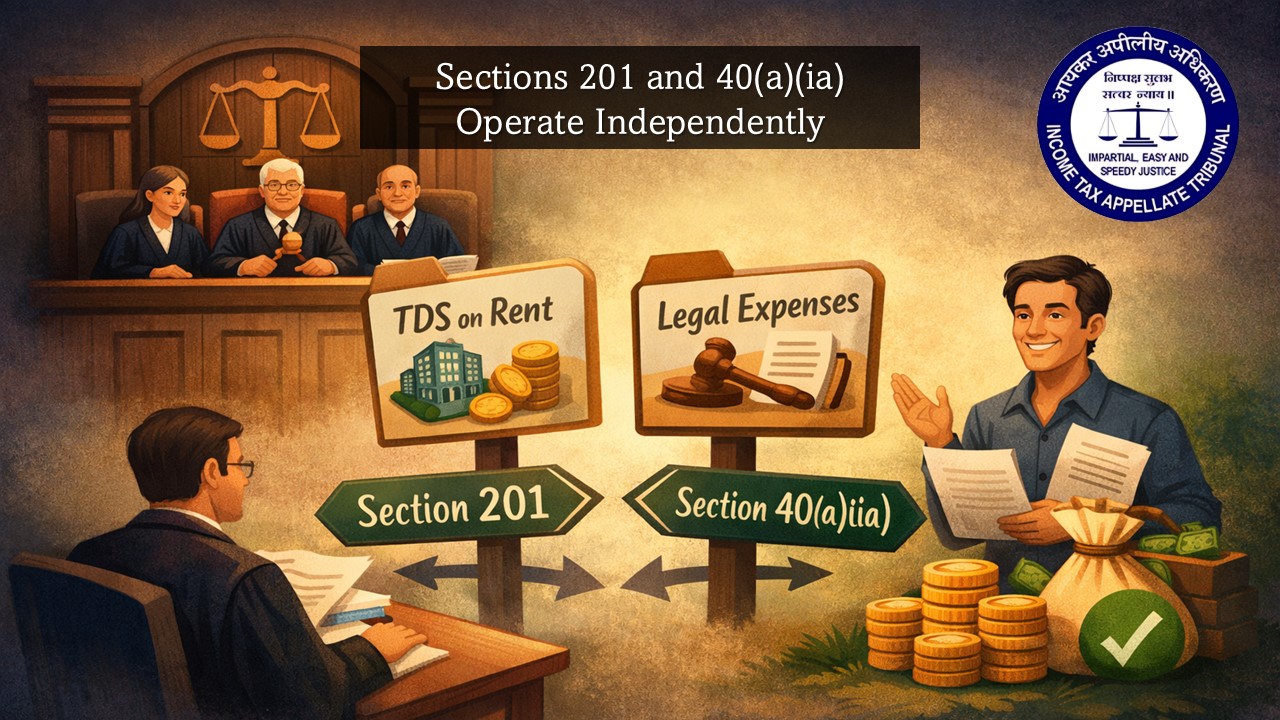
ITAT upheld TDS liability on rent and legal expenses, ruling Sections 201 and 40(a)(ia) independent, granted partial relief to the assessee.
ITAT Rules TDS Must Be Deducted Even If Expense Is Disallowed
 Saloni Kumari
 Jan 23, 2026
ITAT Upholds TDS Demand on Rent and Legal Expenses Ruling Sections 201 and 40(a)(ia) Operate Independently
ITAT Surat upheld TDS demand on assessee over failure to deduct tax on rent and legal expenses for the Assessment Year 2013-14, holding Sections 201 and 40(a)(ia) independent. Partial relief allowed, subject to verifying TDS on Rs. 3.91 lakh.
Udhna Citizen Co-operative Bank Limited (now amalgamated with Kalupur Commercial Co-operative Bank Limited) has filed the present appeal in the Income Tax Appellate Tribunal (ITAT) Surat, challenging an order dated March 03, 2025, passed by the CIT(A) under Section 201(1)/201(1)A of the Income Tax Act. The case involved alleged failure to deduct Tax Deducted at Source (TDS) on rent and legal expenses for the Assessment Year 2013-14.
The assessee Co-operative Bank filed its income tax return (ITR) for the year in consideration, declaring NIL income. During assessment, the Assessing Officer (AO) noted that the assessee had claimed rent expenses amounting to Rs. 20.89 lakh and deductions for legal and consultancy fees of approximately Rs. 5.03 lakh, but did not deduct TDS. In conclusion, the TDS officer treated the bank as an “assessee in default” under Sections 201(1) and 201(1A) of the Income Tax Act and raised a demand of Rs. 4.77 lakh on the assessee, including interest.
The aggrieved assessee filed an appeal before the CIT(A). However, the CIT(A) upheld the demand raised by the TDS officer and dismissed the appeal of the assessee. The assessee thereafter approached the ITAT Surat. Where the assessee raised the key argument that the amounts in question were only provisions in the accounts and no actual payment was made in reality, hence TDS was not required to be deducted. Further flagged that the expenses in question have already been disallowed under Section 40(a)(ia) during regular income assessment, and therefore, no further action should be taken under Section 201.
However, the tribunal rejected this argument, stating that there is no connection between Section 40(a)(ia) (disallowance of expenses) and Section 201 (TDS default); both operate independently. Even if the deduction is disallowed, the compulsion to deduct TDS still lives. The ITAT ruled that, as per the law, TDS should be deducted at the time of credit in books or payment, whichever is earlier. As the bank could not prove that the payees had declared the income and paid tax, it is liable to be treated as an assessee in default.
However, for part of the legal fees (Rs. 3.91 lakh), the Tribunal noted that TDS might have been deducted when the actual payment was made. It directed the TDS officer to verify this. If TDS was properly deducted on that portion, the bank should get relief for that amount. As a result, the appeal of the assessee is partly allowed for statistical purposes.
About Author


Saloni Kumari
Content Writer
Saloni is a Content Writer with 2+ years of experience at studycafe.in. She writes legal, taxation, and finance related content including GST, Income Tax etc. Skilled in translating complex judicial pronouncements and regulatory developments into clear, and reader-friendly articles. Experienced in covering judgements of ITAT, High Court, GSTAT, and news related to Income Tax, GST, and corporate law. She can be reached at [email protected].
Saloni is a Content Writer with 2+ years of experience at studycafe.in. She writes legal, taxation, and finance related content including GST, Income Tax etc. Skilled in translating complex judicial pronouncements and regulatory developments into clear, and reader-friendly articles. Experienced in covering judgements of ITAT, High Court, GSTAT, and news related to Income Tax, GST, and corporate law. She can be reached at [email protected].
 StudyCafe
 Delhi, Delhi, India
 2923
2923My Recent Articles
- MCA and ICSI to Hold User Awareness Session on Form AOC-4 Filing Amid Glitches on MCA-21 Version-3 Portal
- GSTN Introduces New E-Invoicing Facility for Self-Invoices Under Reverse Charge Mechanism
- Flexi Cap vs Multi Cap Funds: What's the Real Difference?
- IBA Recommends Public Sector Banks to Reduce Ambit of Physical Branch Audits to 50% of Total Business
- ITAT Directs AO to Reconsider Rs 16.44 Lakh Capital Gains and Rs 25.87 Lakh Stamp Duty Value Addition
Up Next
Loading suggestions…


Recent Posts



All Posts


Tags
Recent Posts
All Posts