Reopening Based on "mere suspicion or roving inquiry" Invalid Under Section 147: ITAT:
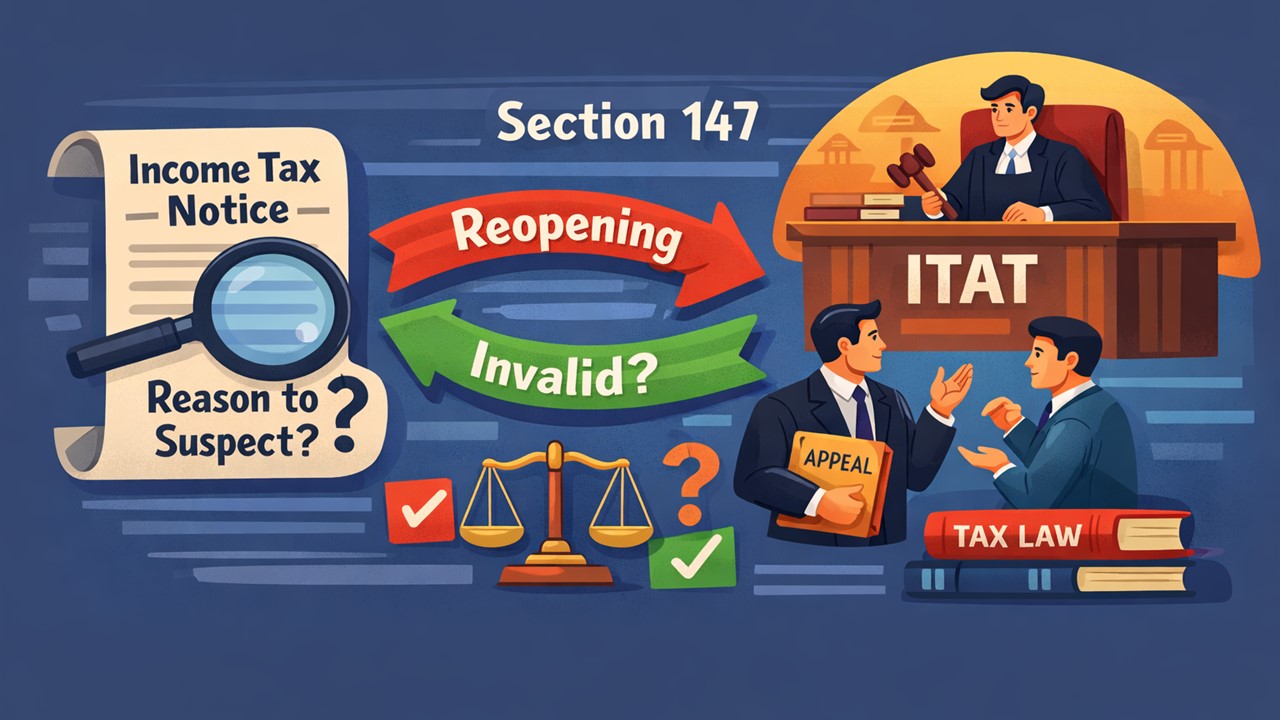
The Tribunal relied on the Supreme Court's Ruling, which held that reopening cannot be based on mere suspicion or roving inquiry.
ITAT Quashes Reassessment u/s 147 Based on AO's Suspicion
 Nidhi
Nidhi Feb 5, 2026
Reopening Based on "mere suspicion or roving inquiry" Invalid Under Section 147: ITAT
The Income Tax Appellate Tribunal (ITAT), Chennai, has quashed an assessment order due to the AO's lack of jurisdiction under Section 147 of the Income Tax Act.
Based on the information that alleged that the Assessee had received an amount of Rs 7,15,11,173 from M/s Orange, a company which was suspected to be involved in making illegal transactions with many parties, the assessing officer reopened the assessee's case. He formed his reason to believe that the income had escaped assessment. Therefore, the AO made an addition of Rs 7,15,11,173 under section 69A of the Income Tax Act. As per AO, it was a bogus accommodation entry from M/s Orange company.
The assessee approached the ITAT, challenging the jurisdiction of the AO to reopen the assessment. The assessee argued that the AO has failed to meet the condition precedent as stipulated under section 147 of the Income Tax Act.
The assessee explained these were client funds for buying/selling shares on stock exchanges, and it had a separate client account. The company claimed that these allegations of income escapement were wrong and the AO wrongly compared client fund transfers with the company's turnover. Further, the company submitted that the 'reason to suspect' is not a jurisdictional requirement of law to reopen, and instead the AO should enquire and collect proofs to substantiate his claim of income escapement.
The ITAT agreed with the assessee, observing that just receiving money from a client does not mean the amount is income of the broker company. Further, the reasons recorded by the AO to reopen the assessment were vague, scanty and without any tangible material, and these things are required to assume jurisdiction under Section 147 of the Act. The Tribunal relied on the Supreme Court ruling in the case of ITO v. Lakhmani Mewal Das and Kelvinator of India Ltd, which held that reopening cannot be based on mere suspicion or roving inquiry.
Therefore, the ITAT quashed the reopening and the reassessment order.
About Author


Nidhi
Content Writer
Nidhi is a skilled content writer specializing in personal finance. She creates clear, engaging articles on mutual funds, investments, insurance, and wealth-building strategies. With a passion for simplifying complex financial topics, Nidhi helps readers make informed money decisions with confidence. She can be reached at [email protected]
Nidhi is a skilled content writer specializing in personal finance. She creates clear, engaging articles on mutual funds, investments, insurance, and wealth-building strategies. With a passion for simplifying complex financial topics, Nidhi helps readers make informed money decisions with confidence. She can be reached at [email protected]
 Studycafe
 New Delhi, Delhi, India
 1832
1832My Recent Articles
- Karnataka High Court Gives Another Chance in GST Matter Due to Lack of Hearing
- Delay Should Be Condoned if Explanation is Unrefuted: ITAT
- Non-Service of Income Tax Notice, Ill health of taxpayer, ITAT condones Appeal filing delay
- Books of Accounts Cannot be Rejected Without Any Specific Defect: ITAT Kolkata
- Karnataka High Court Sends ITC Matter Back to GST Authorities for Reconsideration
Up Next
Loading suggestions…


Recent Posts
All Posts

Tags
Recent Posts
All Posts